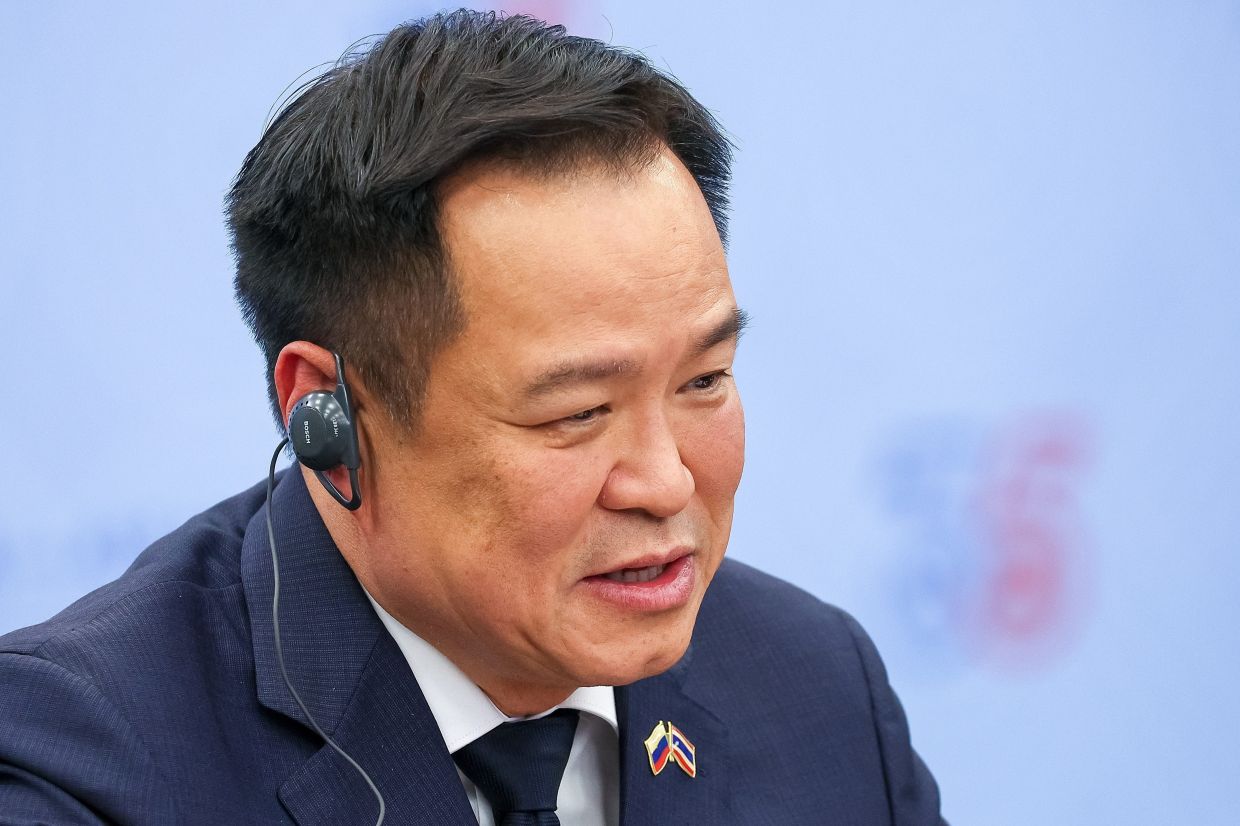
Thailand's Prime Minister Anutin Charnvirakul has reached the 100-day mark since taking the oath of office on March 20, providing a natural moment to assess whether his administration is delivering on its mandate or merely treading water. The benchmark carries particular weight in Thai politics, where decades of military interventions and coalition collapses have made sustained governance something of a luxury. Yet as Anutin's tenure extends beyond this initial checkpoint, a pattern emerges that suggests his government has chosen to consolidate political ground rather than pursue the transformative economic policies many analysts believe the country desperately needs.
The immediate test facing the new administration came swiftly and unexpectedly. The February 28 US-Israel military operations against Iran triggered a cascade of disruptions to global oil markets, with the Strait of Hormuz becoming a flashpoint for supply concerns. Thailand, a net energy importer with limited domestic reserves, found itself acutely vulnerable to these international shocks. Petrol stations experienced refuelling shortages as demand surged, and crude prices spiked above US$100 per barrel as shipping routes through the strategic waterway faced repeated interruptions. For a nation already struggling with structural economic malaise, this external crisis threatened to destabilise an already fragile domestic situation and undermine public confidence in the fledgling government.
Anutin's response demonstrated pragmatism if not innovation. His administration deployed the national Oil Fuel Fund to subsidise fuel prices, insulating consumers from the worst of the price shock while preventing the kind of social unrest that could have toppled a weaker coalition. The government simultaneously directed coal-fired power plants to operate at maximum capacity and accelerated efforts to diversify energy sources by expanding imports from regional suppliers including Malaysia and Brunei. Agricultural lending rates were reduced to ease pressure on the farming sector, one of Thailand's most politically sensitive constituencies. Mathis Lohatepanont, a political science researcher at the University of Michigan, acknowledges that the government successfully navigated this initial storm, managing to avoid the deeper instability that could have fractured the coalition or triggered street-level protest movements.
Beyond crisis management, Anutin has delivered on several campaign commitments that resonate with his political base and the broader electorate. His Bhumjaithai Party had captured the most parliamentary seats by championing nationalist themes and adopting a confrontational stance toward Cambodia over disputed maritime territories. As prime minister, Anutin has maintained continuity with this hardline approach, keeping military forces at the forefront of border security operations and unilaterally terminating a 2001 bilateral pact with Phnom Penh, escalating the dispute to United Nations arbitration. This strategy consolidates support among his core constituency while signalling to regional rivals that Thailand will not be pushed around in territorial disagreements.
The government has also rolled out the "Thais Help Thais Plus" scheme beginning in June, a subsidy programme allowing eligible citizens to purchase selected goods at 40 per cent of retail price. With an allocation of 176 billion baht (US$5.27 billion), the initiative targets approximately 30 million adults aged 18 and above, prioritising those excluded from previous welfare programmes. The scheme proved immediately popular, providing tangible relief to household budgets at a time when living costs remain pressurised. Yet scholars from Thailand's premier universities note a critical limitation: the programme addresses symptoms rather than underlying pathologies. Puangthong Pawakapan of Chulalongkorn University emphasises that whilst Thais recognise the temporary respite the scheme provides, it "absolutely nothing to solve the underlying economic crisis" gripping the kingdom.
These underlying challenges demand attention with some urgency. Over the past five years, Thailand has never achieved annual economic expansion exceeding three per cent, a particularly alarming statistic when compared with regional peers. The International Monetary Fund projects a mere 1.5 per cent growth rate for the current year, making Thailand the slowest-growing major Southeast Asian economy. Vietnam is forecast to expand by 7.1 per cent, Cambodia by four per cent, and even Myanmar, despite its ongoing civil conflict, is expected to grow by three per cent. This yawning gap reflects structural rigidities that temporary stimulus cannot address: sluggish productivity growth, an ageing demographic profile requiring rising social expenditure, and household debt levels that constrain consumption despite government subsidies.
Anutin has publicly identified digital technology, artificial intelligence, and clean energy as potential new economic engines for Thailand. However, analysts detect no clear strategic roadmap translating these aspirations into concrete policy frameworks or resource allocations. Stithorn Thananithichot, a political science professor at Chulalongkorn University, observes that "its energies have gone into routine administration and day-to-day management rather than into any initiative aimed at meaningful economic or political change." This distinction proves crucial: governments engaged in substantive reform typically signal their intentions early through dramatic structural commitments that reorient institutional behaviour and demonstrate resolve to vested interests.
The constitutional question exemplifies this hesitancy. During February's general election, a referendum revealed that nearly 60 per cent of Thai voters—approximately 20 million citizens—wish to revise the 2017 Constitution, widely regarded as anti-democratic because it was drafted by Prayut Chan-o-cha following his 2014 military coup and remained in effect during his premiership until 2023. Despite this decisive popular mandate, constitutional reform has languished with virtually no substantive progress. Stithorn contends that "a government that intended to reform would have signalled at least one substantive structural commitment at the outset; this one did not, and that absence is by design rather than a matter of time." This interpretation suggests that Anutin's administration has consciously chosen stability and consolidation over transformation, reflecting political calculations about coalition durability rather than administrative oversight.
The composition of Anutin's Cabinet has also drawn scrutiny from observers evaluating his commitment to meaningful reform. Thailand's history of military interventions and fractious coalition politics has made continuity in governance exceptionally difficult to achieve, allowing deep structural economic problems to accumulate without resolution. The kingdom has experienced multiple constitutions, coup-driven disruptions to planning horizons, and frequent leadership transitions that truncate policy initiatives before they mature. Against this backdrop, maintaining political equilibrium itself possesses a certain value. Yet critics argue that by treating stability and reform as mutually exclusive objectives rather than complementary ones, Anutin risks presiding over another period of incremental stagnation in which the fundamental challenges confronting Thailand remain unaddressed, merely managed around the margins through subsidy schemes and tactical political manoeuvring.
For Malaysian observers and regional analysts, Thailand's trajectory carries implications beyond its borders. Southeast Asia's second-largest economy stumbling through a period of low growth and deferred structural adjustment creates uncertainty for regional trade patterns and investment flows. Malaysia, as a regional economic and financial hub, maintains significant exposure to Thai markets and competes for similar categories of foreign direct investment. If Thailand fails to revitalise its growth model through technology adoption, workforce development, and institutional modernisation, it could intensify competitive pressures on Malaysia and other neighbours as multinational companies seek higher-growth alternatives elsewhere in the region.
The question facing Thailand as Anutin's first hundred days recede into the rearview mirror is whether his government represents a deliberate strategic choice to prioritise stability as a prerequisite for future reform, or whether it reflects a pattern of deferred action that will consume his entire tenure. The evidence to date leans toward the latter interpretation. Anutin has competently managed immediate crises and fulfilled campaign promises with genuine popular appeal, but he has provided no clear signal that his administration intends to tackle the constitutional blockages, demographic challenges, and productivity deficits that constrain Thai development. Whether such a signal emerges in the months ahead will determine whether this government ultimately proves to be a pause in Thailand's long-running structural stagnation or the beginning of genuine renovation.

