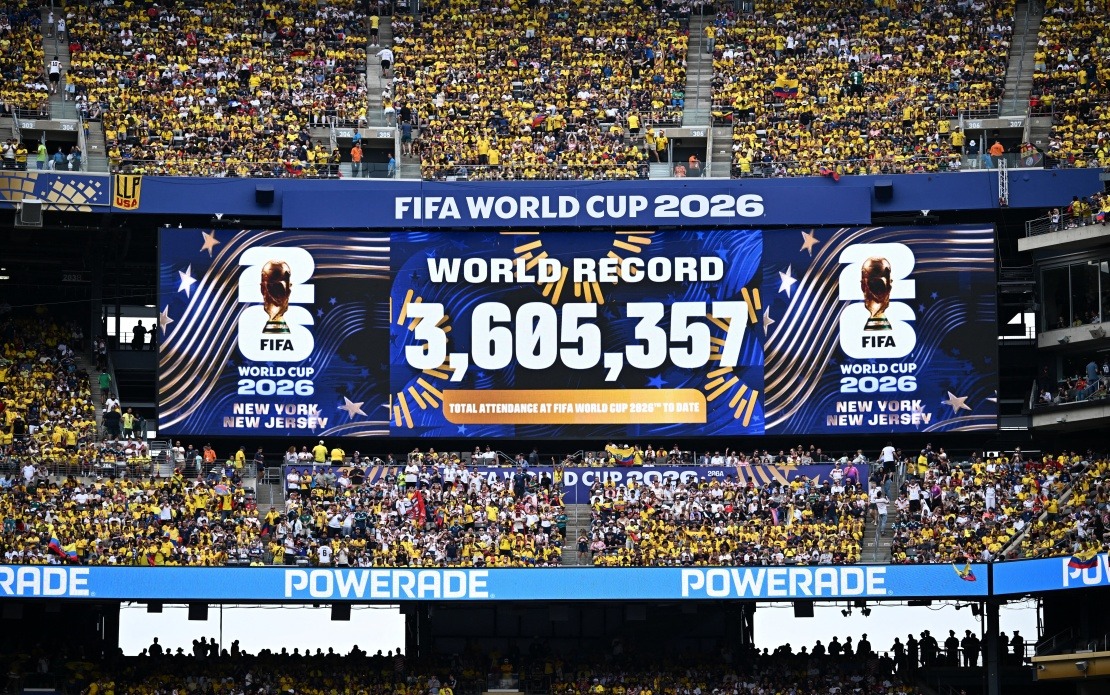
The 2026 FIFA World Cup has etched its name into football history by becoming the best-attended tournament the sport has ever witnessed. The milestone was reached during Germany's encounter with Ecuador in East Rutherford, New Jersey, when the cumulative attendance figure crossed 3,605,357—surpassing the longstanding record established by the 1994 World Cup that had stood for 32 years. The announcement, confirmed by FIFA and reported through the Emirates News Agency, drew thunderous applause from spectators in the stadium as giant screens broadcast the historic achievement to those present.
The significance of this record lies not merely in the numbers themselves but in what it reveals about the global appetite for international football. The 2026 tournament, jointly hosted across 16 cities in the United States, Canada, and Mexico, has demonstrated unprecedented levels of fan engagement across all venue locations. With approximately half the competition still underway at the time this record was established, the tournament structure itself suggests that final attendance figures could potentially nearly double the previous benchmark set three decades ago.
A crucial distinction separates this achievement from its predecessor. The 1994 World Cup, which drew nearly 3.6 million spectators across the entire tournament, featured only 52 matches due to the smaller 24-team format of that era. By contrast, the expanded 2026 format includes 80 matches, fundamentally altering the calculus of attendance potential. This expansion, while creating additional opportunities for fan participation, also underscores just how successfully the current tournament has converted that expanded opportunity into tangible attendance figures.
The operational metrics behind this success paint an equally compelling picture. Stadiums hosting matches across the three nations have operated at an average capacity exceeding 99 per cent, a figure that suggests near-universal enthusiasm across diverse geographic markets. This consistency—rather than spikes concentrated in a few major cities—indicates that the tournament's appeal has genuinely permeated throughout North American football audiences. For Malaysian and regional Southeast Asian observers, this represents a notable contrast with domestic league attendances in the region, where stadium utilization rates rarely approach such saturation levels.
FIFA President Gianni Infantino characterised the achievement as a reflection of football's unparalleled capacity to unite people across cultural and geographic boundaries. He emphasised that the tournament has created moments of genuine celebration and collective joy throughout all 16 host cities and their respective stadiums. This observation carries particular relevance for a sport that commands passionate followings throughout Southeast Asia, where World Cup tournaments regularly dominate media coverage and public conversation despite the region's limited participation in the competition itself.
The geopolitical dimension of hosting a World Cup across three nations appears to have amplified rather than diminished public interest. The logistical complexity of coordinating matches across multiple time zones and international boundaries—spanning the densely populated eastern seaboard of North America through to western venues—created potential friction points that might have suppressed attendance. Instead, the 99 per cent capacity figures suggest that fans in each market have embraced the tournament with enthusiasm, indicating robust local marketing, accessible ticket pricing, or perhaps the novelty of the three-nation format itself.
From a Malaysian sporting perspective, this attendance phenomenon offers instructive lessons. Southeast Asian nations hosting major sporting events—whether ASEAN Football Federation Championships or future continental tournaments—frequently struggle to achieve sustained stadium occupancy rates above 70 per cent even when domestic teams compete. The contrast suggests that international tournaments featuring elite-level competition and global star power command significantly different spectator behaviour than domestic competitions, even in football-obsessed markets.
The 2026 World Cup's attendance success also reflects broader demographic and economic factors shaping North American sports consumption. The United States market particularly has witnessed growing soccer investment at professional levels, with Major League Soccer expanding franchise numbers and investing heavily in player recruitment. The World Cup's presence may accelerate this trajectory, as casual observers converted to enthusiastic spectators during the tournament potentially translate into sustained support for club-level football.
Looking forward, the trajectory established by 2026 carries implications for future tournament hosting decisions. The International Football Federation will undoubtedly analyse these attendance figures as evidence supporting further World Cup expansion to larger stadium networks, potentially encouraging bids from nations with massive stadiums and developed sporting infrastructure. For Southeast Asian football development, the 2026 experience suggests that hosting major tournaments requires not merely adequate stadiums but also widespread demographic appeal and effective fan engagement across multiple geographic markets simultaneously.

