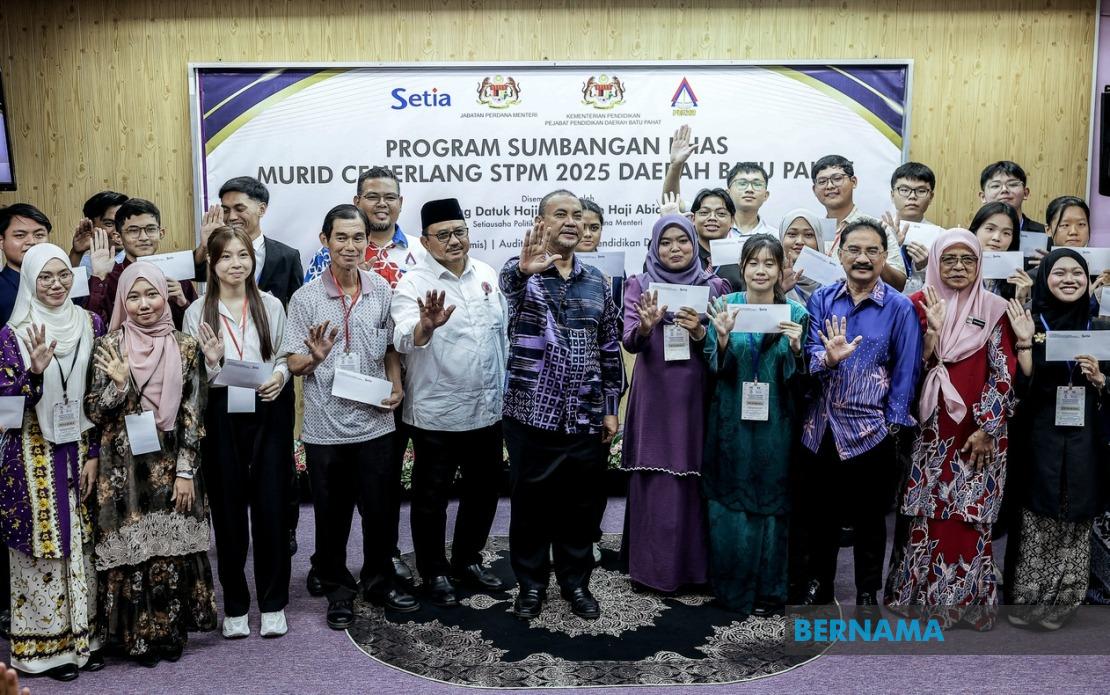
Two hundred and fourteen exceptional students who sat the 2025 Sijil Tinggi Persekolahan Malaysia examination have been recognised with special contributions from the Prime Minister's Office in Batu Pahat district, marking a government initiative designed to celebrate achievement whilst providing tangible support as these young Malaysians prepare for tertiary studies.
The awards ceremony, held at the Batu Pahat District Education Office auditorium, brought together students from 16 secondary schools across the district to receive recognition for their stellar academic performance. Datuk Azman Abidin, Political Secretary to the Prime Minister, oversaw the distribution of these contributions, underlining the government's commitment to identifying and nurturing top talent within the education system. The initiative represents more than symbolic recognition; it addresses a genuine concern among high-achieving students and their families regarding the financial preparations required for university entrance.
According to Datuk Azman, the programme operates within a broader framework aimed at sustaining motivation among excellence-focused students whilst demonstrating governmental support for meritocratic advancement. He emphasised that recipients are expected to leverage this recognition as a catalyst for maintaining their academic trajectories and serving as positive role models within their school communities and beyond. The contribution model, he indicated, remains contingent on budgetary availability, suggesting the government views this as a pilot initiative with potential for geographic expansion.
The underlying philosophy of the scheme extends beyond financial assistance. Officials framing the programme have positioned it as a concrete manifestation of government care and commitment toward educational empowerment. This language reflects a strategic pivot toward acknowledging student achievement as integral to national development, particularly among high-performing cohorts who typically proceed to leadership positions across professional sectors. By formalising recognition at the district level, the initiative creates visible pathways for excellence whilst potentially encouraging institutional competition among schools to elevate overall academic standards.
Among the recipients was Afida Auni Airulnizam, a 20-year-old former student of Sekolah Menengah Kebangsaan Tun Sardon in Rengit, who articulated how the contribution functions simultaneously as validation and motivational reinforcement. She characterised the award as particularly meaningful given her family circumstances and her aspiration to enter university. Her trajectory exemplifies the typical profile of STPM recipients from middle-class backgrounds: academically accomplished yet facing genuine financial constraints as families navigate university preparation costs, from entrance examinations to residential arrangements in tertiary institutions.
Afida's educational ambitions centre on sports science, reflecting a growing Malaysian interest in applied sciences and professionalised athletic training. Her acknowledgement of her older brother's university trajectory as inspirational highlights how family precedent shapes educational pathways. Yet such reliance on familial precedent underscores socioeconomic disparities: students without university-educated relatives lack equivalent guidance and encouragement, making government recognition programmes particularly valuable for first-generation tertiary entrants.
Another recipient, Muhd Ammar Firdaus Mohd Fadzil, aged 20 and formerly of Sekolah Menengah Kebangsaan Tun Ismail, similarly welcomed the initiative whilst emphasising its practical utility. His commentary about easing financial burdens associated with tertiary preparation reflects how direct monetary support translates into tangible relief for households managing multiple competing expenditures. University entrance in Malaysia entails expenses beyond tuition fees—accommodation, learning materials, examination fees, and initial residential setup demand substantial outlay, particularly for families from rural or economically disadvantaged districts like portions of Batu Pahat.
The geographic focus on Batu Pahat carries regional significance. This Johor district, whilst containing several quality secondary institutions, occupies an intermediate position between major urban educational centres and peripheral rural areas. Recognition schemes concentrated on such districts potentially address a critical gap: ensuring that geographically peripheral high achievers receive equivalent acknowledgement and support as their urban counterparts, thereby reducing the educational stratification that emerges from residential location. This serves both equity and national development imperatives, as talent distributed across the nation requires activation regardless of geographic origin.
The involvement of 16 secondary schools suggests deliberate geographic dispersion rather than concentration on elite urban institutions. This breadth indicates governmental intent to identify merit across diverse socioeconomic contexts and school types, including both established urban schools and smaller district institutions. Such distribution patterns reveal how meritocratic recognition, properly structured, can function as a social mobility mechanism, identifying and supporting talented students who might otherwise face institutional barriers to advancement.
Looking forward, Datuk Azman's indication that the programme will continue subject to available funding and with expansion plans suggests this represents an emerging policy strand rather than a one-off initiative. Should this trajectory materialise, the scheme could establish precedent for systematic recognition of academic excellence at the national level, institutionalising recognition of STPM top performers and potentially extending to other examination cohorts. Such systematisation would create predictable incentive structures for secondary students, potentially elevating overall academic standards across the system.
The timing of this initiative reflects broader governmental concern regarding tertiary education access and completion. With Malaysian universities competing internationally whilst facing domestic pressure to improve accessibility, initiatives supporting high-achieving students signal commitment to retaining top talent within the domestic tertiary ecosystem. By reducing financial barriers for academically strong students, the government addresses both equity concerns and institutional competitiveness, ensuring premier institutions can recruit from the full spectrum of capable applicants rather than only those with substantial family resources.
For Malaysian students navigating the competitive STPM examination, this recognition scheme offers practical encouragement beyond the academic validation inherent in excellent examination results. It demonstrates that governmental structures acknowledge meritocratic achievement and are prepared to provide material support, potentially shifting perceptions of state engagement with education from regulatory oversight to active partnership in student success. As the programme potentially expands to other districts and possibly other examination pathways, its evolution will bear watching as an indicator of how Malaysia prioritises talent development and educational mobility.

