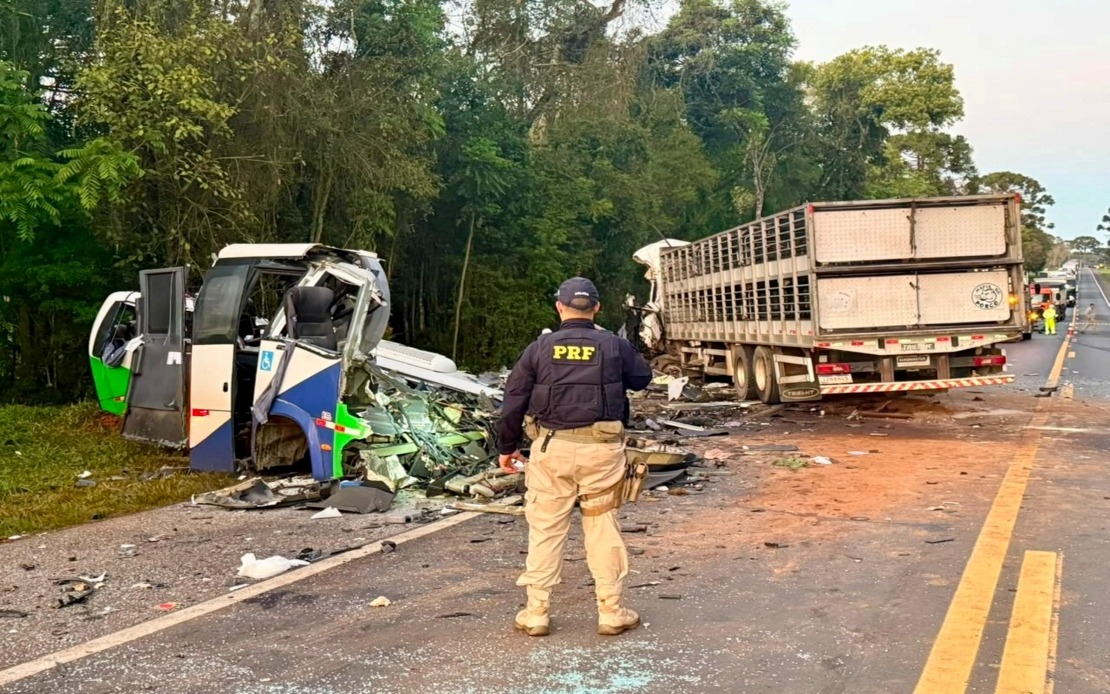
A catastrophic road disaster in southern Brazil claimed 23 lives early Wednesday morning when a minibus transporting medical patients collided with a truck on a national highway. The accident, which unfolded near Ipiranga in the Campos Gerais region of Paraná state, ranks among the region's deadliest recent traffic incidents and has prompted state authorities to declare three days of mourning. The collision occurred on a two-lane national road that connects multiple regions throughout Brazil's southern territories, a stretch notorious for challenging driving conditions.
Initial investigations suggest the heavy truck may have drifted across the centre line into the path of the oncoming minibus, resulting in a severe head-on impact. The exact sequence of events leading to this catastrophic encounter remains under active investigation by authorities, who are examining factors including weather conditions, vehicle maintenance, and driver behaviour at the time of impact. The specificity of preliminary findings points to a possible mechanical failure or driver error on the lorry's part, though complete clarification awaits the completion of formal accident reconstruction procedures.
Among the deceased were 13 women, eight men, and two children, according to statements from the Paraná State Secretariat for Public Security. Notably, this toll includes the driver of the truck itself, making the disaster a shared tragedy across both vehicles involved. The minibus, which belonged to the state health service, had been transporting patients from surrounding areas toward hospitals in the greater Curitiba metropolitan region, approximately 200 kilometres away from the accident site. The loss of life suggests a significant disruption to medical services and raises questions about the vulnerability of patients during transportation between healthcare facilities.
A further five individuals sustained injuries from the collision and were evacuated to nearby hospitals for treatment. The Paraná State Secretariat for Public Security confirmed this figure, indicating that despite the severity of the head-on impact, emergency responders managed to extract and provide care to several survivors. Their ultimate medical outcomes remain unclear, though their survival and subsequent hospitalisation offer at least a measure of mitigation against what could have been an even larger fatality count.
The accident site was completely sealed off for extended hours following the collision, disrupting traffic flow on the national highway during the critical morning period. This closure reflected the extensive nature of the wreckage and the time required for emergency services to manage casualties, conduct preliminary investigations, and clear debris from the roadway. The extended closure underscores how such incidents, beyond their human toll, create significant disruption to regional commerce and daily movement of goods and persons through southern Brazil.
The characteristics of the highway where this tragedy unfolded illuminate broader infrastructure challenges in Brazil's road network. The national route passing through Paraná switches between multi-lane and two-lane configurations, creating hazardous transitional zones where drivers accustomed to wider roads must suddenly adjust to narrower passages. These infrastructure inconsistencies, combined with heavy traffic volumes and long-distance commercial lorries, generate environments ripe for serious collisions. The two-lane sections in particular present elevated risks during overtaking manoeuvres or when vehicles drift across centre markings.
For Malaysian and Southeast Asian observers, this tragedy offers sobering reflection on transportation safety challenges faced across the developing world. Many readers will recognise parallels with road conditions in their own regions, where inadequate lane markings, ageing vehicles, and fatigue-driven long-distance driving contribute to similar incidents. The collision of a medical transport vehicle carrying vulnerable patients raises particular concerns about duty-of-care obligations during healthcare service delivery and the heightened vulnerability of people in transit for medical reasons.
The Paraná state government's declaration of three days of mourning reflects the scale of public grief engendered by this incident and acknowledges its significance within the broader social fabric of the region. Such official recognition typically involves lowered flags, pauses in legislative proceedings, and expressions of solidarity with affected families. For a state government to invoke this gesture indicates widespread recognition of the disaster's impact beyond immediate bereaved families to the community at large.
Road safety remains a persistent challenge throughout Brazil, where multiple factors combine to create elevated accident risks. These include infrastructure limitations, enforcement inconsistencies, vehicle condition variations, and driver behaviour patterns shaped by economic pressures and long working hours. The Paraná incident serves as a stark reminder that despite modernisation efforts across much of Brazil, certain transportation corridors remain prone to catastrophic failures when multiple risk factors align during a single moment of driver error or mechanical failure.
As investigations proceed into the precise causation of this collision, attention will likely focus on whether systemic factors—such as inadequate road maintenance, insufficient safety features, or lax vehicle inspection protocols—contributed to the outcome. Understanding root causes becomes essential for implementing preventive measures that might reduce the likelihood of similar tragedies along this and comparable highways throughout the region.

