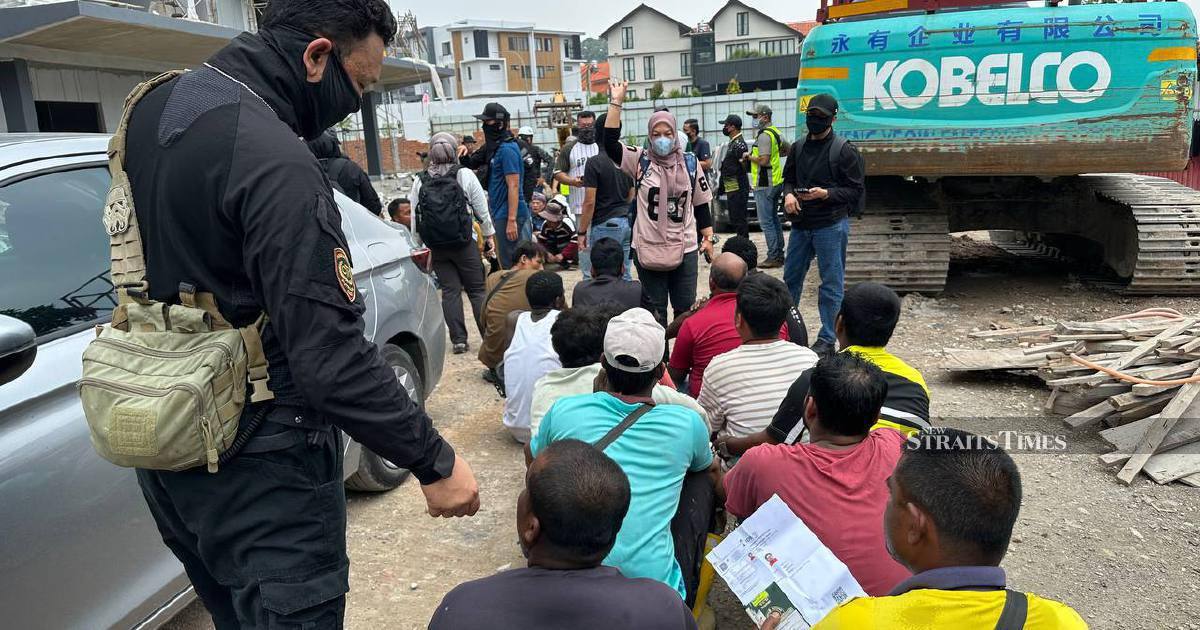
Malaysian immigration authorities have concluded a nationwide crackdown that resulted in the detention of 528 foreign workers found to be in breach of immigration regulations across eight construction sites throughout the country. The joint operation, which wrapped up today, represents a substantial enforcement drive aimed at combating illegal employment and immigration violations within Malaysia's construction sector, one of the nation's largest employers of migrant labour.
The operation reflects growing concern among Malaysia's immigration authorities about the prevalence of undocumented foreign workers and employment irregularities on construction sites. The construction industry has long been identified as a sector particularly vulnerable to labour trafficking, unlicensed employment, and exploitation of vulnerable migrant workers. By focusing enforcement efforts on this specific industry across multiple jurisdictions simultaneously, authorities sought to disrupt networks facilitating illegal employment arrangements that undermine both labour standards and tax compliance.
The coordinated nature of the operation across eight separate construction sites signals a strategic approach to immigration enforcement that prioritises systematic investigation over isolated raids. Rather than responding to individual complaints, the planned joint operation allowed authorities to conduct simultaneous inspections, reducing the likelihood that operators could relocate workers or destroy documentation in advance. This methodology has proven effective in previous years when Malaysian immigration authorities have mounted similar nationwide campaigns.
Construction remains a sector heavily dependent on foreign labour, with workers from Bangladesh, Indonesia, Nepal, Myanmar, and other neighbouring countries filling critical roles in Malaysia's building boom. However, this reliance has created complex challenges for regulators attempting to distinguish between legally documented and undocumented workers whilst maintaining productivity. Many workers operate under informal arrangements or with expired documentation, creating vulnerabilities that traffickers and unscrupulous employers exploit. The operation addresses these structural problems by increasing the costs and risks associated with non-compliance.
The specific immigration offences involved in the detentions are not yet detailed, but typically encompass working without valid permits, overstaying visitor visas, possession of fraudulent documents, and failure to report to immigration authorities as required. Each category represents a different enforcement priority for the immigration service. Some detainees may face deportation proceedings, whilst others might be given opportunities to regularise their status or arrange repatriation. The penalties assessed will depend on the nature and severity of each individual violation.
For Malaysia's construction industry, which is experiencing rapid expansion driven by infrastructure development and urban renewal projects, such operations create pressures to formalise employment practices. Companies operating on major projects are increasingly required to verify worker documentation and maintain comprehensive employment records. Larger construction firms have generally adapted to these requirements, but smaller contractors and subcontractors sometimes struggle with compliance costs, creating incentives for informal hiring arrangements.
The operation also carries implications for regional labour mobility patterns. News of enforcement campaigns can deter workers from accepting informal employment, potentially encouraging migration towards other Southeast Asian nations with different regulatory environments or alternatively incentivising regularisation efforts. Some workers detained during such operations eventually negotiate legal status, either through employer sponsorship or through government programmes allowing temporary work permit regularisation.
From a Malaysian policy perspective, the operation serves multiple objectives beyond immediate law enforcement. It signals government commitment to labour standards, supports legitimate employers competing fairly against those using irregular workers, demonstrates immigration capacity to international observers concerned about human trafficking, and generates administrative data about labour market patterns. The information gathered during such operations helps immigration officials refine their understanding of where violations concentrate and which employment arrangements present greatest risk.
The construction sector represents a visible arena for such enforcement efforts partly because of the concentrated nature of large projects and the physical immobility of construction work. Unlike workers in dispersed household employment or informal services, construction workers operate at fixed sites that are easily identified and monitored. This accessibility makes the sector a logical focus for enforcement resources, though it also means workers in more hidden sectors may face lower detection risks.
The detained individuals will now enter processing procedures that typically include documentation reviews, health screening, and preliminary investigations. Some will be reunited with documents proving legal status, whilst others face administrative detention pending deportation arrangements. Diplomatic coordination with workers' countries of origin becomes essential to facilitate repatriation, particularly for those lacking identity documents.
Looking ahead, this operation underscores ongoing tensions within Malaysia's approach to migrant labour policy. The country simultaneously seeks to attract foreign workers to fill labour gaps, maintain labour standards, prevent exploitation, and enforce regulatory compliance. These goals sometimes conflict, requiring policymakers to balance economic efficiency with social and humanitarian considerations. Regular enforcement operations like this one represent one mechanism for maintaining this complicated equilibrium, though effectiveness ultimately depends on sustained political will and adequate resourcing for immigration authorities.

