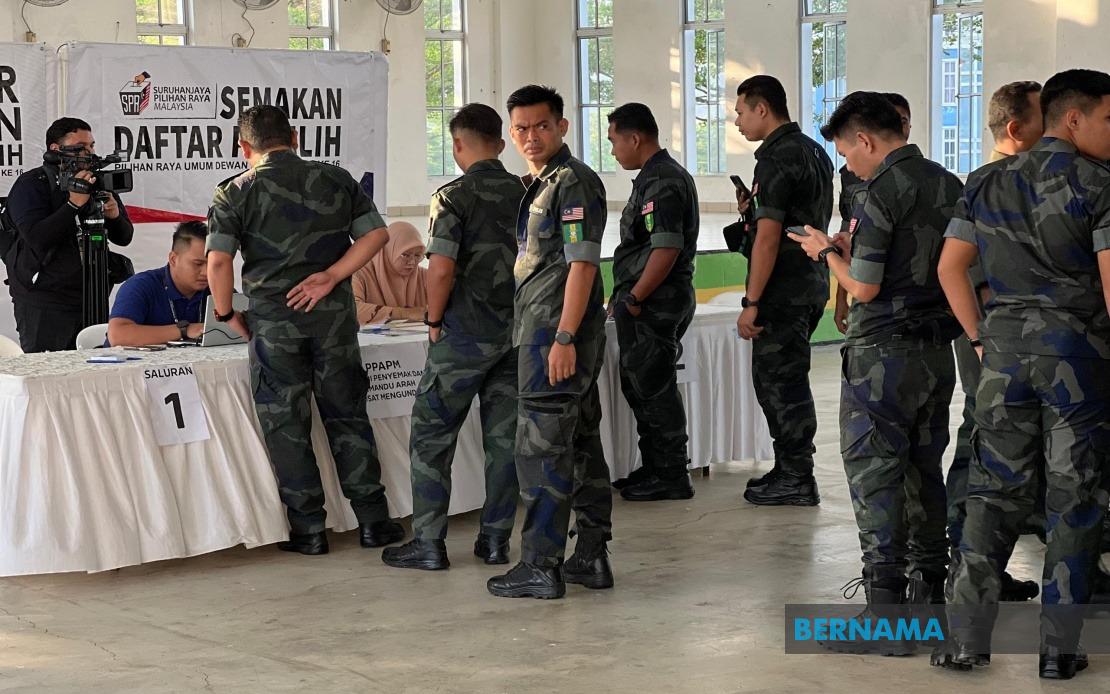
The Election Commission facilitated early voting arrangements for Johor's 16th state election on July 7, establishing 64 dedicated polling centres to serve members of the security establishment and their families. The decision accommodates the operational requirements of military and police personnel who would otherwise face difficulties participating in Saturday's main election event. This parallel voting system, a standard feature in Malaysian electoral processes, ensures that uniformed service members—despite their regular duties—can exercise their constitutional right to vote without compromising essential security operations.
The scale of early voter participation underscores the logistical complexity involved in conducting state-level elections across a major Malaysian state. The Election Commission's statistics reveal that 24,751 eligible voters utilised the early voting arrangement, representing a significant subset of Johor's overall electoral population. This figure comprises both serving personnel and their spouses, reflecting the commission's recognition that security force families often face comparable logistical constraints during standard voting periods. The breakdown between military and police voters provides insight into the deployment patterns and strength levels of various security agencies operating within Johor's jurisdiction.
The Malaysian Armed Forces contingent accounted for 12,041 of the early voters, channelled through 11 designated polling centres distributed across strategic locations. This allocation suggests a deliberate attempt by electoral authorities to minimise travel distances while maintaining security and administrative efficiency. The remaining 12,710 voters comprised personnel from the Royal Malaysia Police and the General Operations Force, alongside their spouses, requiring 53 separate polling locations. The substantially higher number of centres needed for police and paramilitary voters reflects both their greater numerical presence within Johor and the distributed nature of their deployment across the state's various districts and municipalities.
Operational logistics demanded careful coordination of polling centre opening and closing schedules to manage voter flow and maintain electoral integrity. All 64 centres commenced operations at 8 am, establishing a consistent starting point across the early voting period. However, closing procedures followed a staggered schedule spanning from noon through 6 pm, a practical arrangement that likely balanced operational requirements with administrative capacity. This phased closure approach prevented bottlenecks at individual centres while accommodating voters with varying shift schedules and duty commitments throughout the day.
Weather conditions across several Johor districts appeared favourable for the voting exercise, with reports indicating sunny conditions in areas including Batu Pahat, Muar, Pontian and Tangkak. This meteorological backdrop facilitated smooth logistics for both voters and election officials, eliminating potential weather-related disruptions that could have complicated polling centre operations or voter accessibility. The prominence given to weather reporting in election coverage reflects the practical reality that Malaysian climate conditions—particularly during the monsoon transition period—can substantially impact voting participation and administrative efficiency.
The early voting arrangement provided essential context for understanding Saturday's main polling event, when approximately 2.7 million ordinary voters would participate across 56 state seats. This substantially larger participation figure emphasises the relative proportion of security force voters within Johor's total electoral population, representing roughly one percent of the broader voting cohort. The Saturday poll would determine the composition of the Johor State Assembly and shape the peninsula's political dynamics for the ensuing electoral cycle. Early voting mechanics thus represented merely one component of a comprehensive electoral machinery designed to process millions of votes across diverse voter categories and geographical distribution patterns.
The institutional framework governing security force voting reflects Malaysia's commitment to ensuring inclusive political participation despite operational constraints inherent to uniformed services. Electoral commission protocols establishing dedicated centres, allocated timeframes, and structured procedures demonstrate sophisticated understanding of how to accommodate public servants whose duties might otherwise conflict with standard voting arrangements. This systematic approach distinguishes Malaysian electoral administration from less organised systems where security personnel might simply be excluded from participation or compelled to neglect professional responsibilities in favour of voting obligations.
For Malaysian electoral observers, the Johor early voting operations illuminated broader procedural questions relevant to other states and federal elections. The successful management of 24,751 votes across 64 centres within a defined timeframe provided empirical data regarding the administrative capacity of election commissions and the feasibility of multi-venue voting systems. These logistics have direct implications for future electoral reforms, particularly discussions regarding advance voting expansion, overseas voter accommodation, and mechanisms to facilitate participation by geographically dispersed or occupationally constrained populations.
The 16th Johor state election represented the first major electoral test following various institutional and political developments in Malaysian politics. Early voting arrangements allowed security force members—themselves frequent subjects of electoral debate regarding political neutrality and institutional loyalty—to participate as ordinary citizens in democratic processes. This inclusive approach reinforces the principle that electoral participation constitutes a right extending across all eligible demographic segments regardless of occupation or institutional affiliation. The systematic accommodation of security force voting, though administratively demanding, represents an important expression of democratic commitment extending beyond rhetorical endorsement to practical structural accommodation.

