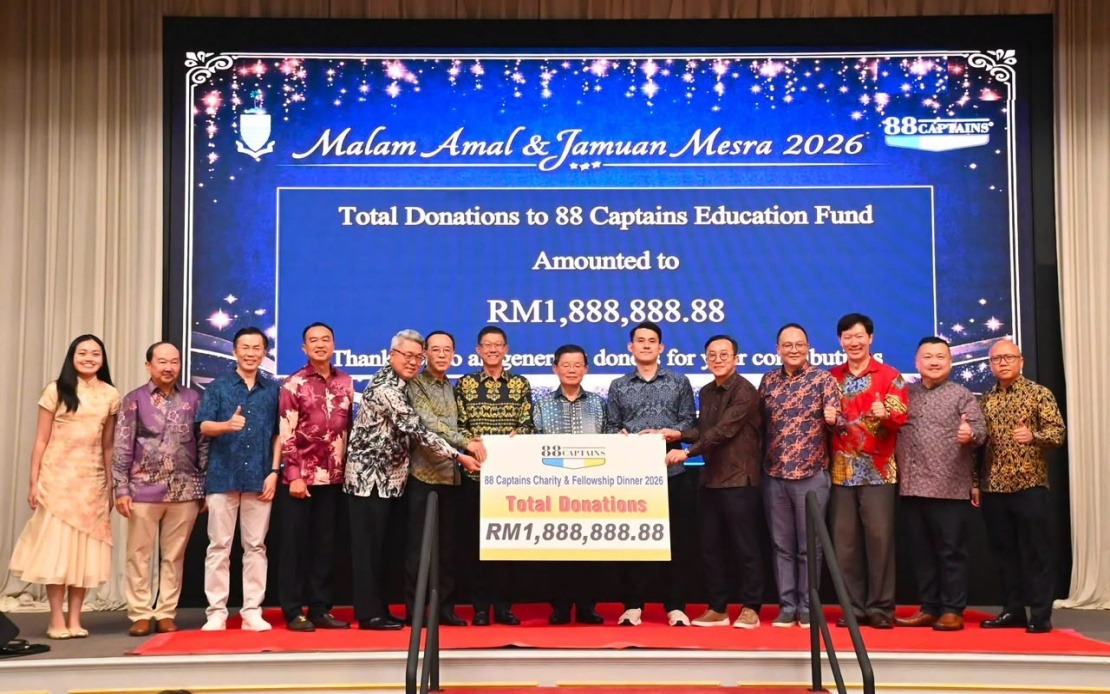
The 88 Captains, a Penang-based charitable organisation, has channelled over RM1 million into scholarships benefiting 44 students drawn from five educational institutions in the state and broader northern region. The announcement came during the group's annual fundraising dinner in George Town, where leadership outlined a vision extending well beyond conventional financial assistance to encompass broader societal transformation through education and workforce development.
Datuk Seri Dr Ooi Eng Hock, who chairs the organisation, framed the scholarship initiative as part of a wider mission to reshape how young Malaysians approach their careers and civic responsibilities. Rather than viewing the grants merely as a mechanism to alleviate financial hardship, he positioned them as catalysts for cultivating ambition, resilience, and a commitment to contributing meaningfully to communities. This philosophical foundation reflects growing recognition within Malaysia's education and business circles that scholarship programmes must nurture character and values alongside academic achievement.
The group's most significant recent innovation is the Apprenticeship, Internship, Reskilling and Upskilling programme, or AIRU, launched at Universiti Sains Malaysia last year. This initiative represents a deliberate attempt to bridge the persistent gap between what universities teach and what employers actually need—a challenge that has long complicated Malaysia's transition toward higher-value economic sectors. By creating structured pathways for students to engage with industry practitioners while still in formal education, the programme addresses a fundamental mismatch that has historically left graduates unprepared for workplace realities.
Central to AIRU's operation is the 88 Captain Young Fellowship, a task force comprising high-achieving scholars from USM, ViTrox College, Tunku Abdul Rahman University of Management and Technology, and INTI International University. Rather than adopting a top-down approach, this structure empowers students themselves to become intermediaries between academia and commerce. These young leaders meet directly with CEOs and company founders to understand expectations within their respective industries, while simultaneously articulating the perspectives and aspirations of contemporary graduates. This bidirectional dialogue is essential, as it ensures both sides appreciate the other's constraints and opportunities.
One concrete outcome of these conversations is an emerging consensus around graduate compensation. The 88 Captain Young Fellowship has identified RM4,000 as a reasonable minimum starting salary for university graduates entering the workforce, a benchmark that reflects both cost-of-living realities and market expectations across advanced manufacturing, technology, and professional services sectors. Such benchmarking exercises, though often overlooked, help set realistic expectations and reduce the disappointment many Malaysian graduates experience upon entering employment.
Beyond scholarship distribution and industry engagement, 88 Captains has constructed a diverse portfolio of educational initiatives over the past four years. The organisation has donated smart televisions to primary and secondary schools, recognising that quality instructional resources remain unevenly distributed across Penang's urban and rural communities. More ambitiously, it has established 5G Education Digital Libraries in 88 schools, a rollout that signals confidence in digital transformation as fundamental to modern pedagogy. The group has also supported the Special Education Integration Programme, ensuring that students with additional learning needs are not left behind as mainstream education shifts toward digital-first approaches.
The 88 Captains' work aligns closely with Penang's strategic economic ambitions. Chief Minister Chow Kon Yeow, who attended the fundraising dinner alongside Penang Governor Tun Ramli Ngah Talib and his wife, explicitly linked the organisation's initiatives to the state's positioning within advanced manufacturing, semiconductors, artificial intelligence, and the digital economy. This convergence is not coincidental. Penang's historical role as a manufacturing and technology hub depends increasingly on a workforce capable of managing sophisticated processes and contributing to innovation. By investing in talent development and industry-education alignment, 88 Captains directly supports these economic priorities.
A particularly timely initiative launched by the organisation is the Joint Mental Health Development in Schools with AI Early Education for Responsible Adoption, unveiled earlier in the week. This programme addresses an intersection of contemporary concerns: the mental health challenges facing Malaysian students, the rapid integration of artificial intelligence into educational and social settings, and the urgent need for young people to develop critical thinking around technology adoption. Chow's observation that this initiative arrives at the right moment, following passage of the Anti-Bullying Act 2026, underscores how education policy, social protection, and technological change now intersect inseparably.
Chow's remarks also highlighted a crucial governance insight: legal frameworks alone cannot solve systemic social problems. The Anti-Bullying Act provides necessary guardrails, but implementation depends on educators, parents, and communities developing the knowledge and cultural commitment necessary to prevent harmful behaviours. By embedding mental health support and AI literacy into school curricula, 88 Captains positions itself at the intersection of legal compliance and proactive cultural change—an increasingly important role for non-governmental organisations operating within Malaysia's education ecosystem.
The financial scale of the organisation's impact became apparent when the annual charity dinner raised RM1.89 million, demonstrating substantial support from Penang's business and professional communities. Founded in 2022, 88 Captains has managed in less than four years to establish itself as a significant actor in regional education funding and programme design. This rapid growth reflects both genuine demand for such initiatives and the receptiveness of Penang's economic elite to investing in systemic educational improvement.
For Malaysian policymakers observing trends in education and workforce development, 88 Captains' approach offers instructive lessons. Rather than treating scholarships, industry engagement, digital infrastructure, and mental health support as separate policy domains, the organisation integrates them into a coherent vision of comprehensive talent development. This holistic model recognises that Malaysian competitiveness in advanced sectors depends not merely on technical skills but on graduates who possess emotional resilience, ethical judgment, and the adaptability necessary to navigate rapid technological change.
Looking forward, the sustainability of such initiatives remains contingent on continued private-sector engagement and philanthropic commitment. The organisation's success in mobilising RM1.89 million annually suggests that Penang's business community recognises education investment as strategically important rather than merely charitable. As Malaysia confronts skills shortages in advanced manufacturing, semiconductors, and digital sectors, the willingness of organisations like 88 Captains to design innovative pathways between education and employment becomes increasingly valuable to the nation's economic trajectory.

