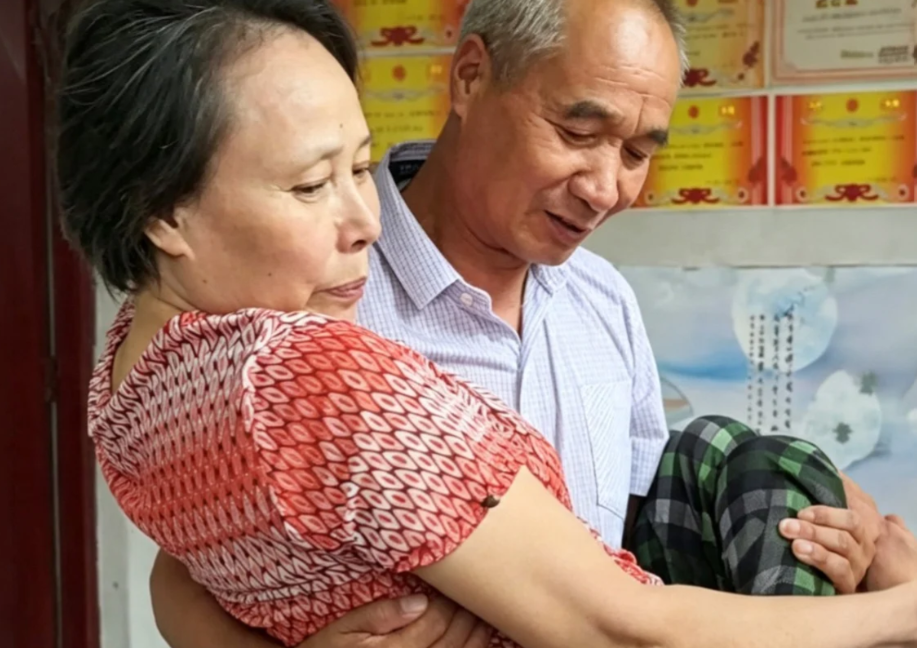
In the central Chinese city of Pingdingshan, an extraordinary testament to marital commitment has unfolded quietly over two and a half decades, only recently capturing the attention of millions across mainland social media platforms. Li Junliang and his wife Jia Fang have navigated a life fundamentally altered by tragedy with a steadfastness that challenges contemporary assumptions about caregiving, duty, and the bonds that sustain long-term relationships through profound adversity. Their story, originating from Henan province, speaks to enduring values of family loyalty that resonate far beyond their modest household.
The catalyst for their life's transformation came in 2001 when Jia Fang, then 36 years old, suffered devastating injuries from a fall while riding in a pedicab that descended a cliff, leaving her paralyzed from the chest downward. The accident occurred when their two children were still young—aged 10 and 13—placing Li at a critical juncture where he had to balance the immediate needs of a gravely injured spouse with the ongoing demands of parenting and family survival. Rather than exploring alternative care arrangements, Li made the determination to become Jia's primary caregiver himself, a decision that would shape the next quarter-century of his existence.
The physical labour involved in such intensive caregiving extends far beyond what many outside the healthcare field might appreciate. During the early years following the accident, Li repositioned Jia's body every two hours—a regimen designed to prevent the painful and dangerous complications of pressure ulcers that plague immobilized patients. This schedule alone eliminated any possibility of uninterrupted sleep, and while Li eventually adjusted the turning interval to four hours as Jia's condition stabilized, he still maintains a sleep pattern disrupted by the demands of caregiving. For someone supporting a family of four, these nightly interruptions have accumulated into a staggering sleep deficit spanning two decades.
Beyond the mechanical aspects of physical care, Li has developed a comprehensive approach to managing Jia's health and wellbeing. He regularly massages her limbs to counteract muscular atrophy, the inevitable consequence of prolonged immobility. He transfers Jia from bed to wheelchair, enabling her to spend time outdoors experiencing natural light and fresh air—small but significant elements of quality of life that require both strength and gentleness. The economic circumstances that allow Li to provide this level of care remain undocumented in available reports, though it is clear that somehow he has managed to support the household while dedicating his primary energies to Jia's needs.
The broader family context reveals another dimension of Li's commitment. Their two children have since matured and established their own families, suggesting they grew up in a home where caregiving and resilience were modeled daily. The certificates adorning their home walls document academic and personal achievements accumulated during years when their father was simultaneously managing their education and their mother's complex medical requirements. This simultaneous parenting and caregiving speaks to a capacity for sustained attention that many would find impossible to maintain across such an extended timeframe.
Jia's own reflections on their partnership reveal the emotional dimensions underlying this practical devotion. She has publicly acknowledged that Li's hair has greyed substantially while hers remains predominantly black—a striking visual metaphor for the disparate toll the years have extracted. Her gratitude, expressed directly to media and through social platforms, centers not on abstract heroism but on the concrete reality of his tireless attention to family needs. When she declared herself "the happiest person in the world" to have married Li, she framed happiness not as an absence of suffering but as the presence of steadfast partnership through it.
Li's own articulation of his commitment reveals the philosophical moorings that sustain such devotion. He traces his caregiving not to obligation born of circumstance but to a promise made at their wedding—that "home is complete only with your presence." This formulation reframes caregiving from an external duty imposed by misfortune into an internal commitment rooted in love and the fundamental meaning he derives from their union. His statement that he would continue caring for Jia for "another 25, 35, or even 45 years" if necessary suggests he has integrated this role into his core identity rather than viewing it as a temporary burden.
The response from their immediate community and the broader online audience in mainland China provides important context for understanding why this story has resonated so widely. A neighbour praised Li's capacity to maintain not just Jia's wellbeing but the household itself—noting that their home remains clean and orderly despite the demands of intensive caregiving. This observation counters potential assumptions that such demanding circumstances necessarily result in neglect or deterioration of living standards. Online commenters have framed Li's actions through frameworks of spirituality and moral exemplification, suggesting his dedication will bring blessings to his family and perhaps reward beyond the material realm.
For readers across Southeast Asia, including Malaysia, this account offers reflection on evolving attitudes toward caregiving, disability, and marital obligation in an era of increasing mobility and social fragmentation. While Li's situation arose from personal tragedy rather than cultural mandate, his choices illuminate what persistent commitment across decades actually entails—not romantic gesture but unglamorous daily repetition, physiological exhaustion, and the quiet erosion of personal convenience. His example exists in tension with modern assumptions that caregiving should be distributed across professional systems and that individuals have rights to lives independent of family demands.
The narrative also raises questions about gender dynamics in caregiving. Li's consistent presence alongside his wife contrasts with historical patterns where women disproportionately assume caregiving roles, often invisibly and without public recognition. The media attention and social celebration of his devotion may reflect both genuine admiration and subtle surprise that a man would prioritize such work. In Malaysia and broader Southeast Asia, where family structures increasingly reflect diverse economic pressures and social changes, Li and Jia's story prompts consideration of how societies support or burden those who choose intensive caregiving roles.
Ultimately, the sustained attention their story has generated suggests that in an age of rapid change and apparent individualism, people remain deeply moved by demonstrations of enduring commitment. Li's quarter-century of caregiving—unseen by the broader world until recently, uncompensated except through the intangible rewards of partnership—represents a form of human devotion that transcends national and cultural boundaries. For the millions who have encountered their story on mainland social media, it appears to have functioned as a mirror reflecting both ideals to which they aspire and the sobering recognition of what such ideals actually require.

