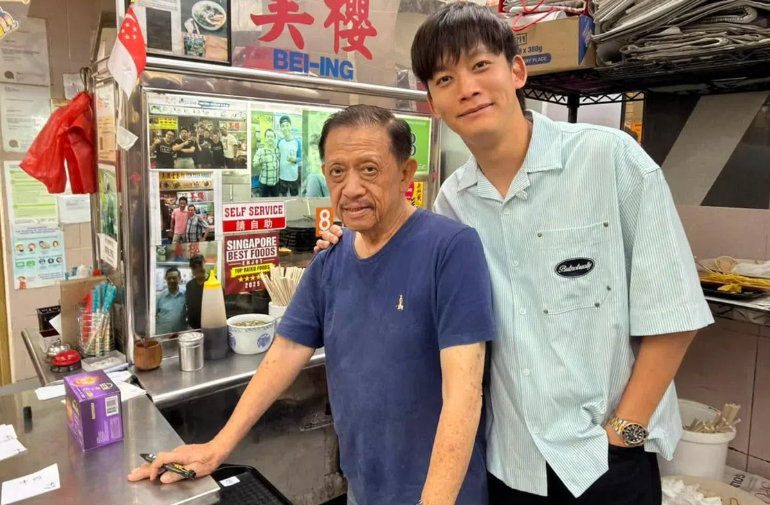
Singaporean actor Noah Yap has firmly rejected online accusations that his recent visit to an injured elderly hawker was a calculated publicity manoeuvre, telling critics to "get a life" in a pointed social media response. The actor, currently appearing in a Channel 5 police drama, faced backlash from netizens after visiting Yeo, the owner of Bei-Ing Wanton Noodle at Roxy Square, who had been assaulted in an incident that drew widespread viral attention across Singapore's online communities. Yap's visit itself became the subject of public scrutiny, with some observers questioning whether his social media documentation of the encounter was driven by a desire to capture positive attention rather than genuine concern for the elderly man's wellbeing.
The controversy stems from an incident on August 15 when Yeo was allegedly assaulted by a younger man at the coffee shop premises. According to accounts provided by Yeo and his family members, the confrontation began when Yeo, having just closed his hawker stall, noticed a young girl at a nearby table whom he found endearing. In what he described as a friendly gesture, Yeo reached out and gently patted the child on the head—an action that would trigger a dramatic escalation. The girl's father, apparently taking objection to the physical contact, confronted Yeo directly. CCTV recordings subsequently shared across social media platforms appear to document the father grabbing Yeo and forcefully pushing him to the ground. Police confirmed that a formal report had been filed and investigations into the matter were continuing at the time of Yap's visit.
Yap's defence reveals a relationship between the actor and the hawker that extends far beyond a casual customer-vendor dynamic. According to Yap's account, he has been a regular patron of Bei-Ing Wanton Noodle for over two decades, beginning during his primary school years when his connection to the establishment first took root. Rather than being a recent acquaintance seeking a sympathetic subject, Yep and his family have maintained a personal interest in Yap's life throughout this extended period, regularly inquiring about his wellbeing and life developments during his visits. Yap characterised this relationship as deeply familial in nature, describing Yeo in affectionate terms that suggest the hawker has served as a mentoring figure through different life stages. The actor emphasised that "Uncle practically saw me grow up," indicating that the connection transcends the typical commercial interaction between establishment owner and customer.
Following news of the assault, Yap made a deliberate decision to visit Yeo the afternoon after the incident occurred, motivated by what he presented as straightforward concern for someone who has been meaningful in his personal history. Rather than attempting to conceal this visit or keep it private, Yap chose to share his experience on social media platforms, though his framing of this decision diverged sharply from critics' interpretations. Yap contended that the purpose of his social media documentation was not self-promotional but informational—designed to draw broader public attention to the assault incident and its context. This distinction between sharing a personal moment for visibility and sharing a moment to amplify awareness of a broader issue becomes central to understanding Yap's defence against the limelight-seeking allegations.
When Yap arrived at the hawker stall on August 16, he discovered Yeo in surprisingly good spirits despite his ordeal. The assault had not dampened the elderly man's characteristic warmth or disposition. However, Yap noted that Yeo demonstrated considerable reluctance when it came to pursuing formal medical evaluation and treatment, a reaction that may reflect both stoicism common among his generation and a desire to minimise disruption to his livelihood. The actor's decision to publicise this visit and the broader incident thus carried an implicit advocacy component—drawing attention not only to what had occurred but also to the human dimensions of the situation.
In his carefully crafted social media response to critics, Yap articulated what he framed as fundamental principles about human interaction and violence in society. Rather than focusing primarily on defending his own reputation, Yap pivoted to emphasising that "violence is never the answer," positioning the incident within a broader conversation about social norms and interpersonal respect. He simultaneously called for increased kindness and compassion in community interactions, transforming a potential personal defence into a statement about collective social responsibility. The rhetorical strategy here suggests Yap viewed the criticism as missing the substantive point about the assault and its social implications.
Yap's blunt dismissal of critics—telling them to "get a life" and characterising them as having excessive free time to manufacture outrage—reflects a growing pattern of public figures pushing back against social media scrutiny in Singapore and across the region. The actor's tone conveyed frustration not merely at being accused, but at what he apparently perceives as a distortion of his motivations and character. This defensive posture, while understandable, also highlights the contemporary challenge faced by public figures attempting to engage authentically with their communities while navigating an environment where documentation and sharing have become inseparable from genuine civic concern.
The incident and its aftermath offer insights into broader social dynamics within Singapore's hawker culture and community relationships. The assault on an elderly hawker—and the subsequent public dispute over how that assault should be addressed and discussed—touches on questions about respect for older community members, the changing norms around physical affection and child-rearing, and the role of public figures in both witnessing and reporting on social incidents. Yap's long-standing relationship with Yeo represents exactly the kind of intergenerational connection that traditionally anchored hawker culture in Singapore, making his intervention neither unprecedented nor extraordinary from a social perspective.
As police investigations continued into the circumstances surrounding the assault, Yap's public statements served to maintain attention on the incident itself rather than allowing it to fade from collective memory. Whether characterising his actions as publicity-seeking or community advocacy ultimately depends on one's interpretive framework—whether social media engagement is viewed as inherently self-interested or potentially compatible with genuine concern. What remains clear is that Yap's response demonstrates the complexity of public engagement in contemporary Singapore, where visibility and virtue have become increasingly difficult to disentangle in the eyes of online observers.

