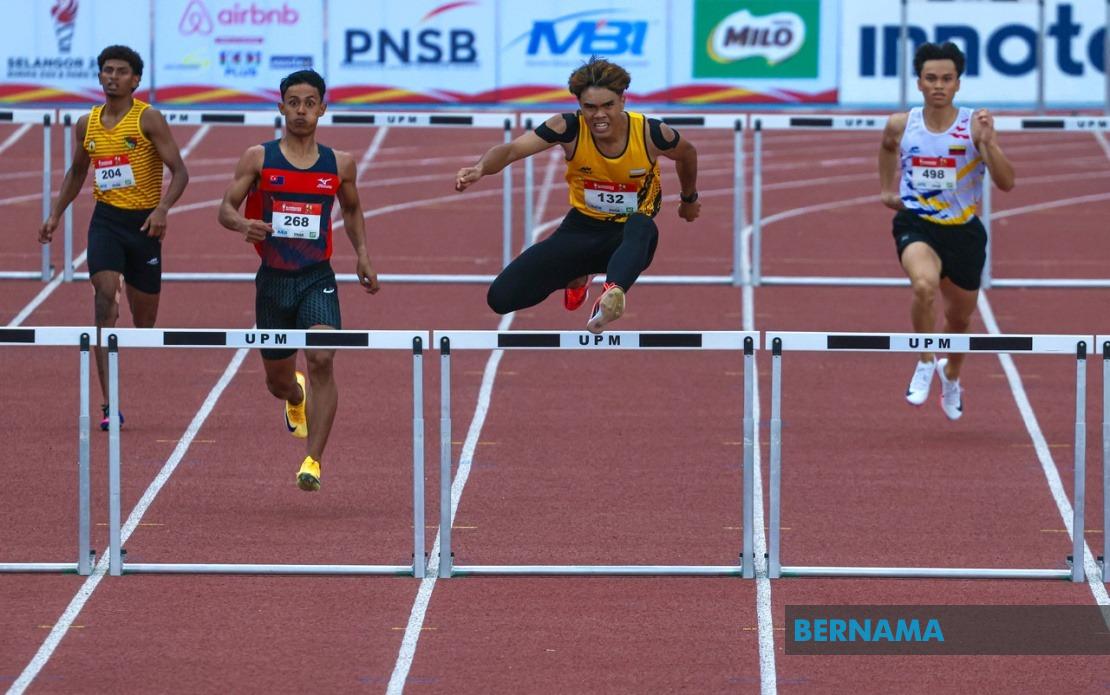
Muhammad Adib Irfan has delivered Perak's first athletics gold medal at SUKMA 2026, dominating the 400-meter hurdles final at Universiti Putra Malaysia Stadium in Serdang with a commanding performance that also shattered his personal record. The 20-year-old sprinter clocked 52 seconds to claim the crown, underscoring his emergence as one of Malaysia's promising middle-distance runners and signalling a potentially strong showing for his state in track and field events throughout the Games.
The triumph represents a watershed moment for Perak's athletics contingent, which has begun its campaign on a high note with a record-breaking display. Adib Irfan's victory margin proved decisive, as Johor's Muhammad Danish Nabil Kamarudin settled for silver with a time of 52.625 seconds, while Terengganu's Shazril Ashraff Shamsurbahry claimed the bronze with 52.8 seconds. The closeness of the finishing times illustrates the competitive calibre of Malaysia's 400-meter hurdles talent pool and underscores how pivotal Adib Irfan's execution was in securing the top spot.
When speaking to reporters immediately following his victory, the young athlete exuded gratitude and quiet confidence about his performance. Adib Irfan acknowledged that capturing gold had been his explicit objective entering the final, crediting his success to divine blessing whilst recognising the months of preparation that had preceded the race. His comments reflected a mature perspective rare among athletes of his age, suggesting that alongside his physical prowess, he possesses the mental fortitude required to excel at Malaysia's premier domestic sporting stage.
The athlete's pathway to the track reveals an intriguing narrative about talent identification and personal resilience. Adib Irfan, who is currently pursuing a degree in sports science and coaching at Universiti Pendidikan Sultan Idris, revealed that his transition into competitive athletics was not originally his chosen trajectory. He had previously engaged in football, a sport where he demonstrated sufficient ability that coaches and educators recognized his potential. However, his parents and mentors encouraged him to reconsider his sporting direction, viewing athletics as a vehicle better suited to his natural abilities.
The decision to pivot away from football proved instrumental in shaping his athletic career. Adib Irfan attributed his ultimate choice to embrace hurdles to a conversation with his mother, who articulated a fundamental distinction between individual and team-based sports. She highlighted that in football, even stellar individual performances cannot guarantee success if the collective team fails to deliver—a reality he found philosophically troubling. In athletics, by contrast, he could fully control his outcome through personal discipline and effort, a prospect that aligned more closely with his competitive temperament.
Adib Irfan's acknowledgement of his coaches and teachers underscores the critical role that institutional support structures play in nurturing Malaysian sporting talent. The coaching staff at his university and earlier mentors had demonstrated the acumen to identify his potential and the expertise to channel his capabilities into a discipline where he could flourish. Such recognition highlights the importance of robust talent pathway systems within Malaysian schools and tertiary institutions, where young athletes can be guided toward their optimal sporting outlet rather than remaining confined within conventional choices.
The women's 400-meter hurdles competition similarly showcased elite performances, with Kelantan's Fatin Mashira Mohd Fadzil extending her medal tally at the Games. Fatin Mashira captured her second gold medal of SUKMA 2026, having previously triumphed in the 100-meter hurdles, crossing the finish line in one minute 2.08 seconds. Her dual success in the shorter and longer hurdles events demonstrates exceptional versatility and aerobic capacity, positioning her among the Games' standout individual performers.
Terengganu's Nur Farisha Ardeana Ardy Abdullah secured the silver medal with a time of 1:02.44 seconds, finishing merely 0.36 seconds behind Fatin Mashira in a closely contested race. Kedah's Siti Rokiah Hashim completed the podium with bronze in 1:04.890 seconds, indicating that competitive depth exists across Malaysia's female hurdles contingent. The performance levels achieved by these athletes, particularly Fatin Mashira's back-to-back gold medals, suggest that women's track and field has become a genuine strength for the SUKMA movement.
Fatin Mashira's accomplishments carry broader significance for Malaysian athletics development. Her success across multiple hurdles distances indicates that her coaches have successfully balanced sprint-oriented speed with middle-distance endurance, a challenging technical achievement that reflects sophisticated coaching knowledge. Her emergence as a dual-event champion provides inspiration to younger female athletes considering careers in track and field, demonstrating that sustained excellence and versatility remain achievable at the national sporting stage.
The inaugural gold medals claimed by both Adib Irfan and Fatin Mashira at SUKMA 2026 are emblematic of a healthy competitive environment within Malaysian athletics. Their performances suggest that states have invested meaningfully in coaching infrastructure and talent identification mechanisms, producing athletes capable of executing races at high technical standards. The proximity of finishing times across medal positions underscores that Malaysia's hurdles talent extends beyond individual champions, with competitive depth that bodes well for future national team selections.
As SUKMA 2026 progresses, these opening athletics triumphs establish benchmarks that subsequent competitors will measure themselves against. Adib Irfan's personal best and Fatin Mashira's dual victories signal that the Games are witnessing performances that may influence Malaysia's athletics landscape beyond Serdang, potentially reshaping perceptions about the nation's track and field capabilities at regional competitions.

