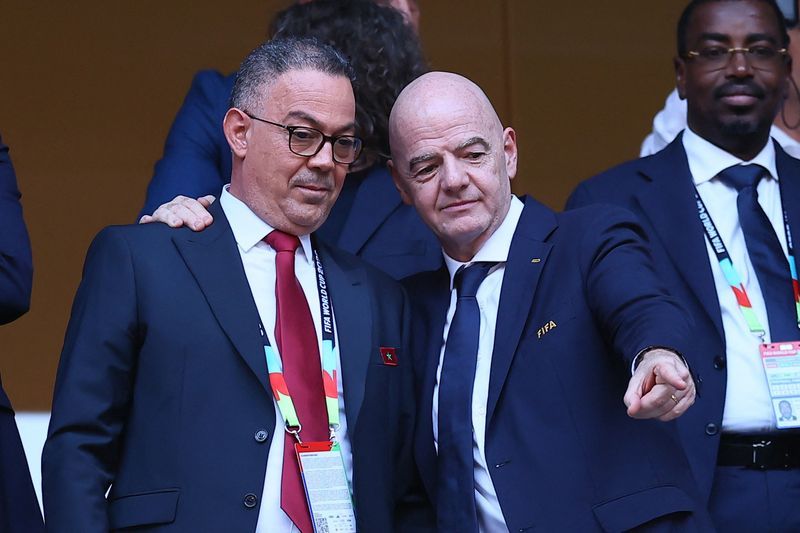
Gianni Infantino's grip on the FIFA presidency faces its greatest test since he assumed office in 2016, yet the embattled World Cup administrator appears to have secured a crucial lifeline from Africa's 54 football nations. As other global football confederations have publicly declared their loss of confidence in his leadership over the past weekend, several of the African continent's most influential football administrators have stepped forward with vocal support, offering Infantino a pathway to survive the March presidential election that will determine his future.
The backing emerged from a coalition of senior African football officials who released carefully coordinated statements of encouragement in the days following Infantino's decision to abandon his controversial FIFA Forward Enterprise initiative. This project had sought to generate $4.2 billion by selling a stake in future World Cup broadcasting and commercial rights to an external commercial entity. The plan, which drew immediate criticism from football confederations worldwide, represented an unprecedented attempt to monetise the sport's crown jewel. Among those expressing support for Infantino are Moroccan Fouzi Lekjaa, who serves as CAF Vice President, Egyptian administrator Hany Abo Rida, Niger's Hamidou Djibrilla, and Mauritania's Ahmed Yhaya, all of whom hold positions on FIFA's Council.
A particularly notable endorsement came from Veron Mosengo-Omba, the newly elected president of the Democratic Republic of Congo's football federation and former secretary general of the Confederation of African Football. Mosengo-Omba's statement gained added resonance from a personal connection to Infantino, having studied with the FIFA chief during university years in Switzerland. These messages of support carry significant weight within African football circles, where personal relationships and demonstrated loyalty often prove as influential as institutional politics.
The contrast between African support and the cooling relationships elsewhere reveals the stark reality of global football governance. While Asia, Europe, and CONCACAF have each issued public declarations of diminished confidence in Infantino's stewardship, the Confederation of African Football has maintained a more measured public posture, neither endorsing nor condemning the FIFA president outright. This strategic ambiguity provides Infantino with hope that CAF's substantial membership base will ultimately prove decisive in his re-election bid. The African confederation released a cautious statement last Wednesday indicating it would study Infantino's plan, but notably withheld judgment even after the project's abandonment became public.
Understanding the depth of African support requires examining the financial machinery that has sustained Infantino's popularity across the continent. When he successfully contested the FIFA presidency eight years ago, Infantino made explicit commitments to dramatically increase financial distributions to member associations, a promise he has substantially fulfilled through expansion of the FIFA Forward programme and other development initiatives. The numbers speak persuasively to African football administrators: FIFA now guarantees each of its 211 member associations a baseline payment of $8 million across each four-year World Cup cycle, supplemented by annual grants that CAF distributes to its members. For many cash-strapped African nations, this represents the lifeblood of their football operations.
The economic desperation that underlies African football's financial dependence on FIFA resources cannot be overstated. Saïd Ali Athouman, president of the Comoros Football Federation, articulated this reality with blunt candour, noting that his nation has virtually no commercial sponsorship and lacks the infrastructure that wealthier nations take for granted. Meanwhile, Fleetwood Haiya, heading Malawi's football federation, drew a pointed comparison between his government's inability to provide basic medical supplies for hospitals and its simultaneous struggle to fund competitive football programmes or construct modern stadiums. These are not abstract complaints about equity in sport, but reflections of genuine structural poverty that FIFA money helps to ameliorate.
This financial dependency represents the culmination of a strategy first initiated by Infantino's predecessor, Sepp Blatter, who deployed promises of direct financial assistance to African nations when he stood for election against UEFA president Lennart Johansson in 1998. Although CAF formally endorsed Johansson at that time, Blatter secured overwhelming support from individual African member nations, who had previously never received direct payments from FIFA's central administration. Infantino inherited this playbook and dramatically expanded it, rebranding Blatter's Goal Project as FIFA Forward whilst exponentially increasing the sums distributed to member associations. The result has been the creation of a constituency with tangible financial incentive to maintain Infantino's leadership.
The broader political context underscores why African support may prove decisive for Infantino's survival. In the immediate aftermath of his abandoned World Cup revenue scheme, he faced a coordinated withdrawal of confidence from Asia, Europe, and the North American confederation. Each region indicated serious concerns about his judgment and leadership methodology. Yet CAF's calculated restraint, combined with the public endorsements from senior African football officials, suggests that Infantino retains sufficient political capital within the continent to withstand this international pressure. The March presidential election will ultimately determine whether his African coalition proves sufficient to overcome opposition from other confederations.
The Confederation of African Football's upcoming executive committee meeting on Thursday will provide the next opportunity to assess the depth and durability of this support. Although the abandoned FIFA Forward Enterprise initiative remains on the formal agenda, there is no certainty that CAF will issue an official institutional endorsement of Infantino or his continued leadership. The statements released by individual administrators, whilst significant, do not necessarily constitute binding commitments on behalf of their respective football associations. Nonetheless, the pattern of coordinated messaging from multiple influential figures suggests a level of political alignment around the FIFA president that extends beyond mere coincidence.
For Malaysian and Southeast Asian observers, the African football federation's relative unity around Infantino stands in instructive contrast to what might be expected from more developed football regions. Whilst Europe and Asia have prioritised concerns about governance, transparency, and accountability in their expressions of lost confidence, African administrators have emphasised the practical value of Infantino's financial distributions and his demonstrated commitment to development funding. This divergence reflects not merely different values, but fundamentally different material circumstances. Southeast Asian nations, whilst not uniformly wealthy, do not depend on FIFA transfers to the extent that many sub-Saharan African states do, providing them greater latitude to prioritise institutional principles over immediate financial benefit.
The unfolding drama within FIFA also illuminates broader patterns of global institutional politics. Infantino's strategy of cultivating deep financial dependencies through targeted aid programmes, whilst expanding the scope of FIFA's commercial operations, has created a political ecosystem where certain constituents have strong material incentives to maintain his position regardless of broader concerns about his governance approach. The willingness of influential African administrators to overlook governance failures and controversial strategic decisions in exchange for continued financial support reflects the asymmetric power relationships that characterise global sports administration. Whether Infantino's African coalition ultimately proves sufficient to return him to the FIFA presidency in March will depend on whether these financial relationships and personal loyalties can withstand continued pressure from other confederations seeking his removal.

