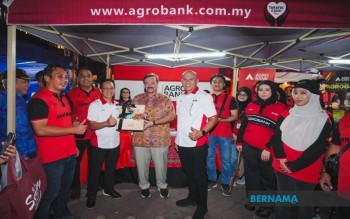
Agrobank's strategy of taking its financing services directly to traders at grassroots locations has yielded substantial results, with applications totalling more than RM8 million collected through a series of engagement sessions held across the country. The development underscores how traditional market venues continue to serve as crucial touchpoints for reaching Malaysia's informal economy, where access to formal financing has historically remained a significant barrier to business growth and expansion. The latest phase of this outreach initiative extends into Sabah, marking the bank's effort to bridge the financial services gap in East Malaysia and demonstrate that economic opportunities for small traders exist well beyond the major urban corridors of Peninsular Malaysia.
The Sabah expansion brought Agrobank's engagement teams to two key market locations: the Api-Api Night Market on Jalan Gaya in Kota Kinabalu and the Papar Tamu Farmers' Market. The selection of these venues reflects deliberate targeting based on where traders congregate and conduct business most actively. At Api-Api Night Market, the bank interacted with 153 hawkers and entrepreneurs, while the Papar farmers' market session involved 95 traders, indicating the scale at which informal businesses operate in Sabah's local economies. These sessions built upon earlier outreach efforts conducted across the Klang Valley, suggesting that Agrobank has developed a replicable model for identifying and supporting financing needs in diverse market settings.
The timing of these engagement sessions aligns with broader policy directives from Malaysia's federal government. Finance Minister II Datuk Seri Amir Hamzah Azizan's presence at the Api-Api session signalled official backing for Agrobank's approach. More significantly, the initiative responds to Prime Minister Datuk Seri Anwar Ibrahim's directive to financial agencies to accelerate outreach and expedite the disbursement of RM5 billion in financing dedicated to small traders. This RM5 billion programme represents a critical injection of capital aimed at sustaining Malaysia's vast informal trade sector, which employs hundreds of thousands and generates substantial local economic activity across residential neighbourhoods and town centres.
Agrobank Group President and Chief Executive Officer Datuk Tengku Ahmad Badli Shah Raja Hussin framed the bank's approach as fundamentally responsive to regional differences in business challenges. His statement reflected recognition that traders in Sabah face distinct operational realities compared to their counterparts in the Klang Valley, whether due to supply chain dynamics, consumer behaviour, transportation costs, or market size. By deploying teams on-the-ground rather than requiring traders to navigate formal banking channels, Agrobank eliminates friction points that often discourage informal business operators from pursuing institutional financing. The direct engagement model also allows bank representatives to explain loan products, eligibility criteria, and support mechanisms in accessible terms, addressing the knowledge gap that frequently exists between formal financial institutions and grassroots entrepreneurs.
During these sessions, Agrobank staff concentrated specifically on assessing working capital requirements and business expansion needs. Working capital financing proves particularly vital for hawkers and micro-traders, who frequently operate with tight cash flows and limited ability to absorb payment delays from customers. Similarly, expansion financing addresses the growth aspirations of traders seeking to increase inventory, upgrade equipment, or extend operating hours. By tailoring these offerings to the demonstrated needs of market traders rather than imposing standardised retail banking products, Agrobank positioned itself as responsive to the actual circumstances of its target market.
The RM8 million in applications represents merely the initial harvest from these engagement sessions. The conversion rate from applications to approved loans will ultimately determine the programme's real impact on trader cash flows and business viability. However, the volume of applications itself suggests strong demand for accessible financing among this demographic. Many hawkers and micro-entrepreneurs operate perpetually constrained by capital limitations, unable to exploit market opportunities when they arise due to insufficient working capital. The substantial application volume indicates that Agrobank's approach has successfully identified genuine financing demand that exists within these communities.
Expanding to Sabah carries strategic importance beyond immediate loan volumes. East Malaysia has historically experienced less intensive financial services penetration compared to Peninsular Malaysia, partly due to geographic dispersion and lower population density in many areas. By establishing an active presence in Sabah's trading communities, Agrobank signals commitment to financial inclusion across Malaysia's federal structure. This geographical expansion also positions the bank to build relationships and market knowledge that may yield longer-term benefits as traders' businesses develop and their financing needs evolve toward larger facilities or diverse products.
The engagement session approach also generates valuable data about financing gaps, trader demographics, and market-specific challenges that Agrobank can leverage to refine future products and service delivery. Each market location functions almost as a research laboratory where the bank learns directly from traders about obstacles they encounter and solutions they would value. This feedback loop enables continuous improvement and adaptation, distinguishing this model from traditional banks that rely primarily on historical lending data and standardised customer profiles.
The Malaysian government's RM5 billion financing initiative addresses a longstanding concern about informal sector access to formal credit. Hawkers and street traders have traditionally relied on informal lending networks, family resources, or suppliers' credit arrangements, often at unfavourable terms. Formal bank financing offers lower interest rates, more flexible repayment structures, and the possibility of building credit histories that support future borrowing. By channelling substantial resources toward these traders through vehicles like Agrobank, the government acknowledges both the economic importance of the informal sector and the market failure that leaves many viable small businesses unable to access adequate capital.
For Malaysian and Southeast Asian policymakers observing this initiative, Agrobank's grassroots model offers a template for financial inclusion that recognises the limitations of expecting informal sector operators to navigate formal banking institutions independently. As regional economies increasingly recognise the importance of small and medium enterprises to employment and economic resilience, the mechanisms through which financing reaches these businesses warrant careful attention. Direct engagement at markets, community centres, and natural gathering points for traders may prove more effective than facility-based banking approaches in contexts where informal businesses predominate.

