Deputy Prime Minister Datuk Seri Dr Ahmad Zahid Hamidi has welcomed the appointment of Datuk Onn Hafiz Ghazi as Johor's new Menteri Besar, using the occasion to reinforce the coalition's confidence in its leadership direction following last week's emphatic electoral performance. The gesture, communicated through Facebook, underscores the unity within Barisan Nasional ranks as it consolidates power in Malaysia's economically significant southern state.
Ahmad Zahid, speaking in his dual capacity as Deputy Prime Minister and BN chairman, characterised Onn Hafiz's elevation as a demonstration of public trust that carries substantial responsibility. He framed the appointment not merely as a political promotion but as a mandate to elevate governance standards across Johor, with explicit emphasis on safeguarding public interests, maintaining institutional stability, and advancing long-term economic development initiatives that benefit residents. This framing reflects the coalition's post-election narrative of renewed purpose and renewed commitment to administrative excellence.
The Deputy Prime Minister's carefully worded message also serves as an implicit endorsement of the transition process itself. In Malaysian politics, such high-profile congratulations from senior federal figures validate state leadership changes and signal to the broader political establishment that factional disputes, if any existed during the selection process, have been resolved. Ahmad Zahid's invocation of divine blessing and wisdom represents standard ceremonial language in Malaysian political discourse, yet it also acknowledges the weight of the responsibility Onn Hafiz now carries.
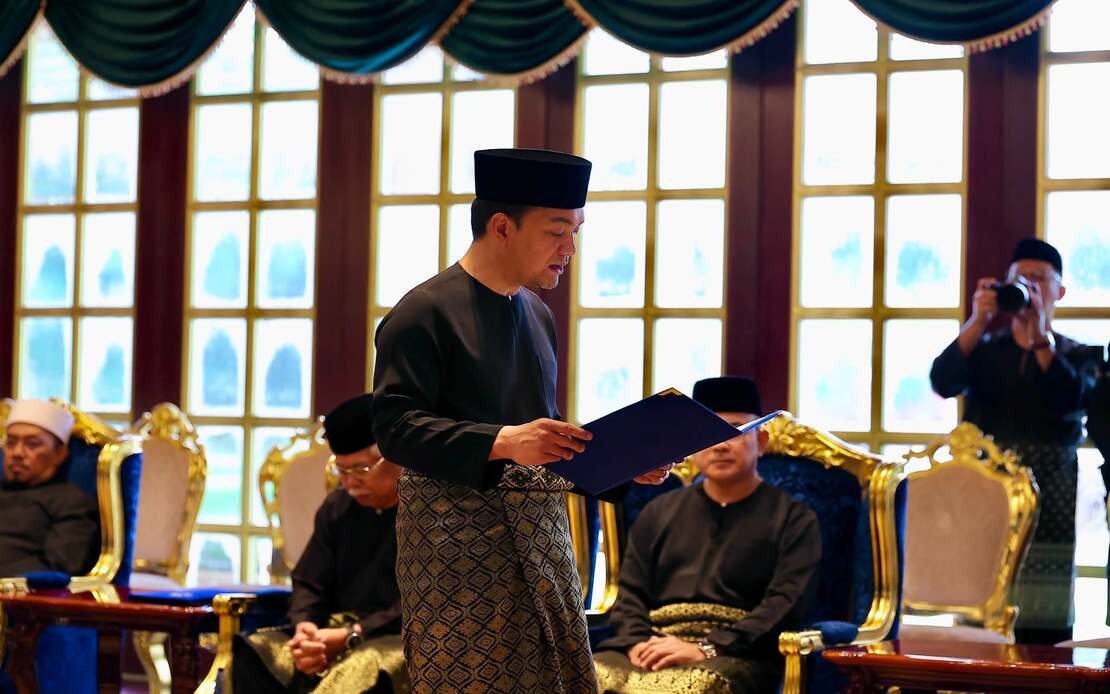
Onn Hafiz, who represents Machap in the Johor state assembly and previously chaired the state BN machinery, underwent the formal oath-taking ceremony at Balai Mengadap within Istana Bukit Serene in Johor Bahru. The choice of venue—the palace's formal audience chamber—underscores the constitutional gravity of the transition. The ceremony before Tunku Ismail Sultan Ibrahim, the Regent of Johor, represents more than procedural formality; it marks the formal investiture of executive authority vested through the constitutional monarchy framework that underpins Malaysian politics.
The appointment arrives in the aftermath of Barisan Nasional's commanding performance in the 16th Johor state election, where the coalition captured 48 of 56 available seats—a two-thirds supermajority that provides substantial legislative flexibility. This electoral outcome represents a significant recovery for the coalition in a state where it had faced mounting pressure in recent years. The magnitude of victory grants Onn Hafiz considerable political capital and a broad mandate that extends beyond merely forming a government to encompassing ambitious policy initiatives.
The transition reflects careful succession planning within the Johor BN hierarchy. Onn Hafiz's background as state BN chairman indicates he has navigated the complex internal dynamics and coalition management that characterises Malaysian state-level politics. His experience managing relationships across BN's constituent parties—UMNO, MCA, MIC, and several smaller components—positions him to maintain the coalition's structural coherence. This continuity appears significant given that cohesion concerns have periodically afflicted the coalition in various states.
The newly sworn Menteri Besar inherits a state administration responsible for overseeing Johor's substantial economic portfolio. As Malaysia's second-most developed state by GDP, Johor's governance has implications extending beyond regional interests. Major industrial zones, port facilities, and cross-border economic arrangements with Singapore feature prominently in state policy. Onn Hafiz's performance in managing these complex portfolios will substantially influence both BN's standing within Johor and broader coalition narratives heading toward the next federal election cycle.
Ahmad Zahid's public endorsement also carries strategic significance for managing potential intra-coalition dynamics. In Malaysian politics, leadership transitions at state level occasionally trigger competitive positioning among different party factions. By issuing prompt and unequivocal congratulations, Ahmad Zahid—representing federal-level UMNO leadership—signals that the selection process enjoyed institutional support and that the new Menteri Besar commands the confidence of senior BN figures. This messaging reduces space for destabilising challenges to the new administration's legitimacy.
The appointment occurs within a broader context of coalition recalibration following the 2022 federal election outcome, which fragmented Malaysia's political landscape considerably. Barisan Nasional's recovery in Johor suggests the coalition's capacity to rebuild support among key electoral constituencies, though this nascent momentum remains vulnerable to national-level political turbulence. Onn Hafiz's success in consolidating support within the state and delivering on governance promises will substantially influence whether the Johor victory represents a durable coalition recovery or a temporary electoral anomaly.
Looking ahead, the new Menteri Besar will confront conventional challenges of state administration—managing competing budgetary demands, addressing infrastructure deficits, and navigating federal-state coordination complexities. Beyond routine governance, he must leverage Johor's electoral mandate to strengthen the broader coalition narrative heading into future electoral contests. The success or otherwise of his tenure will reverberate throughout BN's wider political ecosystem, making his appointment consequential far beyond Johor's borders.

