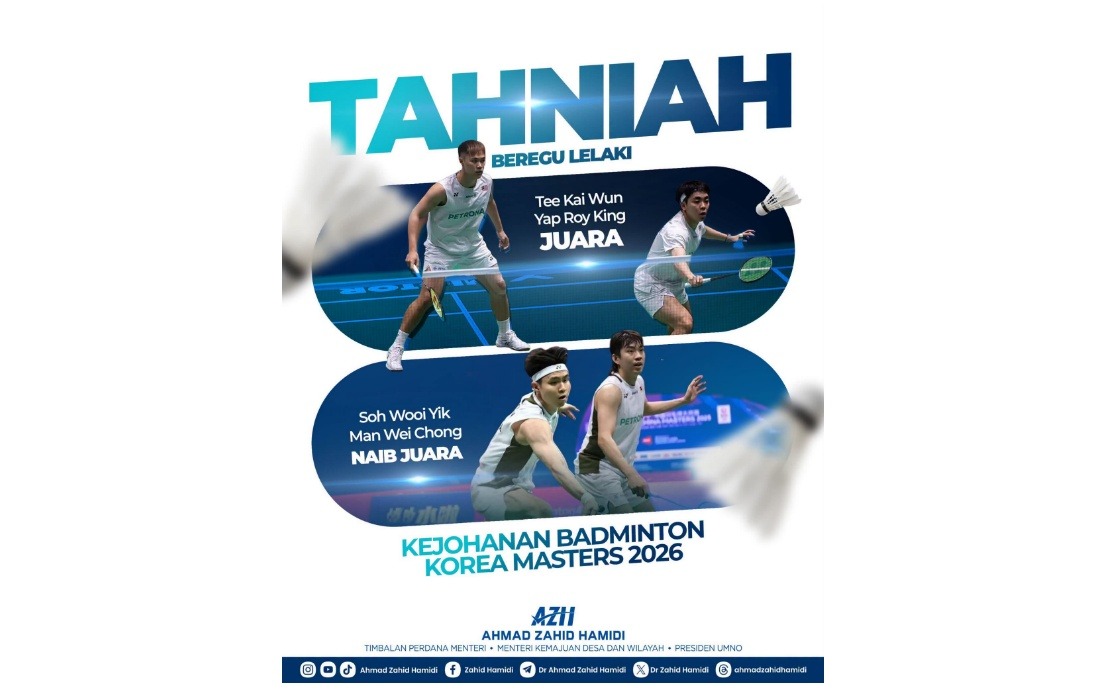
Deputy Prime Minister Datuk Seri Dr Ahmad Zahid Hamidi has thrown his support behind Malaysia's badminton contingent following an exceptional showing at the 2026 Korea Masters Badminton Championships, where the nation's men's doubles programme secured both the title and runner-up position in a compelling display of domestic strength. The achievement marks a significant milestone for Malaysian badminton, underscoring the depth of talent emerging from the country's competitive doubles structure and offering encouragement to athletes seeking consistent international recognition.
Tee Kai Wun and Yap Roy King clinched the Korea Masters crown in their maiden appearance at the prestigious tournament, defeating fellow Malaysians Soh Wooi Yik and Man Wei Chong in a tightly contested final at the Yi Sun-sin Gymnasium in Asan. The champions dispatched their compatriots with a commanding performance, securing a 21-13, 21-18 victory in just 31 minutes, demonstrating the technical proficiency and mental composure required at the highest levels of international badminton competition.
The tournament outcome represents a watershed moment for Kai Wun and Roy King, who navigated a competitive draw to claim their maiden Korea Masters title. Their success carries particular significance given the tournament's status within the badminton calendar and the strength of the field typically competing in such championships. By winning at their debut appearance, the pair has announced itself as a serious contender in the international men's doubles arena, where consistency and clutch performances separate champions from contenders.
Ahmad Zahid's public commendation reflects official recognition of the pairs' accomplishments and represents a broader endorsement of Malaysia's badminton development infrastructure. In his Facebook statement, the Deputy Prime Minister emphasized that the victory should galvanize the athletes to maintain their trajectory and continue elevating Malaysia's standing in international badminton. His message framed the Korea Masters success not as a destination but as a waypoint in a longer journey toward sustained excellence, urging the pairs to channel their momentum into future competitions.
The runner-up finish by Wooi Yik and Wei Chong, whilst technically a second-place result, reinforces Malaysia's competitive positioning in men's doubles. That both Malaysian pairs reached the final and mounted a spirited challenge demonstrates the quality depth within the domestic programme. Wooi Yik brings prior Korea Masters experience, having won the title in 2024 alongside Aaron Chia, indicating that Malaysia's doubles capability has broadened beyond a single partnership.
This marks only the second occasion Malaysia has captured the Korea Masters men's doubles championship, with the 2024 triumph by Wooi Yik and Chia establishing recent precedent for success at this tournament. The back-to-back titles across different partnership configurations suggest that Malaysia's doubles programme possesses systemic strengths in training methodologies, player development, and competitive preparation. The ability to produce multiple championship-caliber pairs simultaneously underscores investments in coaching infrastructure and talent identification systems.
For Malaysian sports observers, the Korea Masters outcome carries broader implications for regional badminton dynamics. Malaysia traditionally competes with Indonesia, Thailand, and other Southeast Asian nations for continental supremacy, and victories at prestigious tournaments like Korea Masters enhance the nation's reputation and credibility. Such achievements provide diplomatic and soft power value beyond the sporting arena, elevating Malaysia's profile within international badminton communities.
The timing of Ahmad Zahid's public congratulations reflects the administration's interest in associating itself with sporting success stories. Badminton occupies a distinctive position within Malaysian national identity, with the sport historically producing champions and serving as a source of collective pride. Political leaders frequently leverage sporting achievements as opportunities to highlight national capability and competence, particularly when Malaysian athletes triumph against international opposition.
Looking forward, the challenge for both pairs will be sustaining performance levels and translating Korea Masters success into consistent results across the international calendar. The badminton schedule features multiple prestigious tournaments annually, and maintaining ranking positions requires steady competition and continuous refinement. Ahmad Zahid's exhortation that the players continue bringing glory to Malaysia on the international stage implicitly acknowledges that single tournaments, however significant, represent only snapshots within longer competitive arcs.
The Korea Masters victory also carries implications for Malaysia's broader badminton ecosystem, including coaching staff, support systems, and institutional frameworks that enable athletes to compete at elite levels. Success at tournaments like Korea Masters validates these investments and generates momentum that can attract additional resources and sponsorship support to the sport. Furthermore, victories by emerging partnerships like Kai Wun and Roy King provide aspirational examples for younger players within the development pipeline, demonstrating that opportunities exist beyond established pairings.
For Malaysian badminton enthusiasts and stakeholders, the Korea Masters triumph represents an encouraging signal heading into the remainder of the international calendar. The demonstration of depth across multiple partnerships suggests that Malaysia's men's doubles programme possesses resilience and capability to sustain competitive presence across multiple fronts. As Ahmad Zahid noted, the performances by both pairs delivered a thrilling match that captivated observers and highlighted the quality of Malaysian badminton at its highest levels.

