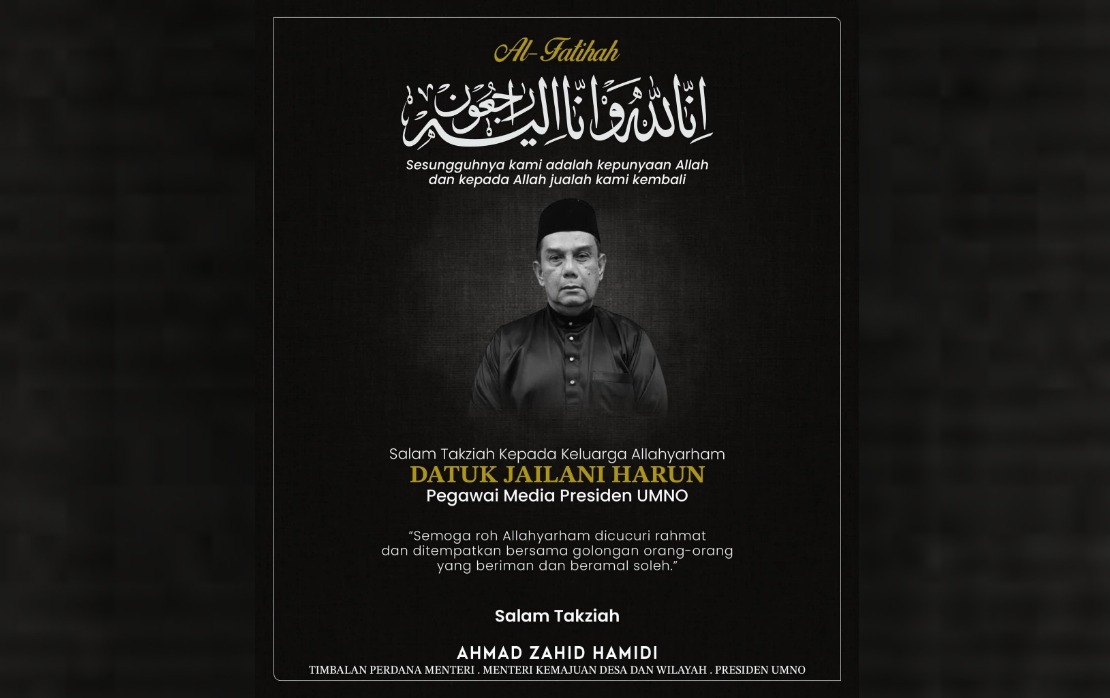
Deputy Prime Minister Datuk Seri Dr Ahmad Zahid Hamidi paid tribute to Datuk Jailani Harun, a longtime figure in Malaysian media circles and prominent member of UMNO's communications apparatus, who died on July 7 at Serdang Hospital. The 66-year-old veteran journalist and former media officer at the UMNO President's Office passed away at 11.34 am, drawing expressions of sorrow from senior government figures and party leadership.
Ahmad Zahid, who also serves as UMNO president, visited Jailani at the hospital earlier that morning, an encounter he described as deeply moving. The Deputy Prime Minister's account of the visit reflects the emotional weight of losing a colleague of considerable standing within party circles. In a statement posted to social media, Ahmad Zahid recalled the moment with candour, acknowledging his initial hopes for recovery even as the gravity of the situation became apparent. The visit underscored the personal relationships that bind Malaysia's political establishment, particularly within UMNO's senior ranks.
The tributes centred on Jailani's character and professional contributions. Ahmad Zahid characterised the deceased as an individual distinguished by kindness, humility, and widespread respect across his professional networks. These qualities, frequently cited in obituaries of public figures, carry particular weight in Malaysian political discourse, where personal integrity and social standing remain culturally significant measures of a person's legacy. For someone who spent decades in media and communications roles within one of Malaysia's largest political parties, such recognition reflects a career navigating the intersection of journalism and partisan politics.
Jailani's career trajectory illuminates the evolution of Malaysia's media landscape and political communications. As a journalist transitioning into a formal media officer role at the UMNO President's Office, he represented a generation of communicators who witnessed and participated in Malaysia's post-independence transformation. His decades of service positioned him as a repository of institutional memory regarding party operations and the development of media relations strategies within UMNO's hierarchy.
The religious observances following his death reflected Malaysian Muslim cultural practices. Ahmad Zahid invoked Islamic prayer traditions, beseeching divine forgiveness for Jailani's soul and mercy upon his memory. These spiritual dimensions, integral to Malaysian public discourse surrounding mortality, extend beyond mere formality—they represent shared cultural and religious values that unite Malaysia's diverse population around common practices of honouring the deceased. The invocation of these traditions by a senior political figure demonstrates their continued centrality to Malaysian public life.
Jailani's funeral arrangements proceeded according to Islamic custom, with burial scheduled at Alam Damai Muslim cemetery in Cheras following afternoon prayers. Such logistical details, routine though they may appear, reflect the coordination required for the funeral of a public figure with extensive networks across government and party structures. The location in Cheras, a suburb within Kuala Lumpur's metropolitan area, would have facilitated attendance by colleagues and associates from across the capital's political and media establishments.
The circumstances of Jailani's death at Serdang Hospital, a major medical facility in Selangor, highlight healthcare access patterns among Malaysia's political and professional elite. Hospital visits by senior government officials, such as Ahmad Zahid's morning visit, underscore both the personal bonds within political circles and the visibility accorded to prominent figures even during medical crises. Such interactions carry symbolic weight within Malaysian political culture, signalling respect and maintaining relationships during vulnerable moments.
Jailani's passing represents the loss of an individual who bridged journalism and political communications at a critical juncture in Malaysian history. Those working in media roles within political parties occupy complex positions, balancing journalistic principles against partisan interests. Over his career, Jailani would have navigated numerous episodes in UMNO's political history, from electoral campaigns to party leadership transitions, providing communications support during periods of substantial change within Malaysian politics.
The death also reflects broader demographic transitions within Malaysia's political establishment. At 66 years old, Jailani belonged to a generation of professionals who came of age during Malaysia's formative post-independence decades. The passing of such figures removes witnesses to earlier periods of political development and institutional practice. For UMNO specifically, the loss of veteran communicators like Jailani removes individuals with deep knowledge of party operations and historical precedent.
Ahmad Zahid's public expressions of condolence serve multiple functions within Malaysian political culture. Beyond the immediate gesture of respect to Jailani's family, they reaffirm UMNO's solidarity around the loss of a longstanding member and acknowledge contributions made across decades of service. Such public mourning also provides opportunities for senior figures to demonstrate the human dimensions of political leadership, countering perceptions of politics as purely transactional or adversarial. The emphasis on Jailani's personal qualities—kindness and humility—suggests a figure who, despite working in partisan politics, maintained relationships across professional boundaries.
For Malaysia's media community specifically, Jailani's death marks the passage of someone who witnessed profound shifts in journalism and communications technology. His career spanned from print journalism's dominance through the emergence of digital platforms and social media. Having worked within UMNO's communications infrastructure, he experienced firsthand the evolution of how political parties engage with media and public audiences.

