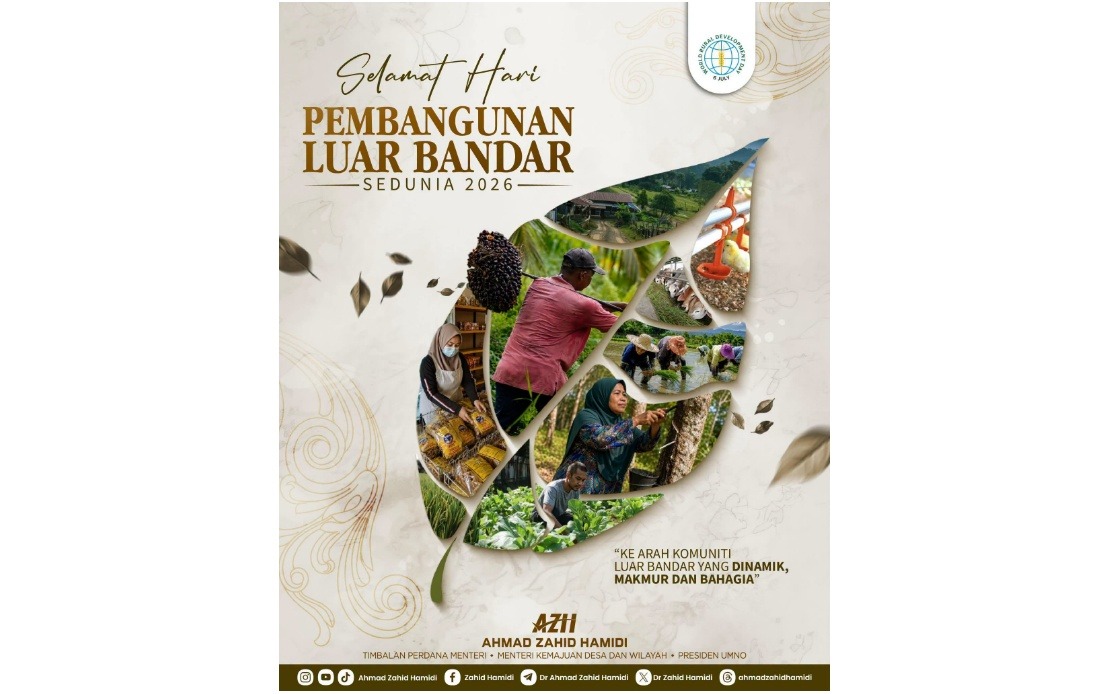
Malaysia is commemorating World Rural Development Day (HPLBS) for the first time, with Deputy Prime Minister Datuk Seri Dr Ahmad Zahid Hamidi emphasising the occasion as a watershed moment for the nation's rural agenda. Speaking on the occasion, Ahmad Zahid, who also serves as Rural and Regional Development Minister, stressed that the celebration represents a formal acknowledgement of the Ministry of Rural and Regional Development's (KKDW) mandate to orchestrate comprehensive rural advancement across the country.
The selection of July 6 carries more than ceremonial weight. The date aligns with the founding of the Centre on Integrated Rural Development for Asia and the Pacific (CIRDAP), a regional institution that has shaped rural development policy and practice throughout the Asia-Pacific region for decades. By anchoring Malaysia's inaugural celebration to this date, the government signals its commitment to connecting domestic rural initiatives with broader regional frameworks and expertise. This positioning places Malaysian rural policy within an international context, suggesting that solutions to village-level challenges will increasingly draw from pan-Asian experience and knowledge-sharing mechanisms.
According to Ahmad Zahid, the establishment of an annual observance on July 6 serves multiple strategic purposes beyond symbolic recognition. The ministry intends to use the platform to elevate rural development concerns to national prominence, ensuring that peripheral communities receive sustained policy attention and resource allocation commensurate with their demographic and economic significance. By institutionalising the celebration, authorities aim to create an annual checkpoint for assessing progress, identifying bottlenecks, and recalibrating rural development strategies.
The inaugural event was held at the Tun Abdul Razak Stadium in Jengka, near Maran, Pahang—a location chosen to underscore the government's commitment to delivering ceremonies and policy initiatives directly to rural constituencies. The venue selection reflects a deliberate shift away from exclusively Kuala Lumpur-based announcements, demonstrating that rural affairs warrant physical presence and direct engagement with local stakeholders. This geographical choice also provides visibility to Pahang's own development trajectory and positions the state as a microcosm of Malaysia's broader rural modernisation efforts.
Three pillars structured the inaugural celebration's thematic framework. Community innovation emerged as the first pillar, recognising that rural progress depends partly on tapping endogenous creativity and problem-solving capacities within villages themselves. Rather than imposing top-down solutions, this pillar acknowledges that rural communities possess intrinsic knowledge systems and entrepreneurial instincts that, when properly supported and incentivised, can drive sustainable local development. The second pillar, rural digitalisation, addresses perhaps the most pressing infrastructure gap between urban and peripheral Malaysia. Digital connectivity has become foundational to market access, financial services, education quality, and healthcare delivery—making it essential infrastructure rather than luxury amenity.
Rural entrepreneurship development constitutes the third pillar, recognising that employment generation and income supplementation in villages depend on supporting small-scale business ventures. Agricultural diversification, agro-tourism, artisanal manufacturing, and value-added food production represent pathways through which rural households can improve livelihoods without forced rural-urban migration. By elevating entrepreneurship to a primary focus, the government acknowledges that sustainable rural prosperity requires wealth-creation mechanisms beyond traditional farming.
Ahmad Zahid articulated an overarching vision extending beyond these three pillars. The underlying aim is ensuring that rural populations access expanding economic opportunities, benefit from robust economic structures, enjoy modern infrastructure and facilities, and achieve genuine prosperity aligned with Malaysia's overall development trajectory. This formulation suggests recognition that rural communities have historically lagged in accessing opportunities available in urban centres, and that bridging this gap requires purposeful government intervention across multiple sectors simultaneously.
For Malaysian and Southeast Asian readers, this inaugural celebration carries significance beyond national boundaries. Rural development challenges—insufficient infrastructure, limited market access, brain drain, environmental degradation—are endemic across the region. Malaysia's formalisation of an annual observance and its articulation of a comprehensive rural agenda may offer templates or policy reference points for neighbouring countries grappling with similar demographic and development asymmetries. CIRDAP's involvement provides institutional machinery for disseminating Malaysian experiences throughout the region.
The celebration's theme, "Toward Vibrant, Prosperous and Happy Rural Communities," signals that development is conceived not merely in economic metrics but encompasses quality of life, cultural vitality, and subjective wellbeing. This holistic framing distinguishes contemporary rural policy from narrower productivity-focused approaches, suggesting that policymakers recognise rural communities as complete social entities with multifaceted needs rather than labour reserves or resource extraction zones.
Looking forward, the institutionalisation of World Rural Development Day creates accountability structures. An annual observance implies regular progress reporting, stakeholder consultation, and public discourse around rural advancement. Politicians and bureaucrats will face recurring occasions to explain what has been accomplished, where implementation has faltered, and how strategies will evolve. This cyclical reckoning may gradually shift rural development from episodic attention toward sustained policy commitment, aligning incentives for consistent implementation rather than intermittent announcements.

