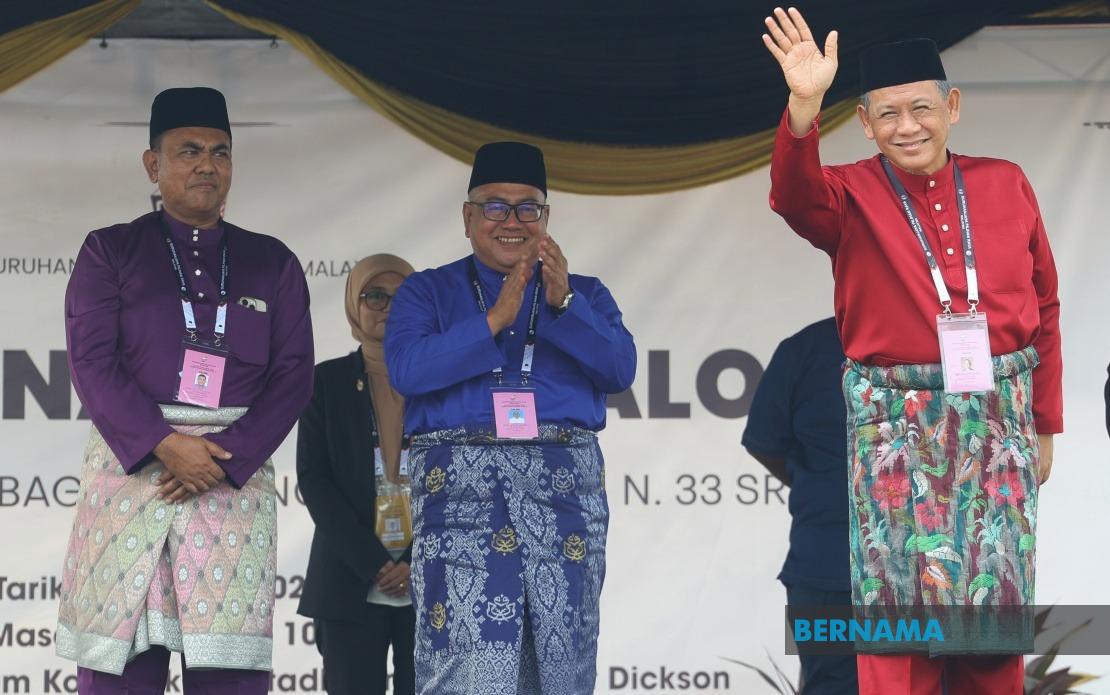
Negeri Sembilan's ruling Pakatan Harapan coalition faces a stern electoral challenge in the upcoming state election, with Menteri Besar Datuk Seri Aminuddin Harun now confronting a three-way contest for his Linggi constituency. The nomination process on Friday revealed that the veteran politician will square off against incumbent Datuk Mohd Faizal Ramli, who stands as the Barisan Nasional candidate, and Bersatu representative Datuk Zamri Md Said, signalling intensified competition in one of Negeri Sembilan's key battlegrounds.
The announcement came from returning officer Nurhazelin Makli at the Port Dickson District Administration Complex following the closure of nominations. The Linggi seat has emerged as a focal point for the 16th Negeri Sembilan state election scheduled for August 1, reflecting broader political realignments across the state that have fractured the once-dominant coalition votes. Aminuddin's presence as both Menteri Besar and frontline candidate underscores the strategic importance Pakatan Harapan assigns to retaining control of the state apparatus, which the coalition has governed since 2018.
The three-cornered contest in Linggi mirrors a broader pattern evident across multiple constituencies in the state election. In Sri Tanjung, incumbent assemblyman Dr G. Rajassekaran of Pakatan Harapan must defend against Barisan Nasional's A. Achutan and Bersatu newcomer Leevineshwaraan Murugan. The Lukut seat presents another fragmented scenario where Pakatan's Choo Ken Hwa confronts Perikatan Nasional candidate Sathes Kumar Nilameham alongside independent contestant Teo Seng Lee. These contests indicate that the simplicity of two-party battles characteristic of previous electoral cycles has given way to more complex, multi-sided competitions that could dramatically reshape seat distributions.
Bagan Pinang similarly demonstrates how the political landscape has become atomised. There, incumbent Pas assemblyman Abd Fatah Zakaria defends his seat against Nasir Raman representing Pakatan Harapan and Sheikh Junaidy Jamaludin standing as Bersatu candidate. The presence of Islamist Pas in opposition reflects continued fragmentation within Malaysia's opposition bloc, a consequence of the fractious 2022-2023 political realignments that followed the 15th general election. For Malaysian observers tracking state-level dynamics, these contests provide important indicators of how Pakatan Harapan's coalition mechanics are holding up under pressure from rival coalitions and intra-opposition competition.
Not all seats present equally complicated contests. The Chuah constituency will witness a straightforward two-way battle between incumbent Yew Boon Lye of Pakatan Harapan and Barisan Nasional's Pau Jeou Ching. Such direct confrontations, while fewer in number, may prove decisive in determining overall state control. The variation in contest formats across different constituencies means that candidates and parties must calibrate campaign strategies seat-by-seat, complicating efforts at coordinated messaging and resource allocation across the state apparatus.
The Electoral Commission has registered 889,490 eligible voters for the Negeri Sembilan polls, comprising 867,151 ordinary voters together with 16,884 military personnel and spouses and 5,455 police personnel and spouses. This voter composition reflects Negeri Sembilan's particular demographic characteristics and institutional presence, including significant military and police establishments. Early voting has been scheduled for July 28, providing security force personnel and their families with an opportunity to cast ballots before the main polling day, a standard provision that aims to facilitate participation among uniformed services.
For Pakatan Harapan, retaining Negeri Sembilan represents a crucial test of its capacity to maintain coalition cohesion and electoral appeal outside peninsula urban heartlands. The state served as a crucial proving ground for Pakatan's 2018 federal breakthrough and has remained a symbolic stronghold. Loss of Menteri Besar status would constitute a significant setback for the coalition's narrative of steady political recovery following the tumultuous 2022-2023 period when internal fractures created openings for Barisan Nasional's resurgence.
For Barisan Nasional, Negeri Sembilan offers opportunity to expand its state government portfolio beyond the significant gains achieved in the 2022 general election. The coalition's competitive positioning across multiple constituencies reflects its partial recovery from the 2018 electoral debacle. However, the strong challenge posed by Bersatu and other parties suggests that Barisan cannot assume automatic advantage from being the establishment coalition, a stark contrast to the pre-2018 era.
Bersatu's decision to field candidates across contested seats, including the high-profile Linggi championship against the incumbent Menteri Besar, represents its continued positioning as a distinct political force beyond the Pakatan and Barisan umbrellas. This approach echoes Bersatu's strategy in recent elections, where party leadership has sought to maintain autonomy and voter identity rather than subordinate itself within larger coalitions. For Southeast Asian political analysts, Bersatu's trajectory offers insights into how personality-based parties attempt to navigate Malaysian coalition politics while preserving organisational independence.
The staggered voting arrangements, with early polling on July 28 preceding the main August 1 election day, follow standard protocols designed to maximise participation while accommodating special voter categories. The distinction between ordinary voters and security force voters reflects constitutional provisions that recognise the unique electoral requirements of armed forces and police establishments, though in practice these provisions generate only modest participation differentials.
Negeri Sembilan's state election will provide the first comprehensive electoral assessment since the 2023 general election transformed the political landscape. Voters' choices in constituencies from Linggi to Bagan Pinang will signal whether Pakatan Harapan can consolidate state control, whether Barisan Nasional's federal recovery translates into substantive state-level gains, and whether parties like Bersatu can maintain meaningful electoral influence. The results will likely shape campaign messaging and coalition strategies heading toward eventual federal elections, making this seemingly localised state contest carry disproportionate significance for Malaysia's broader political trajectory.

