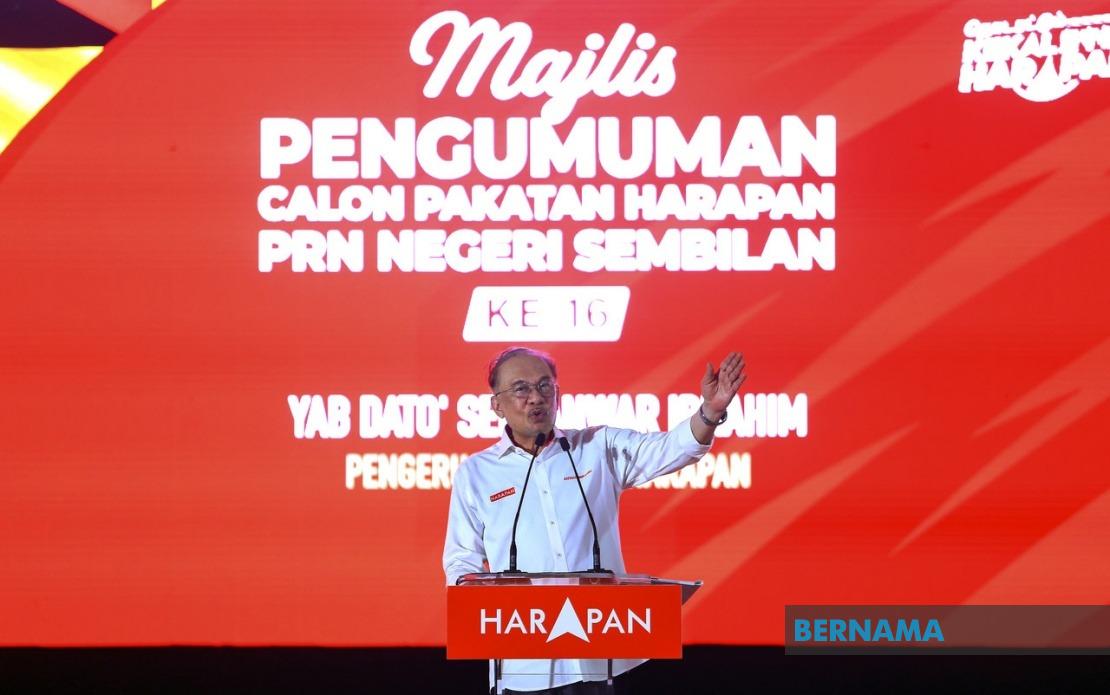
Prime Minister Anwar Ibrahim unveiled Pakatan Harapan's slate for the 16th Negeri Sembilan State Election at a packed nomination ceremony in Kuala Pilah on July 14, announcing two significant candidacies that underscore the coalition's strategy heading into the contest. Negeri Sembilan Menteri Besar Datuk Seri Aminuddin Harun will seek the Linggi seat, a move that shifts the long-serving administrator from his traditional stronghold into fresh electoral territory as he carries forward the coalition's momentum in the state.
Aminuddin's shift to Linggi marks a calculated repositioning within Negeri Sembilan's political landscape. The Menteri Besar has dominated the Sikamat state constituency since 2008, securing four consecutive electoral victories that established him as a fixture in the state's political hierarchy. His move to Linggi signals Pakatan Harapan's confidence in the candidate and its broader electoral prospects, positioning him to defend or expand the coalition's representation in a different segment of the state. As both Menteri Besar and Negeri Sembilan Pakatan Harapan chairman, Aminuddin carries the weight of the coalition's state leadership into the campaign, making his candidacy emblematic of the government's push to consolidate support.
The coalition simultaneously confirmed its approach to defending existing ground through the re-nomination of DAP secretary-general Anthony Loke in the Chennah seat, where he has maintained continuous representation since 2013. Loke's bid for another term reflects both his personal electoral strength and the coalition's strategy of leveraging proven vote-getters in contested terrain. The Chennah seat has been a DAP stronghold, and Loke's sustained presence there demonstrates the party's capacity to retain urban and semi-urban support in Negeri Sembilan's complex electoral dynamics.
Anwar's personal involvement in the candidate announcement ceremony underscored the strategic importance Pakatan Harapan attaches to the Negeri Sembilan election. As Prime Minister and coalition chairman, his appearance alongside senior leaders provided symbolic weight to the nominations, signalling that the coalition views this state contest as material to its broader political fortunes. The gathering drew thousands of party supporters and representatives, creating a visible show of organisational strength and party unity at a moment when such demonstrations carry electoral significance.
The ceremony brought together the constellation of Pakatan Harapan's senior leadership, reflecting the coalition's federal and state dimensions. Amanah president Datuk Seri Mohamad Sabu's attendance linked the conservative Islamic-oriented partner of the coalition to the announcements, while PH communications director Datuk Seri Fahmi Fadzil and election director Datuk Seri Amirudin Shari's presence embedded these nominations within the coalition's broader electoral machinery. This assembly of figures illustrated how state elections in Malaysia integrate with federal party structures and national political calculations.
Negeri Sembilan's electoral dynamics present a distinctive challenge for all contending forces. The state's nine state constituencies scatter across an economically diverse landscape encompassing Kuala Lumpur suburbs, industrial zones, and rural areas. Pakatan Harapan's performance here carries implications beyond the state's immediate governance; results influence broader perceptions of coalition stability and federal government legitimacy. The positioning of candidates like Aminuddin, who manages state administration alongside electoral contestation, mirrors the compressed nature of Malaysian politics where administrative effectiveness and campaign competitiveness remain intertwined.
The decision to field sitting Menteri Besar in a different seat represents a calculated risk-reward calculation common in Malaysian state elections. Shifting Aminuddin from Sikamat to Linggi requires careful management of his outgoing constituency while simultaneously establishing credibility in new terrain. Such transitions, when executed successfully, can refresh a politician's public image and expand their appeal beyond longstanding power bases. Conversely, missteps in managing the transition between constituencies can create openings for opposition parties to reclaim lost ground or fragment coalition support through accusations of negligence.
Loke's continued presence in Chennah embodies a contrasting but complementary strategy. DAP's consistent performance across peninsular Malaysian constituencies relies significantly on retaining experienced legislators who command personal loyalty and organisational networks. Loke's decade-long tenure in Chennah has allowed cultivation of constituent relationships and party infrastructure that cannot be quickly replicated elsewhere. His re-nomination prioritises solidity over expansion, a pragmatic acknowledgment that consolidating existing gains matters as much as pursuing new territory.
The electoral calendar for Negeri Sembilan reflects broader patterns in Malaysian state politics where electoral timelines remain staggered and unpredictable. State elections serve as bellwethers for coalition health and opposition viability between federal contests, functioning as intermediate tests of political legitimacy. For Pakatan Harapan, maintaining control of Negeri Sembilan reinforces claims of sustained electoral appeal beyond the 2022 federal election that brought Anwar to the premiership. Conversely, significant setbacks would provide ammunition to opposition parties seeking to portray the coalition as weakening.
The announcement ceremony's emphasis on coalition unity and candidate quality addresses implicit concerns about PH's structural coherence. Fielding candidates of administrative stature and proven electoral competence while maintaining party balance among DAP, Amanah, and other components demonstrates coalition discipline. These nominations position the coalition to argue that experienced, capable leadership warrants continued voter support. The opposing narrative from competing forces will inevitably emphasise fatigue with incumbent administrations and the need for political renewal through alternative leadership.
For Malaysian observers and Southeast Asian analysts monitoring Malaysia's political evolution, the Negeri Sembilan contest acquires significance as a test of post-2022 political stability. The manner in which Pakatan Harapan manages candidate nominations, campaigns, and ultimately performs at the ballot box informs assessments of whether the coalition has consolidated sufficient institutional strength to govern effectively and predictably. Conversely, opposition performance will clarify whether alternatives command sufficient momentum to challenge federal incumbency. These state-level contests, though geographically bounded, reflect and potentially shape the broader political environment within which Malaysia's federal democracy operates.

