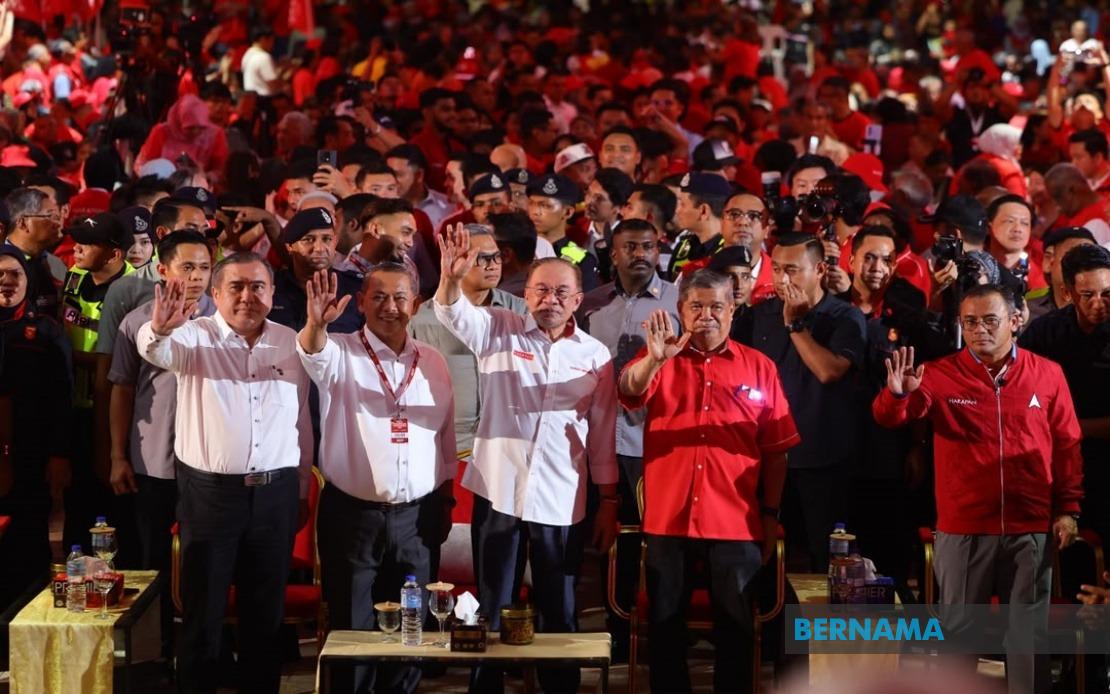
Datuk Seri Aminuddin Harun, the Negeri Sembilan Pakatan Harapan chairman, has made an appeal to voters in the state to entrust the opposition coalition with a renewed mandate during the forthcoming 16th state election. Speaking at a candidate announcement event in Kuala Pilah on July 14, Aminuddin framed the election as a choice between continuity and uncertainty, emphasising that sustained governance would preserve the political equilibrium necessary for the state's economic progression. He argued that investor sentiment relies heavily on governmental predictability, and that interrupting the current administration would jeopardise ongoing development initiatives and community assistance schemes that residents have come to depend upon.
The coalition leadership assembled at the event underscored the significance PH places on this contest. Present alongside Aminuddin were DAP secretary-general Anthony Loke, Amanah president Datuk Seri Mohamad Sabu, PH communications director Datuk Seri Fahmi Fadzil, and election director Datuk Seri Amirudin Shari, a show of unity intended to project strength as the campaign begins. This gathering of senior figures reflected internal recognition that Negeri Sembilan represents a critical test following the coalition's defeat in the Johor state election earlier in the year, an outcome that had prompted soul-searching within PH's ranks regarding messaging and campaign execution.
Aminuddin's track record since assuming office appears central to PH's electoral strategy. He highlighted that the state government has delivered substantially on pledges made during the 2018 campaign, pointing to expanded welfare programmes including educational subsidies and the distribution of complimentary tablets to students. Beyond these immediate initiatives, the Menteri Besar outlined structural improvements in state finances, particularly a remarkable increase in zakat collection from approximately RM80 million to nearly RM200 million, enabling greater assistance directed toward vulnerable populations. Such figures, if accurately reflecting improved resource mobilisation, suggest administrative competence that Aminuddin hopes will convince voters that retaining PH governance serves their material interests.
The economic performance narrative formed another pillar of the coalition's pitch. Aminuddin cited Negeri Sembilan's success in attracting RM19.1 billion in investments, a figure intended to demonstrate that the state remains an attractive destination for business and foreign capital. In Malaysia's competitive environment, where states increasingly vie for manufacturing and technology investments, maintaining investor confidence represents genuine strategic value. A change in government carries inherent risk of policy discontinuity or altered regulatory frameworks that could spook international investors, a consideration that extends beyond mere political rhetoric to genuine economic consequences affecting employment and revenue generation.
Integration between state and federal governance featured prominently in Aminuddin's remarks, underscoring an often-overlooked complexity in Malaysian federalism. He stressed that effective implementation of development projects requires harmonious coordination between Negeri Sembilan's administration and federal authorities. In the current Malaysian political context, where PH governs both the state and federal levels, this alignment is theoretically straightforward, yet maintains significant vulnerability. Should PH lose Negeri Sembilan while remaining in federal power, coordination would become fraught with partisan tension, potentially delaying infrastructure projects and disadvantaging the state in federal resource allocation, a reality that speaks to voters' practical concerns beyond electoral symbolism.
Anthony Loke's intervention revealed the coalition's analytical response to its recent setback in Johor. Characterising the Negeri Sembilan election as PH's "second round," Loke communicated determination to reverse momentum through improved campaign discipline and messaging precision. He acknowledged that the Johor outcome had disappointed PH supporters and signalled that the coalition interpreted the result not as a terminal verdict but as a correctable strategic miscalibration. This framing aims to restore confidence among party machinery and grassroots activists whose morale typically suffers after electoral reverses, a psychological dimension often underestimated in campaign analysis but critical to sustained volunteer effort and door-to-door voter contact.
The coalition leadership's emphasis on Negeri Sembilan as "home ground" strategically invoked familiarity and rootedness, contrasting PH's historical presence in the state against potential challenger parties. Loke committed the coalition to mobilising all component parties as a unified force, with Aminuddin designated as the coalition's commander and Menteri Besar candidate, a structural clarity intended to eliminate confusion about PH's leadership hierarchy and vision. Such internal coordination matters substantially in Malaysian electoral contests, where voter perception of divided or competing messages within coalition structures can erode support among swing voters uncertain about which direction a government would ultimately take.
Critically, Loke's injunction regarding campaign decorum and respect for royal institutions signalled PH's calculated sensitivity to potential opponents' weaponisation of religious and constitutional issues. This defensive posture reflects lessons learned from previous campaigns where PH component parties, particularly DAP, faced accusations of disrespecting Islam or federalism, charges that resonated with certain voter segments despite factual contestation. By publicly recommitting to constitutional monarchy, federal institutions, and Rukun Negara, Loke attempted preemptive inoculation against anticipated attacks, acknowledging that electoral contests in Malaysia operate within a cultural and constitutional framework where perceived disrespect carries electoral consequences.
The rally represented a critical moment for PH to consolidate its membership and project an image of forward momentum rather than defensive retrenchment. Having suffered defeats in recent state elections, the coalition faces questions about whether it retains adequate grassroots capacity and public appeal to govern effectively. Negeri Sembilan, where PH had established institutional presence and administrative achievements, presented an optimal venue for attempting reversal. However, the election would ultimately test whether economic indicators and developmental accomplishments translated into voter enthusiasm sufficient to overcome any anti-incumbency or fatigue factors that might have accumulated during PH's tenure.
For Southeast Asian observers, the Negeri Sembilan contest illuminates Malaysian democracy's functioning at the state level, where coalition politics, federalism, and leadership succession intersect. PH's positioning of Aminuddin as continuity candidate suggests succession planning considerations within the coalition, particularly regarding DAP's political management given Loke's elevated federal role. The election results would carry implications extending beyond Negeri Sembilan itself, signalling whether PH retains capacity to retain consolidated state governments and potentially affecting confidence among federal coalition partners regarding PH's organisational vitality and electoral competitiveness entering any prospective national contest.

