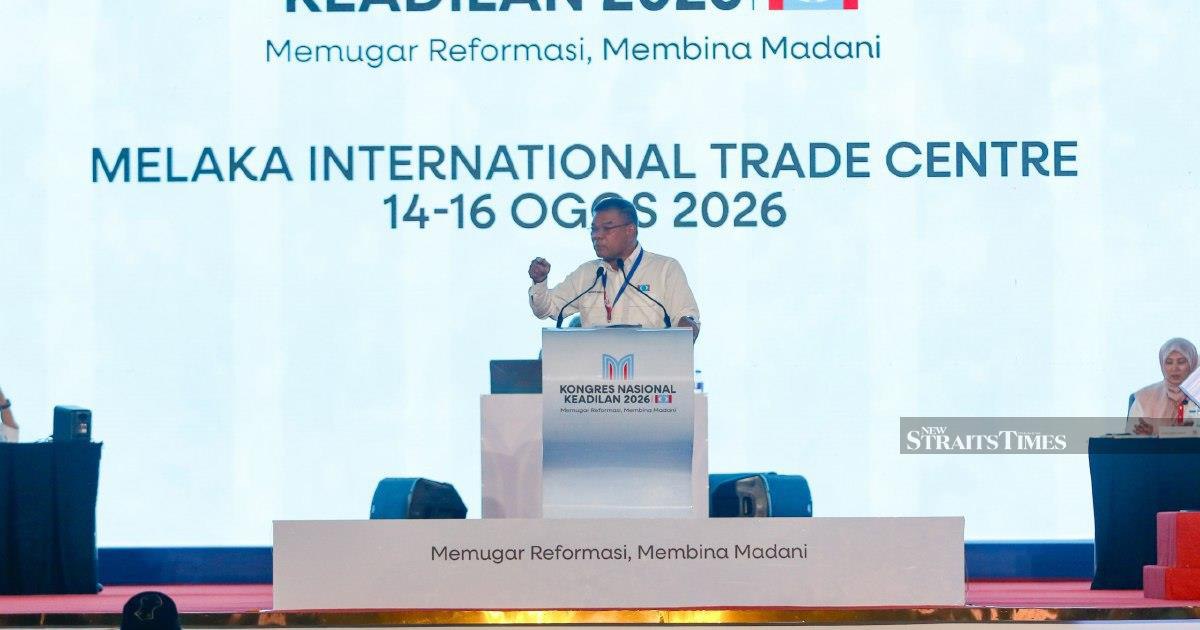
Malaysia's fight against graft risks becoming a tool for political opportunism unless leaders deliberately frame the issue around principles of good governance and ethics rather than exploiting communal fault lines, PKR vice-president Datuk Seri Saifuddin Nasution Ismail cautioned at Ayer Keroh today. His intervention reflects growing concern within the reform movement that populist politicians may be channelling anti-corruption sentiment in divisive directions, potentially undermining the credibility of institutional reforms and civil oversight mechanisms.
Saifuddin's remarks underscore a critical vulnerability in Malaysia's anti-corruption agenda: the ease with which legitimate enforcement actions against wrongdoing can be reframed through prisms of ethnicity or religion to stoke partisan mobilisation. When graft prosecutions become perceived as weapons targeting specific communities rather than violations of universal standards of conduct, public confidence in the independence of enforcement bodies erodes, and anti-corruption becomes another theatre of identity politics rather than a shared national interest.
The Malaysian context renders this concern particularly acute. Over the past decade, high-profile corruption cases have frequently been interpreted through communal lenses, with supporters of accused figures sometimes portraying investigations as persecution and critics weaponising cases to attack political opponents' credibility. This pattern has muddied the distinction between principled enforcement and selective targeting, making it harder for institutions like the Malaysian Anti-Corruption Commission (MACC) to maintain the perception of impartiality essential to their legitimacy.
Framing corruption as fundamentally a governance failure rather than a communal problem has practical benefits beyond symbolism. It anchors enforcement on measurable institutional standards—compliance with procurement regulations, transparency in asset declaration, proper documentation of decision-making processes—rather than subjective assessments of intent or identity. When anti-corruption becomes a matter of demonstrable breaches of procedure and law, debate centres on facts and remedies rather than grievance and group identity, making genuine reform possible.
Saifuddin's intervention also signals concern within PKR, the de facto lead coalition partner on reform issues, that competitors may be seizing on anti-corruption language to consolidate support along ethnic or religious lines. Opposition figures and even some government allies have occasionally deployed corruption narratives to question whether particular communities deserve trust with power, a rhetorical move that corrodes institutional integrity and replaces merit-based accountability with communal suspicion.
For Southeast Asia's broader anti-corruption architecture, Malaysia's experience offers a cautionary lesson. Across the region, nascent institutions and oversight bodies face pressure to deliver visible results under tight political constraints. Leaders may be tempted to use anti-corruption drives to eliminate rivals or consolidate advantage, lending credence to narratives that enforcement is selective or weaponised. Once that perception takes root, genuine wrongdoing becomes harder to address credibly, as accused parties and their supporters can claim victimisation with greater plausibility.
The Malaysian Anti-Corruption Commission, despite its statutory independence, remains vulnerable to questions about political influence in case selection and prosecution. Saifuddin's call for corruption to be treated as a governance matter rather than a communal one is partly an attempt to shore up the MACC's standing by insisting that cases be evaluated against universal benchmarks rather than calculations about whose interests they serve. This reframing requires public leadership willing to resist the political temptation to weaponise prosecutions.
The principle Saifuddin articulates—that accountability must be applied consistently and without regard to the suspect's identity—represents an aspirational standard rather than a description of current practice in Malaysia or elsewhere in Southeast Asia. Achieving it requires political will to pursue wrongdoing among allies with the same rigour applied to opponents, a discipline that is genuinely challenging in polarised environments where control of enforcement institutions frequently shifts between competing coalitions.
Building public trust that anti-corruption is primarily a governance imperative also requires consistent messaging from multiple institutions and political constituencies. Opposition parties and ruling coalitions alike must demonstrate through their conduct that they prioritise the integrity of the system over tactical advantage. When every major prosecution becomes an opportunity for partisan messaging about ethnic or religious targeting, the distinction between enforcement and persecution becomes academic.
Saifuddin's remarks may also reflect internal PKR debates about how reform-minded politicians should distinguish their agenda from that of competitors who may deploy anti-corruption rhetoric more opportunistically. By anchoring anti-corruption in universal moral and governance principles, PKR attempts to position itself as genuinely committed to institutional integrity rather than simply using anti-graft language to attack rivals or mobilise communal support.
The practical implication of treating corruption as a governance issue is straightforward: enforcement should focus on the act—misuse of public resources, breach of procedure, concealment of transactions—rather than speculation about the motivation or identity of the wrongdoer. This approach does not preclude vigorous prosecution or public accountability, but it shifts the basis of legitimacy from group-based grievance to institutional principle.
For Malaysia and the region, embedding anti-corruption deeply enough in governance rather than politics will require sustained institutional reform: clearer independence for enforcement bodies, transparent case selection criteria, regular public reporting on investigations, and political leaders willing to insulate prosecutors from short-term pressure. Saifuddin's intervention suggests that at least some within Malaysia's political leadership recognise the stakes of allowing anti-corruption to be captured by sectarian politics.

