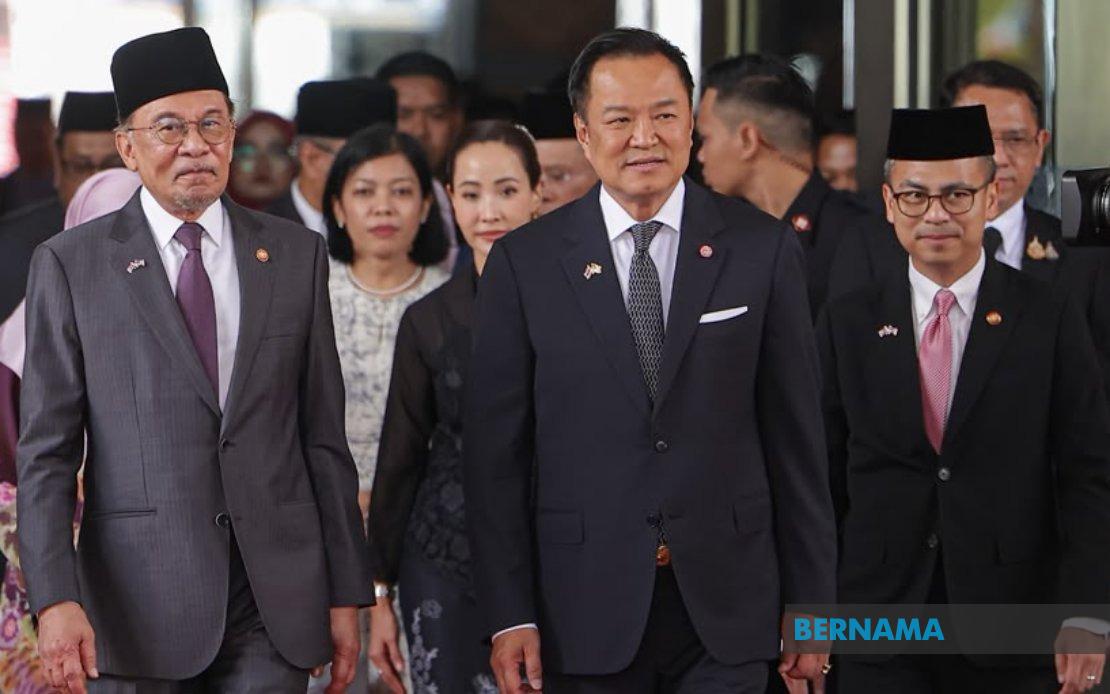
Prime Minister Datuk Seri Anwar Ibrahim convened a bilateral meeting with Thailand's Prime Minister Anutin Charnvirakul at the Perdana Putra Complex in Putrajaya on July 9, seeking to assess the trajectory of Malaysia-Thailand relations while identifying fresh avenues for deepening engagement across multiple economic and social domains.
Anutin arrived at Kuala Lumpur International Airport at 11.11 am, completing a two-day official visit to Malaysia that he undertook at Anwar's invitation. The Thai leader was formally received by Anwar at the Bunga Raya Complex before the two delegations proceeded to the Perdana Putra Complex for the substantive discussions. The timing and formality of the reception underscored the significance both nations attach to their bilateral ties, which have grown increasingly important as Southeast Asia navigates complex geopolitical shifts and seeks to strengthen regional economic integration.
The agenda for the talks encompassed a comprehensive sweep of bilateral cooperation frameworks. Trade and investment featured prominently, reflecting Malaysia and Thailand's shared interest in expanding commercial ties and attracting joint investment initiatives. Border connectivity emerged as a critical discussion point, given the two countries' extensive land frontier and the need to facilitate seamless movement of goods and people across crossing points. Security cooperation, a longstanding pillar of Malaysia-Thailand relations, was expected to receive considerable attention, particularly given ongoing challenges in the southern border region where both nations have collaborative mechanisms to address transnational crime and terrorism.
Agriculture represented another focal point, with both countries recognising their complementary agricultural sectors and the mutual benefits of enhanced collaboration. Malaysia's food security imperatives and Thailand's position as a regional agricultural powerhouse create natural synergies. Tourism featured prominently as well, reflecting the substantial people-to-people flows between the two nations and the economic opportunities presented by deepening tourism linkages. Education and cultural exchanges were positioned as essential foundations for building stronger societal connections beyond government-to-government relations, fostering understanding among younger generations who will shape bilateral ties in coming decades.
The two leaders also intended to exchange perspectives on regional and international developments of mutual concern, particularly within the ASEAN framework and other regional mechanisms. This dimension is particularly significant as both Malaysia and Thailand navigate questions around regional stability, trade architecture, and their relationships with major powers. The bilateral context provided an opportunity to align positions ahead of broader ASEAN meetings and to ensure coordination on issues from the South China Sea to economic integration initiatives.
The Malaysian delegation reflected the whole-of-government approach to the engagement, with Deputy Prime Minister and Minister of Energy Transition and Water Transformation Datuk Seri Fadillah Yusof, Foreign Minister Datuk Seri Mohamad Hasan, and Transport Minister Anthony Loke in attendance. The presence of the Minister of Agriculture and Food Security Datuk Seri Mohamad Sabu signalled Malaysia's seriousness about agricultural collaboration, while Home Minister Datuk Seri Saifuddin Nasution Ismail's participation underscored the security dimensions of the engagement. Minister of Investment, Trade and Industry Datuk Seri Johari Abdul Ghani represented Malaysia's trade and investment interests, while Human Resources Minister Datuk Seri Ramanan Ramakrishnan and Economy Minister Akmal Nasrullah Mohd Nasir brought their respective economic portfolios to the table.
Thailand's delegation was equally comprehensive and ministerial in composition, indicating Bangkok's commitment to substantive engagement. Deputy Prime Minister and Minister of Foreign Affairs Sihasak Phuangketkeow led the diplomatic contingent, while Deputy Prime Minister and Minister of Transport Phiphat Ratchakitprakarn brought infrastructure and connectivity expertise. The presence of Deputy Prime Minister and Minister of Finance Ekniti Nitithanprapas elevated the discussions to the highest levels of economic policy-making. Minister of Tourism and Sports Surasak Phancharoenworakul, Minister of Defence Lt. General Adul Boonthumjaroen, Minister of Agriculture and Cooperatives Suriya Juangroongruangkit, and Minister of Labour Julapun Amornvivat rounded out a delegation covering the full spectrum of bilateral cooperation areas.
A significant outcome of the bilateral meeting was the scheduled signing of a Memorandum of Understanding on agricultural cooperation, a concrete manifestation of both countries' dedication to advancing collaboration in this sector. Agricultural cooperation holds particular relevance for Malaysia and Thailand given regional food security concerns, climate change impacts on agricultural production, and the need for sustainable farming practices. The MOU would likely establish frameworks for knowledge-sharing, technology transfer, and coordinated approaches to supply chain resilience in food production.
The formal luncheon that Anwar hosted following the meeting provided an additional setting for the two leaders and their delegations to engage in more relaxed discussions, often where substantive progress on particular issues can be negotiated away from the formalities of official meetings. These informal moments frequently prove instrumental in building personal rapport between senior officials, relationships that subsequently facilitate smoother implementation of bilateral agreements and more cooperative approaches to regional challenges.
For Malaysia and Thailand, strengthening bilateral ties carries implications beyond the two countries themselves. As ASEAN members navigating a region increasingly shaped by great power competition and economic interdependence, stronger Malaysia-Thailand cooperation contributes to broader ASEAN cohesion and stability. The emphasis on trade, investment, and people-to-people exchanges reflects recognition that economic interdependence and cultural understanding provide stable foundations for long-term regional peace and prosperity. The meetings also demonstrated both governments' commitment to elevating relations above temporary political considerations, focusing instead on enduring strategic interests and mutual benefits.
The bilateral engagement illustrated how Southeast Asian neighbours are deepening practical cooperation across multiple domains while maintaining focus on regional mechanisms like ASEAN. As Malaysia and Thailand continue refining their relationship through such high-level engagements, they establish templates for effective bilateral cooperation that can inform wider regional initiatives. The comprehensive nature of the discussions, touching on security, trade, agriculture, and people-to-people exchanges, reflects mature relationships where countries recognise that prosperity and stability require attention to multiple dimensions simultaneously rather than narrow sectoral focus.

