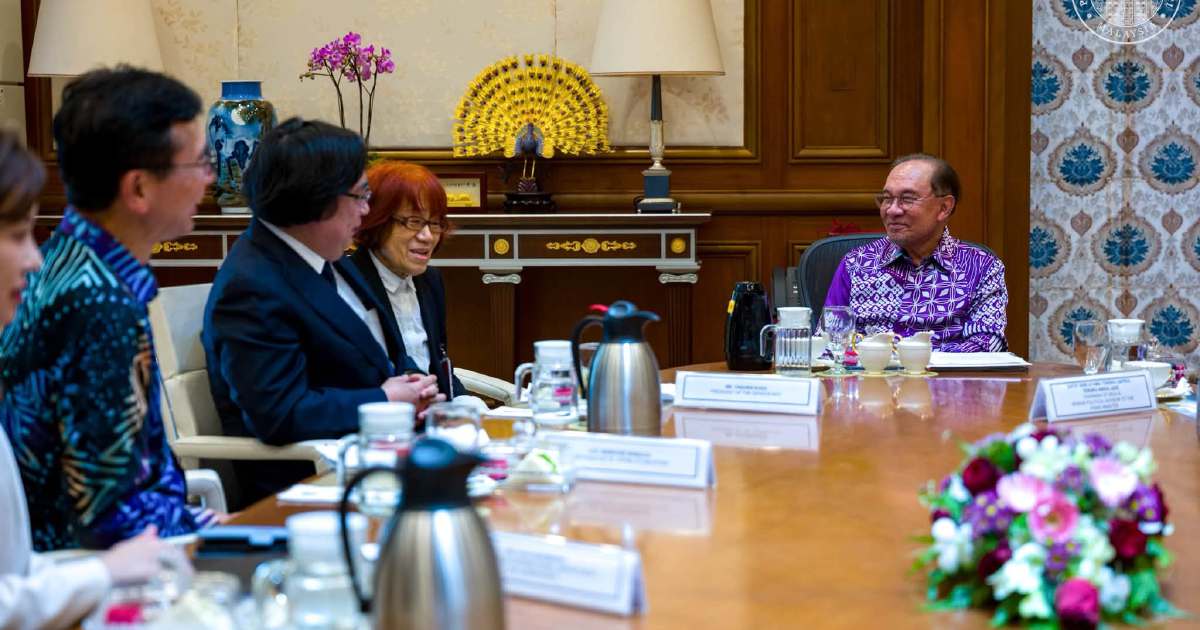
Prime Minister Datuk Seri Anwar Ibrahim held discussions with Genron NPO president Yasushi Kudo this week, signalling renewed commitment from Malaysia's government to fortifying its relationship with Japan through structured strategic engagement. The courtesy call, held at the prime minister's office in Kuala Lumpur, reflected both nations' interest in developing mechanisms that extend beyond traditional diplomatic channels and into civil society dialogue.
Genron NPO, Japan's leading non-profit organisation focused on public diplomacy and international dialogue, represents a significant avenue through which Tokyo conducts strategic communications with key regional partners. The organisation's engagement with Malaysian leadership indicates Japan's continued prioritisation of Southeast Asia in its foreign policy architecture, particularly given the region's geopolitical importance amid evolving great power dynamics. Kudo's visit underscores the Japanese government's recognition that maintaining robust relationships with countries like Malaysia requires sustained engagement at multiple institutional levels.
The discussions between Anwar and Kudo centred on mechanisms for strengthening strategic dialogue between the two nations. This encompasses not merely governmental-to-governmental interaction but also people-to-people exchanges, academic partnerships, and track-two diplomacy initiatives that allow officials and intellectuals to explore complex bilateral issues in less formal settings. Such dialogue frameworks have proven instrumental in building mutual understanding during periods of regional tension or disagreement, providing space for candid conversation without the constraints of formal diplomatic protocol.
Malaysia-Japan relations have historically been characterised by strong economic interdependence and security cooperation. Japan remains one of Malaysia's largest investors, with significant Japanese enterprises operating across manufacturing, automotive, and technology sectors. The bilateral trade relationship continues to thrive, though both governments recognise opportunities for expansion, particularly in emerging areas such as green energy, digital infrastructure, and healthcare technology. Strategic dialogue initiatives could identify new sectors for collaboration while deepening existing economic partnerships.
From Malaysia's perspective, Japan represents a crucial counterbalance in regional geopolitics. As a major developed economy with significant soft power and technological capabilities, Japan offers partnership opportunities aligned with Malaysia's development ambitions. The Anwar government has emphasised the importance of balanced foreign policy that engages multiple powers without subordinating itself to any single bloc, and cultivating a robust relationship with Japan fits squarely within this approach. Enhanced strategic dialogue would provide platforms for clarifying respective policy positions on regional issues and identifying convergent interests.
The timing of this engagement holds particular significance given the current regional environment. The Indo-Pacific region faces mounting pressures from strategic competition between major powers, concerns over supply chain resilience, and shared challenges including climate change and pandemic preparedness. Both Malaysia and Japan have vested interests in preserving a stable, rules-based regional order that permits smaller nations to pursue independent foreign policies. Through intensified dialogue, the two countries can coordinate positions on these transnational issues while advancing their bilateral interests.
Genron NPO's involvement in facilitating Malaysia-Japan dialogue points to the growing importance of non-governmental actors in international relations. Beyond formal diplomatic establishments, think tanks, civil society organisations, and private institutions increasingly shape how nations perceive each other and develop long-term strategic relationships. By working with respected international organisations like Genron NPO, Malaysia and Japan signal their commitment to pragmatic, forward-looking engagement that transcends political cycles and personalities.
The breadth of potential cooperation areas discussed during such exchanges typically extends beyond conventional diplomatic domains. Education represents a particularly rich field, with increased student exchanges and joint research initiatives strengthening intellectual connections between societies. Cultural and sporting collaborations foster broader societal links that complement government-to-government relations. Business communities benefit from enhanced policy coordination and information sharing that reduces uncertainty and facilitates investment.
For Malaysian policymakers, engagement with Japanese institutions and leaders offers valuable opportunities to understand Japan's evolving strategic thinking within Asia. Japan's experiences managing relationships with China and other major regional actors, combined with its technological prowess and institutional expertise, provide knowledge resources that Malaysian officials can leverage. Reciprocally, Malaysia's position as a central Southeast Asian nation with significant Muslim population and important maritime geography offers Japan insights into regional dynamics and perspectives that prove invaluable for Tokyo's policy formulation.
The emphasis on strategic dialogue during Kudo's visit reflects a sophisticated understanding that international relations in the 21st century require continuous conversation and relationship management. Rather than allowing ties to rest solely on historical foundations or institutional inertia, proactive engagement through organisations like Genron NPO ensures that Malaysia-Japan relations remain dynamic and responsive to changing regional circumstances. This approach aligns with Malaysia's broader foreign policy objectives under Anwar's leadership, which prioritises substantive engagement across multiple dimensions with key international partners.
Moving forward, the outcomes of this engagement may include expanded track-two dialogues addressing specific policy challenges, enhanced institutional exchanges, or coordinated positions on shared regional concerns. The meeting between Anwar and Kudo represents not an endpoint but rather a catalyst for ongoing collaboration that benefits both nations by deepening mutual understanding and identifying new pathways for cooperation in an increasingly complex international environment.

