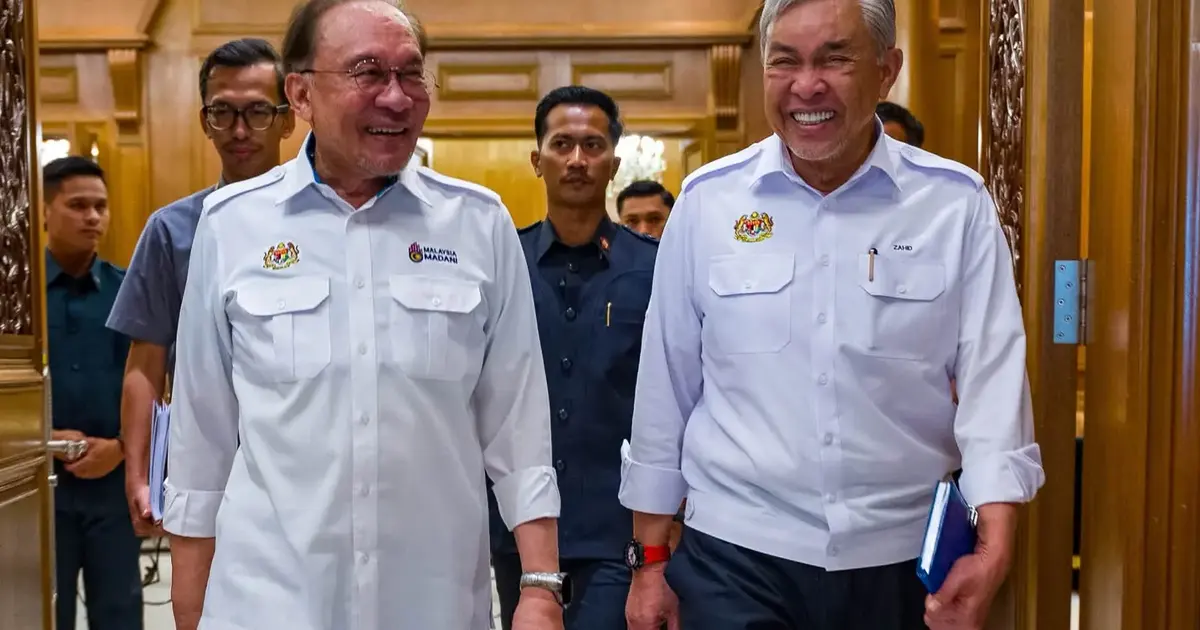
Prime Minister Anwar Ibrahim and Barisan Nasional chairman Ahmad Zahid Hamidi were photographed in upbeat spirits together, presenting a united coalition front just hours after tensions surfaced between the two leaders over the composition and authority within the federal cabinet.
The warm public display followed a day of pointed commentary from Zahid, who had suggested that Anwar possessed the authority to dismiss the eight ministers representing BN within the current cabinet structure. The remark, which on the surface appeared to reaffirm the prime minister's executive prerogative, carried an underlying edge—a reminder that BN's participation in the governing coalition remained conditional on satisfactory performance and alignment with leadership expectations.
Such rhetorical manoeuvres are not uncommon in Malaysian politics, where coalition partners must continually negotiate their roles and influence. The statement served multiple purposes: it demonstrated BN's confidence in its ministerial representatives while simultaneously signalling to the prime minister that any dissatisfaction could be addressed through cabinet adjustments. For Malaysian observers accustomed to reading between political lines, Zahid's comments reflected the delicate balance required to maintain stability within the Pakatan Harapan-Barisan Nasional alliance.
The apparent smoothing over of tensions within hours suggests that both leaders recognised the risks of allowing public disagreement to fester. In the current political climate, where government stability depends on maintaining coalition cohesion, such rapid reconciliation serves as an important signal to investors, international observers, and the Malaysian public that the administration retains firm control. Any prolonged visible tension could invite speculation about potential defections or realignment, particularly given the historically fluid nature of Malaysian coalition politics.
Anwar's administration has faced persistent questions about its durability since taking office, with various political actors testing the boundaries of their influence and ministerial responsibility. BN's participation represents a crucial component of the coalition's parliamentary majority, making its satisfaction essential to government longevity. The presence of eight BN ministers across various portfolios gives the coalition tangible influence over policy implementation and resource allocation.
Zahid's reference to the prime minister's theoretical capacity to remove ministers also functioned as a subtle assertion of BN's importance—only significant coalition partners warrant such consideration. Smaller parties or independent ministers occupy a more peripheral position within the cabinet structure, lacking the leverage to trigger such high-level negotiations. The implicit message to other political actors was clear: BN commands attention and respect befitting its parliamentary and organisational weight.
The timing of the friendly public appearance is particularly instructive. Rather than issue formal statements or allow spokespeople to manage the narrative, both leaders chose to demonstrate unity through direct visual communication. This approach resonates with Malaysian political culture, where personal relationships and visible harmony often carry more weight than carefully worded official responses. The photographs effectively neutralised any storyline suggesting friction between the two senior figures.
For the broader coalition, the incident underscores the ongoing challenge of managing a government spanning multiple political traditions and constituencies. Pakatan Harapan's reformist orientation exists in constant tension with BN's more establishment-focused approach. Reconciling these differences while maintaining cabinet unity requires repeated negotiations and mutual confidence-building exercises. The episode demonstrates how even minor public disagreements can trigger corrective measures to preserve coalition stability.
Looking ahead, the durability of the current arrangement will depend on maintaining this delicate equilibrium. Both leaders clearly understand that allowing coalition tensions to escalate serves no one's interests. Anwar requires BN's parliamentary support, while Zahid benefits from ministerial positions that enhance BN's relevance and resource distribution. This mutual dependence creates a natural incentive toward cooperation, even when underlying differences of opinion exist.
The incident also reflects the broader maturation of Malaysian coalition politics post-2018. Where previous governments might have allowed such tensions to simmer publicly, the current administration appears committed to managing disagreements more smoothly. This professionalisation of coalition management, while less dramatic than previous eras of Malaysia's political theatre, may ultimately prove more stabilising for governance and economic confidence.
For Malaysian citizens and businesses monitoring political stability, the quick resolution provided reassurance about the government's ability to navigate internal differences without triggering larger constitutional crises. In a region where political uncertainty can affect everything from investor sentiment to currency valuations, such signals matter considerably. The smiling photographs thus serve as more than mere political optics—they represent concrete evidence of institutional stability in action.

