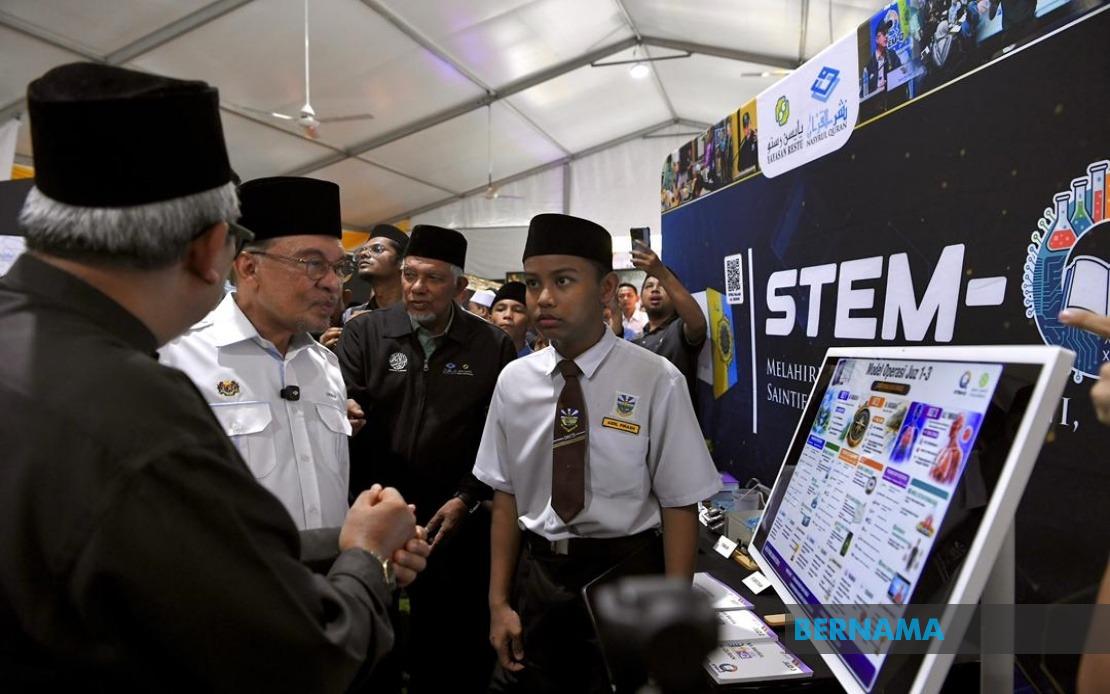
Prime Minister Datuk Seri Anwar Ibrahim has announced a RM4.6 million allocation to upgrade basic infrastructure at 27 Islamic educational institutions throughout Penang, marking a significant increase in government investment in religious education facilities across the state. The funding, approved this year, represents more than double the RM2.11 million directed towards 11 similar institutions just twelve months earlier, signalling a deliberate escalation in the government's commitment to strengthening Islamic educational infrastructure in the region.
Anwar, speaking at the National Tadabbur Perdana and Maidah Wanita MADANI Permatang Pauh programmes held at Masjid Muhajirin in Butterworth, outlined the scope of improvement works that the new funds would support. The allocation encompasses diverse upgrading initiatives aimed at modernising facilities and expanding educational capacity, ranging from essential infrastructure repairs such as walls and fences to more substantial construction projects including new madrasah buildings, school facilities, dedicated kindergarten structures, and specialist tahfiz academies for Quranic memorisation programmes.
In his capacity as both Prime Minister and Finance Minister, Anwar framed the investment as evidence of the government's ongoing priority to address the practical needs of religious schools and Islamic educational institutions nationwide. He emphasised that such funding commitments reflect a strategic objective to enhance the overall quality and accessibility of religious education infrastructure, recognising that adequate facilities form a foundational prerequisite for effective Islamic learning and development across Malaysian communities.
Beyond infrastructure spending, Anwar articulated a vision for Islamic education that embraces contemporary technological advancement while maintaining traditional values. He stressed the importance of integrating artificial intelligence and modern digital tools into Quranic and Islamic studies curricula, acknowledging that educational institutions must evolve to remain relevant in an increasingly technology-driven world. However, he injected a critical caveat into this modernisation agenda, insisting that technological deployment must never occur in a moral or ethical vacuum.
The Prime Minister's comments on artificial intelligence reveal a measured approach to educational innovation, one that resists the wholesale adoption of technology without ethical guardrails. He cautioned against the development of AI systems purely for technical capability or talent advancement divorced from foundational moral principles, arguing instead that technology must be deliberately anchored in values and rooted in strong ethical foundations. This position reflects broader regional and global concerns about ensuring that rapid technological integration in education does not erode the spiritual and moral dimensions that remain central to Islamic pedagogy.
For Malaysian policymakers and religious educators, Anwar's remarks suggest an emerging framework for balancing modernisation with preservation of educational identity. The emphasis on values-based technology adoption carries implications for how Islamic institutions across Southeast Asia approach curriculum development and teaching methodology, particularly as artificial intelligence applications expand into religious education domains including Quranic interpretation, Islamic jurisprudence, and hadith studies.
Anwar further encouraged broader civic participation in strengthening Islamic learning outside formal institutional settings. He called upon Malaysian communities to leverage the freedom of association and religious expression available within the country's constitutional framework to organise comprehensive religious programmes that deepen public understanding and engagement with Islam. This appeal extends beyond attendance at classes and lectures to encompass structured learning initiatives that combine traditional approaches with contemporary methodologies.
Specific programmes highlighted by the Prime Minister include regular Quran study circles, tadabbur sessions designed to foster Quranic contemplation and reflection, and religious discourse forums that encourage substantive discussion of Islamic teachings. Anwar advocated for continuous scheduling of such activities, positioning them as essential mechanisms through which communities can develop more nuanced and authentic comprehension of Islamic principles and values. The emphasis on continuous programming suggests an underlying conviction that Islamic learning represents an ongoing process rather than a one-time educational achievement.
For Penang specifically, the substantially increased funding demonstrates the state's recognised importance within national Islamic education policy. As a state encompassing diverse religious communities and a significant Muslim population, Penang represents a strategic locus for government investment in Islamic institutional capacity. The doubling of annual allocations to religious institutions signals either expanded recognition of previous funding gaps or deliberate acceleration of development timelines within the state's Islamic educational sector.
The announcement also reflects broader patterns in Malaysian governance where federal financing increasingly targets religious institution development. This trend carries implications for understanding how state religious administration, federal educational policy, and Islamic institutional autonomy interact within Malaysia's federal structure. Penang's experience may serve as a bellwether for funding trajectories in other states, particularly regarding how allocated resources are deployed and what measurable outcomes policymakers expect from such investments.
The integration of technological modernisation with value-based learning represents a nuanced response to the tension many Islamic educational institutions face when navigating between traditional pedagogical approaches and contemporary instructional demands. By explicitly articulating that technological tools must serve moral and spiritual objectives rather than merely enhancing technical capability, Anwar has positioned Islamic education as inherently value-directed rather than neutral or instrumental.
Looking forward, the substantial funding increase and the Prime Minister's policy statements on technology integration suggest that Islamic educational institutions in Malaysia may anticipate parallel guidance on specific applications of artificial intelligence and other emerging technologies in religious curricula. Institutions across Penang receiving this funding will likely develop prototype approaches to technology-enhanced Islamic learning that could influence practices in neighbouring states and potentially establish regional precedents for how Muslim-majority nations balance innovation with doctrinal integrity in religious education.

