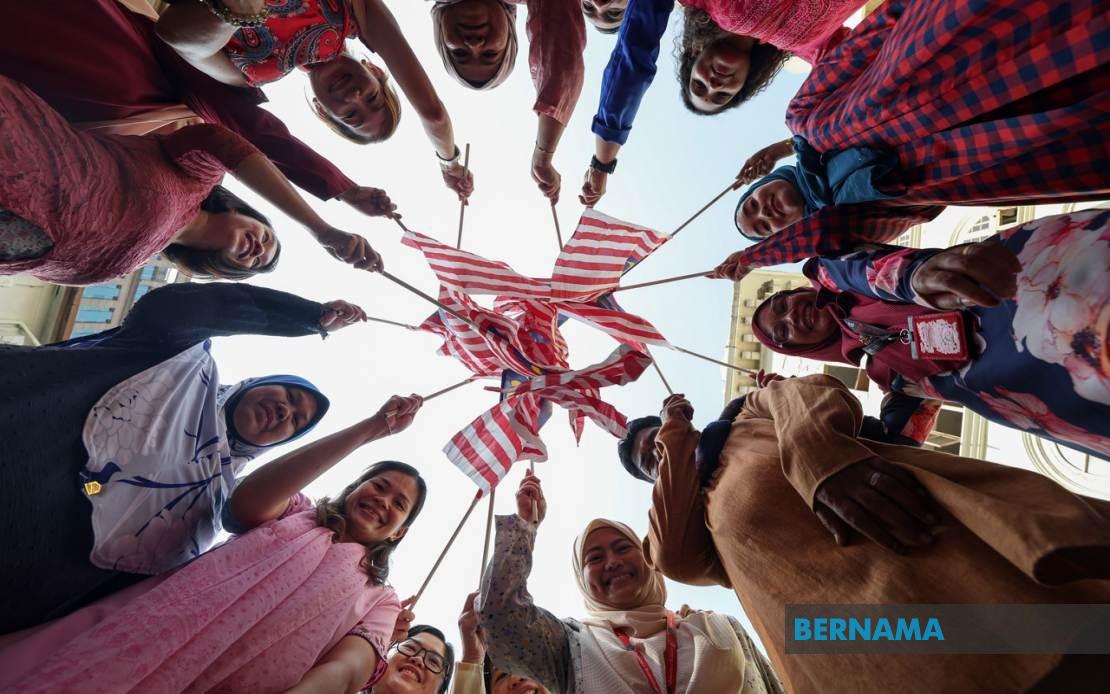
Prime Minister Datuk Seri Anwar Ibrahim has issued a stirring call to Malaysians to stand united in protecting the nation's interests, emphasising that the bonds holding the diverse population together represent the country's greatest asset. Speaking ahead of Malaysia's 69th National Day tomorrow, Anwar framed national cohesion not merely as a social ideal but as an essential foundation for the country's continued stability and prosperity in an increasingly complex regional landscape.
In a message shared on social media, Anwar articulated a vision of independence that extends beyond formal sovereignty to encompass the psychological and collective confidence of the nation's people. He characterised true independence as the ability to chart one's own destiny with assurance, grounded in the strength and dignity of both the nation-state and its citizens. This framing suggests a departure from purely institutional definitions of independence, instead emphasising the role of popular will and national morale in sustaining a country's standing.
The Prime Minister's emphasis on multi-ethnic cohesion carries particular significance given Malaysia's historical trajectory and current political dynamics. By explicitly naming communities across Peninsular Malaysia and East Malaysia—Malay, Chinese, Indian, Iban, Kadazan, Murut, Bidayuh and Orang Ulu peoples—Anwar acknowledged the structural diversity that both strengthens and complicates national identity. This inclusive approach reflects an attempt to position the government as a steward of pluralism rather than narrow sectarian interests, a positioning increasingly important as regional competition and internal pressures test the social compact.
Central to Anwar's message is the notion of inherited obligation. He reminded Malaysians that contemporary freedoms and achievements were secured through the labour, sacrifice and suffering of preceding generations, suggesting that present-day citizens bear a responsibility to preserve and enhance what was passed to them. This intergenerational framing serves multiple rhetorical purposes: it legitimises appeals for collective action, it appeals to national memory and tradition, and it implicitly argues that taking national unity for granted would constitute a betrayal of historical struggle.
An important dimension of Anwar's appeal concerns the relationship between ethnic and regional particularism on one hand and overarching national interest on the other. He explicitly urged Malaysians to subordinate ethnic and regional sentiments to the broader Malaysian interest, a formulation that acknowledges ongoing tensions between these levels of identity while asserting the primacy of the national frame. For policymakers and citizens alike, this represents an ongoing tension in Malaysian political discourse, where competing claims based on ethnicity, religion, region and class frequently intersect.
The Prime Minister also articulated a substantive vision of what Malaysian nationalism should encompass, moving beyond symbolic unity to questions of justice and inclusion. Anwar stressed that Malaysia must distinguish itself as a nation guaranteeing justice for all its inhabitants, with particular attention to marginalised and sidelined populations. This commitment to substantive equality suggests recognition that formal legal equality, while necessary, proves insufficient to sustain genuine social cohesion if significant groups experience systematic disadvantage or exclusion from prosperity and opportunity.
Anwar's invocation of collective action and teamwork reflects awareness that national cohesion requires sustained commitment rather than passive acceptance. His call for Malaysians to "continue working as one team, preserve unity, boost their spirit and defend the country with all their might" positions unity not as a stable achievement but as an ongoing project requiring active participation and vigilance. This dynamic conception acknowledges that in diverse societies, social solidarity must be continuously reproduced through deliberate effort and institutional reinforcement.
The timing of these remarks, coming immediately before the National Day celebration, demonstrates the government's intention to use the occasion to reinforce narratives of shared purpose and collective identity. The chosen theme for this year's celebration, "Malaysia MADANI: Kesejahteraan Dinikmati" (Malaysia MADANI: Shared Prosperity), aligns with Anwar's emphasis on inclusive growth and comprehensive wellbeing. This thematic coherence suggests a coordinated effort to position the government as championing both unity and material progress.
For Southeast Asian observers, Anwar's emphasis on defending national interests against external and internal pressures carries implications beyond Malaysia's borders. At a moment when regional powers vie for influence and when transnational movements occasionally challenge state authority, reassertions of national sovereignty and cohesion serve as important statements of commitment to state consolidation. Malaysia's ability to maintain internal stability while navigating regional geopolitics depends substantially on the legitimacy and resilience of its founding pluralistic compact.
The broader significance of such messaging lies in its attempt to construct a nationalism that is simultaneously inclusive of Malaysia's ethnic and religious diversity while also asserting clear boundaries around national loyalty and interest. This balancing act remains one of Malaysia's defining political challenges, as successive governments have grappled with the tension between recognising communal particularities and maintaining an overarching civic framework. Anwar's appeal to both unity and justice represents one contemporary approach to this enduring problem, even as implementation remains contested across different constituencies and regions.

