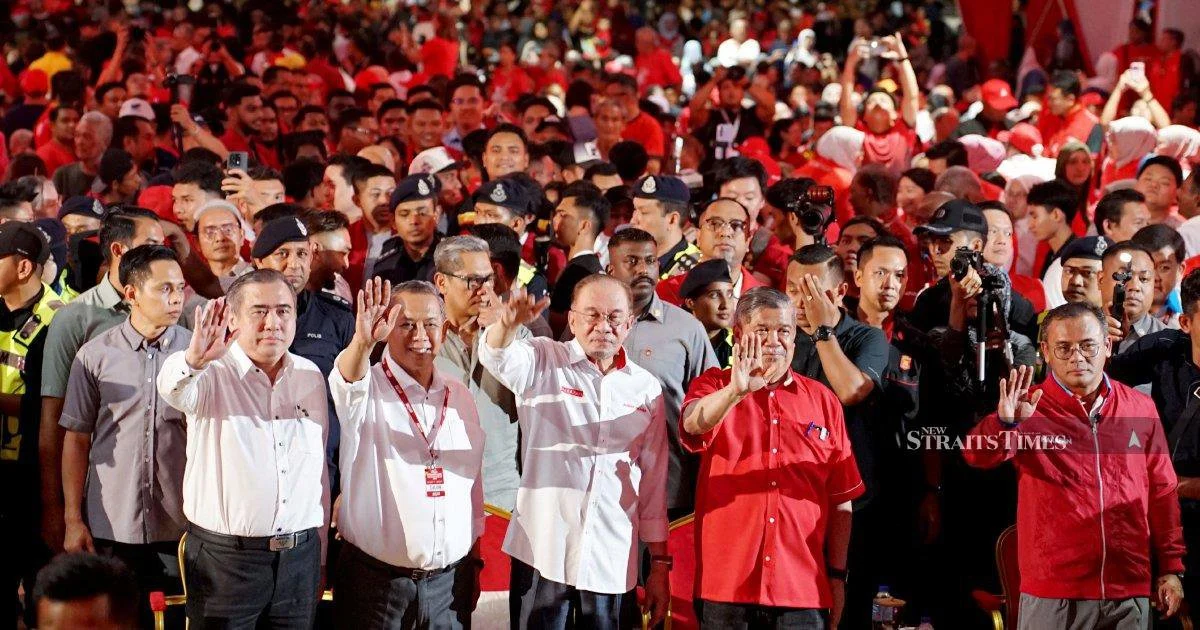
Prime Minister Datuk Seri Anwar Ibrahim has issued a cautionary statement aimed at political stakeholders, particularly party leaders across the spectrum, urging them to maintain a strict boundary between electoral competition and the nation's revered royal institution. Speaking in Kuala Pilah, the Prime Minister emphasised that the monarchy must remain insulated from the rough-and-tumble nature of campaign politics, reflecting longstanding constitutional conventions that protect the throne from partisan contestation.
The warning arrives at a particularly delicate moment for Malaysian politics. Election campaigns, by their nature, tend to generate heightened partisan rhetoric and competitive jostling as contending parties seek electoral advantage. Negri Sembilan, a state with deep historical significance and close ties to the institution of Malay royalty, presents additional sensitivities. The state is uniquely governed by a council of chiefs rather than a single hereditary ruler, making questions of sovereignty and leadership particularly layered and nuanced for local voters.
Anwar's intervention reflects a broader concern about institutional integrity in Malaysian democracy. The royal institution occupies a constitutionally protected and culturally revered position in the Malaysian system of governance. Article 32 of the Federal Constitution codifies the immunity of the monarch, while the monarchy is widely recognised as a stabilising force that transcends partisan divides. When political actors invoke the crown or its prerogatives for electoral gain, they risk eroding the very neutrality that makes the institution effective as a symbol of national unity.
The timing of the Prime Minister's statement carries particular weight given Malaysia's recent political history. Previous election cycles have occasionally witnessed attempts by competing factions to claim alignment with royal sentiments or to invoke perceived royal preferences in their electoral messaging. Such manoeuvres, even when subtle or indirect, can strain the delicate constitutional balance that keeps the monarchy above partisan contestation. By issuing this warning now, Anwar appears intent on establishing clear guardrails before campaign intensity escalates.
For Negri Sembilan specifically, the distinction matters even more acutely than in other states. The council of nine rulers who collectively hold sovereignty in the state carries particular significance as custodians of Malay-Muslim traditions and constitutional governance. Any attempt to instrumentalise their position or to suggest that electoral outcomes should be influenced by appeals to their authority would constitute a fundamental breach of the social compact that underpins Malaysia's constitutional monarchy.
The Prime Minister's message implicitly acknowledges that campaign discipline does not always come naturally to political organisations energised by electoral competition. By setting expectations in advance, Anwar appears to be attempting preventive governance—establishing norms that can be referenced if violations occur. This approach recognises that avoiding institutional damage through clear communication upfront is preferable to managing controversies after the fact.
For Southeast Asian observers watching Malaysian politics, Anwar's statement underscores a critical distinction between monarchies in the region. Unlike some neighbouring constitutional monarchies that have periodically faced challenges to their political neutrality, Malaysia's royal institution has generally maintained its capacity to stand apart from partisan contention. This separation has historically served the nation well, providing a constitutional ballast during periods of political turbulence or transition. Preserving this buffer zone should therefore be understood as essential to Malaysia's broader political stability.
The broader context also matters significantly. Malaysia faces a complex electoral landscape with multiple competing visions for the nation's direction. In such an environment, the monarchy's capacity to represent all Malaysians rather than factional interests becomes increasingly valuable. When politicians subordinate institutional integrity to short-term electoral advantage, they diminish the crown's effectiveness as a symbol of national cohesion. This is a calculus that extends far beyond the Negri Sembilan campaign itself.
Anwar's warning equally reflects the expectations of the voting public. Malaysians across the political spectrum have consistently expressed strong attachment to the monarchy as a stabilising force above politics. Public opinion research repeatedly demonstrates that Malaysians view the royal institution as belonging to everyone, not as a prize to be captured by any particular faction. Election campaigns that ignore this sentiment and attempt to politicise the throne risk generating backlash that extends well beyond the immediate electoral contest.
The practical implications of the Prime Minister's statement will likely shape how political campaigns unfold in Negri Sembilan in coming weeks. Campaign messages will presumably be scrutinised for any perceived attempts to invoke royal authority or to claim special alignment with the state's sovereign structures. Political parties will need to calibrate their appeals carefully, focusing on substantive policy positions and local governance issues rather than on claims about royal preferences or institutional positioning.
Looking forward, Anwar's intervention may serve as a template for how Malaysian political leadership addresses similar tensions in other contexts. As the nation continues to grapple with the challenge of sustaining robust democratic competition while maintaining institutional integrity, clear statements of principle from the nation's highest office can help establish norms that protect the monarchy from partisan contestation. The challenge, ultimately, lies in ensuring that electoral ambition does not override the constitutional conventions that have served Malaysia's system of governance well.
The statement ultimately represents an investment in Malaysia's long-term political health. While individual election campaigns rise and fall, the monarchy's position as an institution above politics remains essential to national stability. By reminding political actors of this fundamental principle, Anwar demonstrates an understanding that preserving the integrity of national institutions serves all political players better than any short-term electoral advantage gained through their politicisation.

