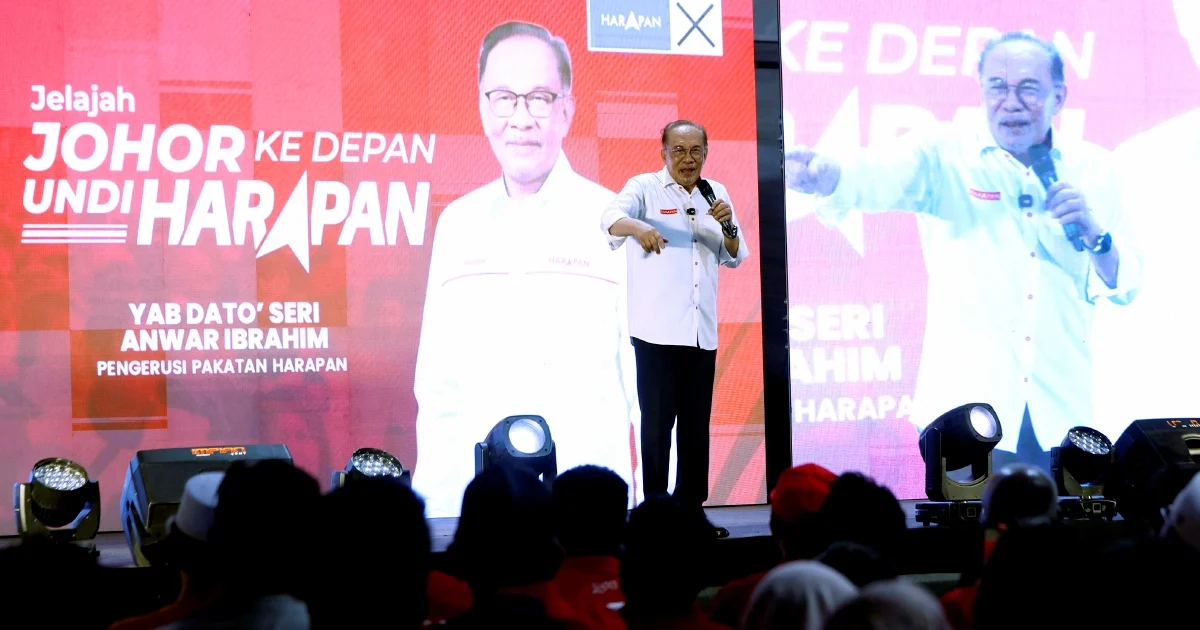
Pakatan Harapan chairman Datuk Seri Anwar Ibrahim has levelled accusations that Barisan Nasional's decision to dissolve the Johor state assembly stemmed from the coalition's desire to restore its once-dominant position in the state's political landscape. Speaking in Tangkak, Anwar characterised the move as a strategic calculation by BN to reassert control in a crucial heartland that had slipped from its grasp in recent years.
The dissolution of the Johor assembly marked a significant political juncture in Malaysia's second-largest state by population. Johor has historically served as a BN stronghold, but the coalition's grip weakened considerably following the 2018 general election, when a wave of anti-establishment sentiment swept across the country. That electoral shock forced a recalibration of Malaysia's political dynamics and opened space for opposition coalitions to contest territory previously considered safe for the ruling alliance.
Anwar's remarks underscore the high stakes surrounding Johor's political future for both major coalitions. For PH, maintaining or expanding its footprint in the state is crucial to demonstrating that its 2020 comeback after losing power in 2018 has genuine staying power beyond federal government control. For BN, Johor represents an essential testing ground and potential launchpad for re-establishing itself as the dominant political force across Malaysia, particularly as it seeks to rehabilitate its image and recover from years of electoral setbacks.
The timing of the assembly dissolution warrants scrutiny beyond the formal procedural explanations offered by state leadership. In Malaysian politics, the decision to call a snap election rarely occurs in a vacuum; such moves typically reflect calculations about optimal political conditions, internal party dynamics, and broader national trends. From BN's perspective, calling the election when conditions appear favourable—whether due to perceived weaknesses in opposition coalitions, shifts in public sentiment, or internal consolidation within its own ranks—represents standard strategic practice.
Johor's electoral significance extends beyond its own jurisdiction. The state commands substantial parliamentary representation and serves as a critical indicator of nationwide political sentiment. Regional divisions between Peninsular Malaysia's developed west coast and the eastern states create distinct political economies and voter preferences. Johor's position as a bridge between these zones makes it particularly influential in shaping perceptions about which coalition possesses genuine national momentum.
The dissolution also reflects tension within Malaysia's coalition politics regarding the durability of agreements forged during the COVID-19 pandemic. After the 2020 general election produced no clear majority, Malaysia witnessed rapid realignments, including defections and the formation of various informal understandings. Some constituencies and state governments have experienced multiple shifts in political control as elected representatives switched allegiances or as coalitions recalibrated their configurations. Whether the Johor assembly dissolution represents a genuine reset of political conditions or merely another manoeuvre within Malaysia's fluid coalition landscape remains contested.
For opposition supporters and PH strategists, the framing of the election as opportunistic rather than inevitable carries important implications. If voters accept the narrative that BN engineered the dissolution primarily for self-interested dominance-seeking rather than to serve the state's developmental interests, it may undermine BN's ability to present itself as a responsible governing coalition. Conversely, BN will likely counter that new elections provide voters with a fresh opportunity to evaluate performance and chart their preferred direction.
The electoral mechanics themselves carry consequence for adjacent states and federal politics. Should BN achieve decisive victory in Johor, it would gain substantial momentum heading into future national contests and potentially influence the calculations of smaller parties and independent lawmakers in parliament. Conversely, if PH sustains or grows its presence, it signals that anti-BN sentiment retains electoral potency and that opposition coalitions remain competitive forces across diverse Malaysian constituencies.
Anwar's comments also reflect the personalised nature of Malaysian politics, where national leaders campaign intensively in state elections to demonstrate their relevance and influence local outcomes. His presence in Tangkak and his willingness to contest BN's strategic rationale illustrate how state elections serve simultaneously as local contests and as barometers of national political health. The messaging around Johor's election reverberates across the federation, influencing how politicians, activists, and ordinary citizens assess which coalition possesses genuine support and credibility.
Historically, Johor's political trajectory has mirrored broader Malaysian trends with a lag of one or two election cycles. During the BN-dominated decades before 2018, Johor delivered overwhelming support to the ruling coalition. The shifting dynamics visible in recent years, including the state's vulnerability to opposition challenges, suggest that even Malaysia's perceived strongholds contain significant pockets of contestation and voter ambivalence. Whether the 2024 election represents a decisive correction back towards BN hegemony or a continuation of the more competitive, uncertain political environment that has characterised Malaysia since 2018 remains to be seen.
Ultimately, the framing of the dissolution matters profoundly. Anwar's insistence that BN pursued cynical self-interest rather than governance improvement represents an attempt to shape voter interpretation of the state election within a broader narrative about democracy, legitimacy, and the purposes of political institutions. How Johor voters respond to these competing narratives will meaningfully influence not only the state's government composition but also the trajectories of national politics across coming months.

