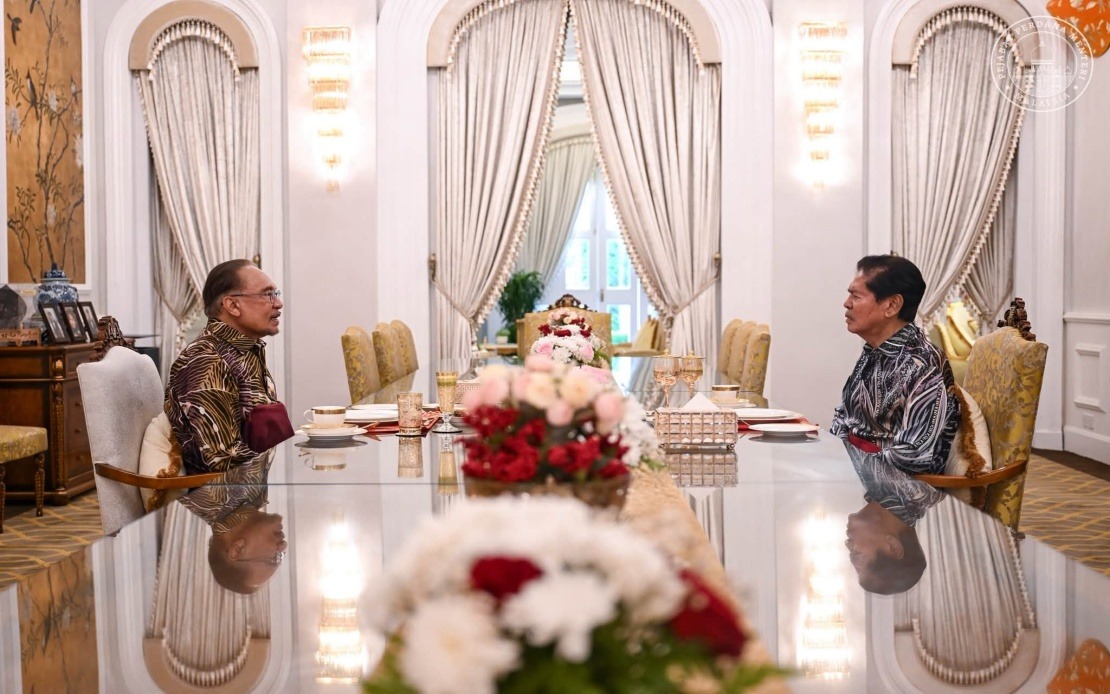
Prime Minister Datuk Seri Anwar Ibrahim brought his two-day working visit to Penang to a close on August 29 with a formal tea reception at Seri Mutiara, the official residence of Yang di-Pertua Negeri Penang Tun Ramli Ngah Talib. The occasion served as a fitting capstone to a busy itinerary that had taken the Prime Minister across multiple engagements throughout the state, underscoring the federal government's continued engagement with Penang on matters of mutual significance.
Reflecting on the reception in a social media update, Anwar described the gathering as further cementing the collaborative relationship between Kuala Lumpur and Penang's state administration. He emphasised that both levels of government remain aligned in their vision for advancing the island state's economic and social development while prioritising the wellbeing of its residents. Such affirmations of federal-state harmony carry particular weight in Malaysia's federal system, where coordination between central and regional authorities often determines the effectiveness of major development programmes.
Tun Ramli, for his part, expressed satisfaction at hosting the nation's chief executive at his residence. The Governor characterised the visit as a valuable platform for substantive dialogue on pressing matters affecting Penang as well as broader national concerns. His emphasis on "exchange of views" suggests that the discussions extended beyond ceremonial courtesies to substantive policy considerations, reflecting the depth of engagement expected at such high-level encounters.
A charming detail emerged from the Governor's own account of the reception: his grandson, Aldrey Alfi, was present during the gathering and engaged the Prime Minister with questions, which Anwar received with warmth and patience. This humanising moment, shared publicly by Tun Ramli, illustrates how formal state functions often contain informal dimensions that contribute to relationship-building between leaders. The Governor's gratitude for Anwar's accessibility and friendly demeanour hints at the personal dimensions of executive-level cooperation.
Anwar's forty-eight-hour programme in Penang had been notably substantive and wide-ranging. Beyond the closing reception, his schedule encompassed participation in the Permatang Pauh Entrepreneur Revival Programme, reflecting the federal government's focus on small and medium enterprise development in key constituencies. The programme appears designed to address economic resilience and job creation in a pivotal Penang parliamentary seat with a history of significant electoral contests.
The Prime Minister's attendance at the 15th Malaysia Scout Jamboree represented engagement with youth development and national character-building initiatives. The Scout movement, with its long pedigree in Malaysia and deep institutional roots, serves as a platform through which government leaders can communicate priorities to younger generations while endorsing the values of discipline, civic responsibility, and community service that the organisation instils. Such appearances carry symbolic weight beyond the immediate event.
Anwar's participation in the MADANI Sahabat 2026 National Day Countdown Programme linked his visit to the government's broader messaging around the MADANI framework, which has become central to the administration's policy narrative. The National Day countdown activities, even at this early stage, signal the government's intention to frame 2026 as a significant milestone year. Penang, as one of Malaysia's most economically important and electorally significant states, represents a natural venue for launching such initiatives.
The concentration of these engagements within a single two-day visit reflects a strategic approach to state visits by the Prime Minister's office. Rather than treating visits as ceremonial occasions, this model maximises the policy outreach and public engagement potential of each trip. Penang's significance—as both an economic powerhouse and a politically competitive state—warrants this level of attention from the federal leadership.
The tea reception at Seri Mutiara thus functioned as more than a courteous farewell. It represented an opportunity for the Prime Minister to exchange reflections on his engagements during the visit with the chief state administrator, potentially allowing Tun Ramli to flag issues requiring federal attention or to reinforce state priorities for national consideration. Such moments of direct interface between the head of government and state leadership, when used effectively, can smooth implementation of joint initiatives and clarify policy directions.
For Malaysia's broader political landscape, Anwar's focused engagement with Penang underscores the importance this administration places on the state as a barometer of national development progress and political stability. Penang's success in inclusive growth, business competitiveness, and social cohesion remains relevant beyond its own borders, offering lessons applicable to other regions. The Prime Minister's visible commitment to maintaining strong federal-state relations, particularly through formal mechanisms that include the Yang di-Pertua Negeri, reinforces constitutional frameworks and institutional cooperation.
Looking ahead, the visit pattern suggests that Anwar's office is implementing a deliberate schedule of state engagements designed to communicate government priorities while gathering insights into regional concerns. For Penang specifically, the focus on entrepreneurship revival, youth development, and the MADANI agenda indicates where federal resources and policy attention are being directed. These initiatives will likely influence state-level planning and resource allocation in coming months.

