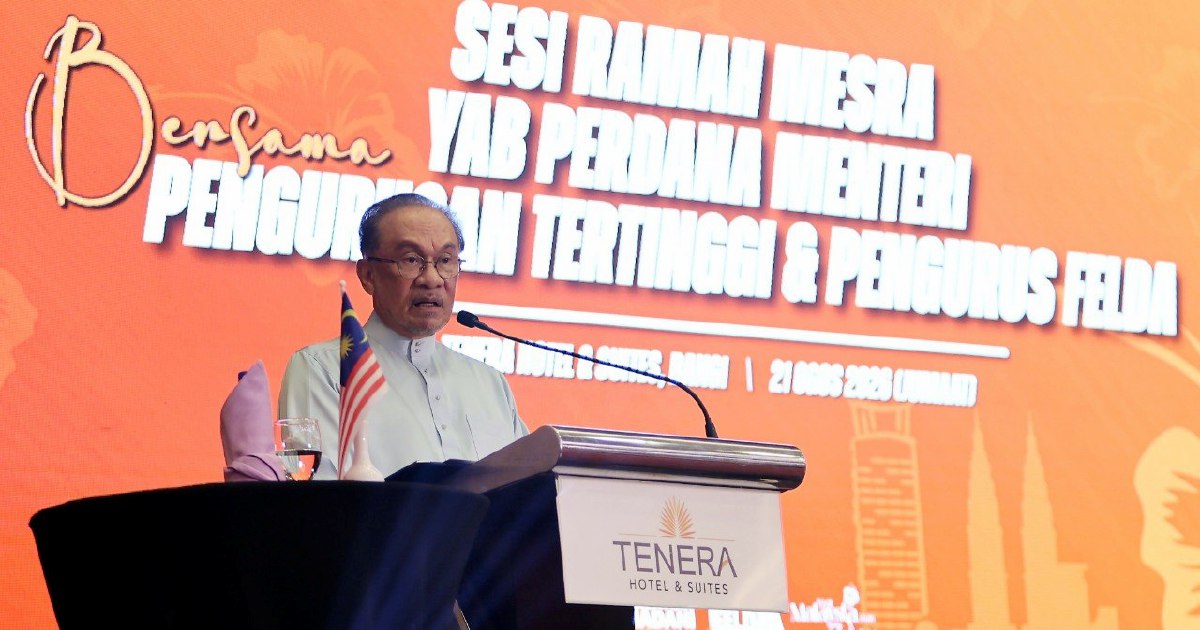
Prime Minister Datuk Seri Anwar Ibrahim confirmed today that a specially constituted task force tasked with examining issues at the Federal Land Development Authority has officially commenced operations. Speaking in Bangi, Anwar indicated that the investigation into Felda matters would proceed systematically, with comprehensive findings to be released once the inquiry reaches its conclusion.
Felda, a longstanding institution in Malaysia's agricultural development landscape, has faced scrutiny over various operational and governance concerns in recent times. The establishment of this dedicated task force represents a formal governmental commitment to examining these matters with rigour and transparency. The move signals the administration's intent to address accumulated issues affecting one of the nation's most significant land settlement schemes, which touches the lives of hundreds of thousands of smallholder farmers across the country.
The timing of this investigation carries particular significance within Malaysia's broader governance reform agenda. Since returning to office in late 2022, the Anwar administration has prioritised institutional accountability and investigative oversight across multiple government agencies. The Felda task force fits within this pattern of enhanced scrutiny, reflecting the government's stated commitment to tackling systemic inefficiencies that may have accumulated over years of operation.
Felda operates as the principal vehicle for rural development in Malaysia, managing vast tracts of agricultural land and overseeing the welfare of settler families who depend on the authority's management for their livelihoods. Issues under investigation likely encompass financial management, land administration practices, settler benefit distribution, and organisational efficiency—matters that directly impact the economic stability of rural communities across peninsular Malaysia.
The announcement provides little detail regarding the task force's specific mandate or the timeline for completing its work. However, Anwar's public acknowledgment suggests the government views these investigations as sufficiently important to warrant executive attention. For settler communities and agricultural stakeholders, the task force represents an opportunity to surface longstanding grievances that may not have received adequate attention under previous administrations.
Malaysia's development authorities have historically operated with considerable autonomy, and ensuring institutional accountability remains an ongoing challenge across the civil service. The Felda task force exemplifies the executive branch's effort to bring greater oversight to bodies managing substantial public assets and affecting vulnerable populations. The investigation may encompass both contemporary operational matters and historical decisions that shaped the organisation's current trajectory.
In the Southeast Asian context, land settlement schemes similar to Felda have faced comparable challenges regarding sustainability, settler welfare, and financial viability. Malaysia's experience with Felda—both its successes in rural transformation and its contemporary difficulties—carries lessons relevant to agricultural development policies across the region. A thorough investigation and subsequent reforms could provide insights for policymakers elsewhere grappling with similar land development challenges.
Stakeholders including settler representatives, agricultural industry observers, and parliamentary watchdog committees will likely anticipate the task force's findings with considerable interest. The investigation's scope and depth may determine whether reforms prove merely cosmetic or constitute meaningful restructuring of the authority's governance and operational frameworks. Transparency in the investigative process and genuine engagement with affected communities will be crucial for generating public confidence in whatever recommendations emerge.
The Felda task force announcement occurs within the broader context of Malaysian agricultural policy, where modernisation, sustainability, and farmer welfare increasingly compete for limited resources and institutional attention. Addressing challenges within Felda could free resources and administrative capacity for advancing Malaysia's agricultural competitiveness in an era of climate change and global commodity market volatility. Settler communities dependent on Felda structures may view this investigation as a critical juncture determining the authority's future direction and their own economic prospects.
For investors and development agencies monitoring Malaysia's institutional reform trajectory, the task force represents visible government engagement with longstanding structural issues. The quality of investigations and subsequent policy responses may influence broader confidence in the administration's capacity to pursue meaningful reform across the public sector. Malaysian stakeholders and international observers will assess not merely whether investigations occur, but whether their findings translate into substantive institutional change.
Anwar's statement, though brief, underscores the government's acknowledgment that Felda requires executive-level attention. The investigation itself marks recognition that issues have accumulated sufficiently to warrant formal investigation rather than routine administrative management. As the task force pursues its work, the government faces the subsequent challenge of implementing findings in ways that restore confidence in an authority whose performance bears directly on rural prosperity and social stability across significant portions of peninsular Malaysia.

