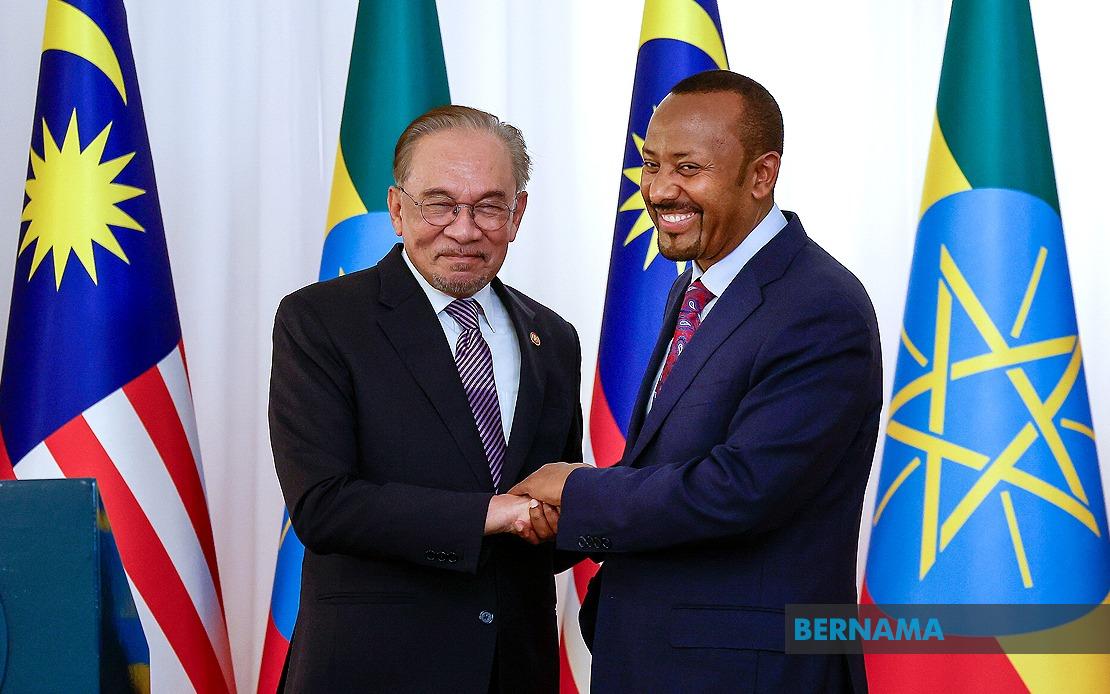
Prime Minister Datuk Seri Anwar Ibrahim has conveyed his felicitations to Ethiopian Prime Minister Abiy Ahmed Ali and the Prosperity Party following their triumph in Ethiopia's recent general election. Through a statement posted on social media, Anwar expressed warm acknowledgement of the electoral outcome and reaffirmed the deepening bilateral relationship between Malaysia and Ethiopia.
The Malaysian leader's message carries particular significance given the trajectory of Malaysia-Ethiopia relations over the past year. Anwar's visit to Addis Ababa in 2023 marked a watershed moment in this engagement, constituting the first official trip by a sitting Malaysian prime minister to the East African nation. That journey underscored Malaysia's pivot towards forging substantive ties with African partners and demonstrated Anwar's commitment to expanding Malaysia's diplomatic footprint beyond traditional regional boundaries.
In his congratulatory remarks, Anwar reflected positively on his previous interactions with Prime Minister Abiy, characterising their exchanges as reflecting a shared worldview and similar strategic perspectives. The Malaysian leader emphasised that both nations view international relations through a comparable lens, suggesting alignment on issues of mutual concern to the Global South. This alignment appears rooted in a recognition that emerging economies and developing nations possess considerable capacity to advance their interests through collaborative mechanisms.
Anwar's framing of Malaysia-Ethiopia cooperation within the context of Global South solidarity carries broader geopolitical implications. The statement underscores Malaysia's positioning within coalitions of non-aligned nations seeking to amplify their voice in international affairs. Ethiopia's prominence as the host of the African Union and its regional influence as a major East African power make it a strategically valuable partner for Malaysia's African engagement agenda. By highlighting the potential for cooperation among Global South nations as equals, Anwar signals Malaysia's vision of a multipolar world order that reduces dependency on traditional Western-led frameworks.
The timing of this diplomatic gesture comes as Ethiopia continues its post-conflict reconstruction following years of internal instability. The Prosperity Party, led by Abiy, has positioned itself as the architect of national renewal and reform. Malaysia's swift recognition of the electoral outcome and reaffirmation of partnership demonstrates Anwar's administration's confidence in Ethiopia's political trajectory and willingness to deepen engagement regardless of Ethiopia's complex domestic circumstances.
Malaysia's approach to Ethiopia reflects a broader strategic calculus regarding African engagement. As a Muslim-majority nation with significant economic interests globally, Malaysia has long recognised Africa as an emerging market and a crucial partner in advancing shared developmental objectives. Ethiopia, as the pan-African institutional centre and a nation of over 120 million people with considerable agricultural and manufacturing potential, represents an important node in Malaysia's continental strategy.
The foundation laid during Anwar's 2023 visit has created momentum for bilateral cooperation across multiple domains. The Prime Minister's reference to initiatives set in motion during that previous engagement suggests concrete projects or agreements may be underway in areas such as trade, investment, education, or diplomatic coordination. The explicit commitment to building upon this foundation indicates that Malaysia views the relationship as requiring sustained attention and development.
Anwar's congratulatory message also reflects Malaysia's pragmatic diplomacy in acknowledging electoral outcomes in other nations. By promptly recognising the Prosperity Party's victory and extending congratulations to Abiy, Malaysia positions itself as a supporter of Ethiopia's democratic processes and inclusive governance. This approach aligns with Malaysia's broader diplomatic positioning as a nation committed to respecting sovereignty and supporting constructive engagement across borders.
The emphasis on shared perspectives among Global South nations carries particular resonance given current international tensions and the reassertion of great power competition. Anwar's messaging suggests Malaysia seeks to build coalitions of like-minded developing nations that can articulate common interests in addressing challenges ranging from economic development to climate change to reforming international institutions. Ethiopia's strategic location and continental influence make it a valuable participant in such coalitions.
Looking forward, the continuation of Malaysia-Ethiopia relations under Abiy's government suggests both nations are committed to translating diplomatic goodwill into tangible cooperation. The areas where potential collaboration could expand include trade and economic partnerships, technical cooperation in sectors where Malaysia possesses expertise, cultural and educational exchanges, and coordination on multilateral platforms. Malaysia's experience as a middle-income developing economy navigating global economic currents may offer valuable lessons for Ethiopia as it seeks to accelerate its own development trajectory.
The broader context of Malaysian foreign policy under Anwar's leadership reveals an administration keen on diversifying partnerships and reducing concentration of engagement in any single region. Africa represents an underutilised frontier for Malaysian diplomacy, and Ethiopia's unique status as a continental hub makes it an optimal entry point for deeper African engagement. The congratulatory message thus signals not merely courtesy but strategic intent.

