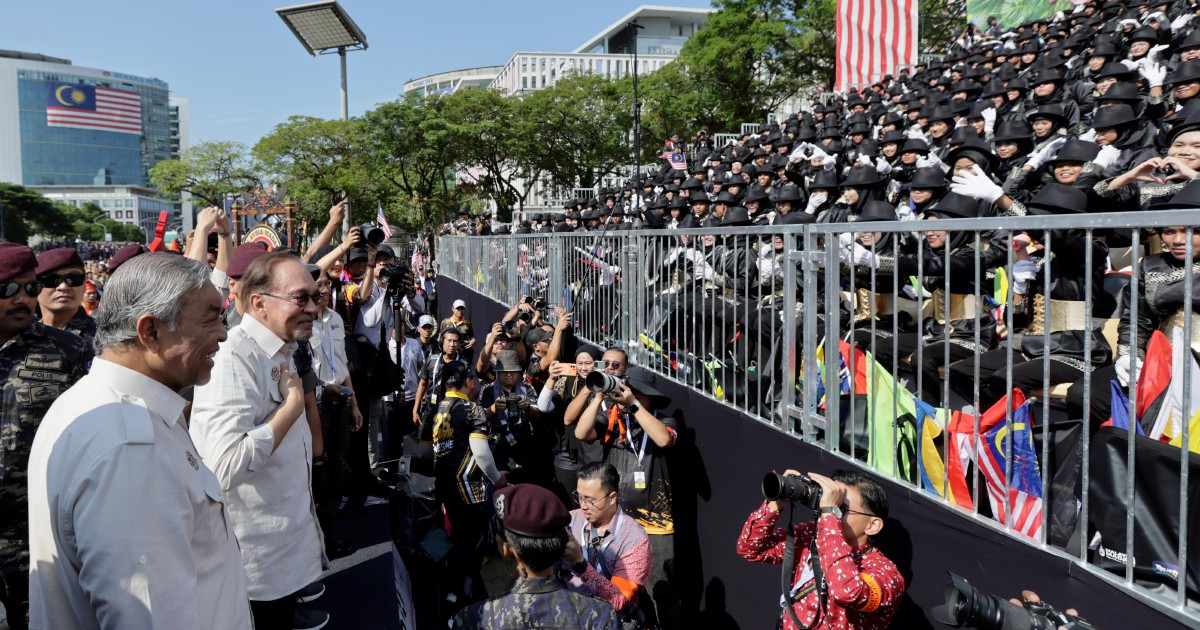
Prime Minister Datuk Seri Anwar Ibrahim seized the opportunity to build personal connections with ordinary Malaysians on National Day, moving among crowds at Dataran Putrajaya with evident enthusiasm following the formal parade proceedings. The walkabout demonstrated a more informal side to high-level governance, with the Premier stopping repeatedly to acknowledge well-wishers and engage directly with families who had gathered for the celebrations.
The interactions at Dataran Putrajaya reflected a calculated approach to public engagement that increasingly characterises Anwar's tenure. Rather than departing immediately after ceremonial duties concluded, the Prime Minister chose to linger in the public space, creating impromptu moments of connection that resonated beyond the immediate crowd. Such gestures carry political significance in Malaysia's evolving democratic landscape, where direct leader-to-citizen contact remains valued by voters across socioeconomic lines.
Children featured prominently in these exchanges, with Anwar taking time to embrace several youngsters and engage them in brief conversations. These moments, capturing the human dimension of leadership, have become increasingly central to how contemporary political figures cultivate public perception. For a nation where family values and community bonds remain culturally significant, such displays of warmth from top leadership carry particular resonance with voters who appreciate visible demonstrations of accessibility and approachability from their elected representatives.
The National Day celebration at Putrajaya provided an ideal platform for this public engagement, as the festivities naturally drew diverse crowds including families, students, and community groups. The formal parade concluded, Anwar transitioned seamlessly into the role of public ambassador, using the relaxed atmosphere that typically follows ceremonial events to interact authentically with attendees. This fluidity between official function and public engagement represents an evolution in how contemporary Malaysian political leaders navigate their public personas.
Such interactions serve multiple functions within Malaysia's political ecosystem. They provide genuine opportunities for constituents to encounter their leaders in accessible settings, whilst simultaneously generating positive media coverage that reinforces narratives of responsive governance. For a Prime Minister navigating complex domestic challenges and regional positioning, moments of public warmth offer visual counternarrative to policy debates and parliamentary discourse that dominate news cycles.
The embrace of children particularly carries symbolic weight in Malaysian political culture, where such imagery invokes themes of national continuity, generational investment, and benevolent stewardship. These encounters, whether spontaneous or subtly orchestrated, communicate messages about leadership qualities that transcend specific policy platforms. They suggest attentiveness to citizens' lived experiences and a willingness to engage beyond the formal trappings of high office.
For Malaysian media observers, the significance of this engagement extends beyond immediate optics. Such moments reflect broader questions about how elected leadership maintains public legitimacy in an era where direct communication channels have proliferated yet paradoxically traditional forms of face-to-face engagement retain distinctive power. The walkabout at Dataran Putrajaya represents deliberate cultivation of accessibility, distinguishing Anwar's approach from predecessors whose public appearances more rigidly adhered to protocol-driven structures.
National Day celebrations provide cyclical opportunities for political leaders to reinforce narratives of national unity and shared purpose. By extending his engagement beyond the parade proper, Anwar signalled receptiveness to the broader community gathering, suggesting that leadership encompasses both ceremonial responsibility and genuine connection with citizens. This positioning proves particularly relevant for a Prime Minister inheriting complex political landscape characterised by competing interests and evolving public expectations.
The children and families who encountered Anwar at Dataran Putrajaya likely carried away memorable impressions, with such personal moments often proving more impactful than scripted addresses in shaping how ordinary citizens perceive their leaders. These encounters create individual stories that circulate through family networks and social circles, constructing grassroots narratives about leadership character that supplement formal communication strategies. The authenticity or perceived authenticity of such interactions significantly influences public sentiment and political capital.
Regionally, Malaysia's National Day observances attract international attention, with such celebrations serving as platforms for demonstrating national cohesion and effective governance to both domestic and external audiences. Anwar's visible engagement with citizens at Dataran Putrajaya contributes to broader messaging about Malaysia's stability and the accessibility of its democratic institutions. For Southeast Asian observers, Malaysia's National Day celebrations offer insights into how the region's major democracy balances ceremonial tradition with contemporary political engagement strategies.
The embrace of informal public engagement by Malaysia's Prime Minister reflects evolving expectations of political leadership in the digital age, where perceived authenticity carries premium value. Whilst formal duties remain essential, citizens increasingly expect their leaders to demonstrate human dimensions through accessible, unscripted interactions. Anwar's walkabout at Dataran Putrajaya exemplifies this contemporary approach, merging ceremonial obligation with genuine public connection in ways that resonate with modern expectations of democratic leadership.

