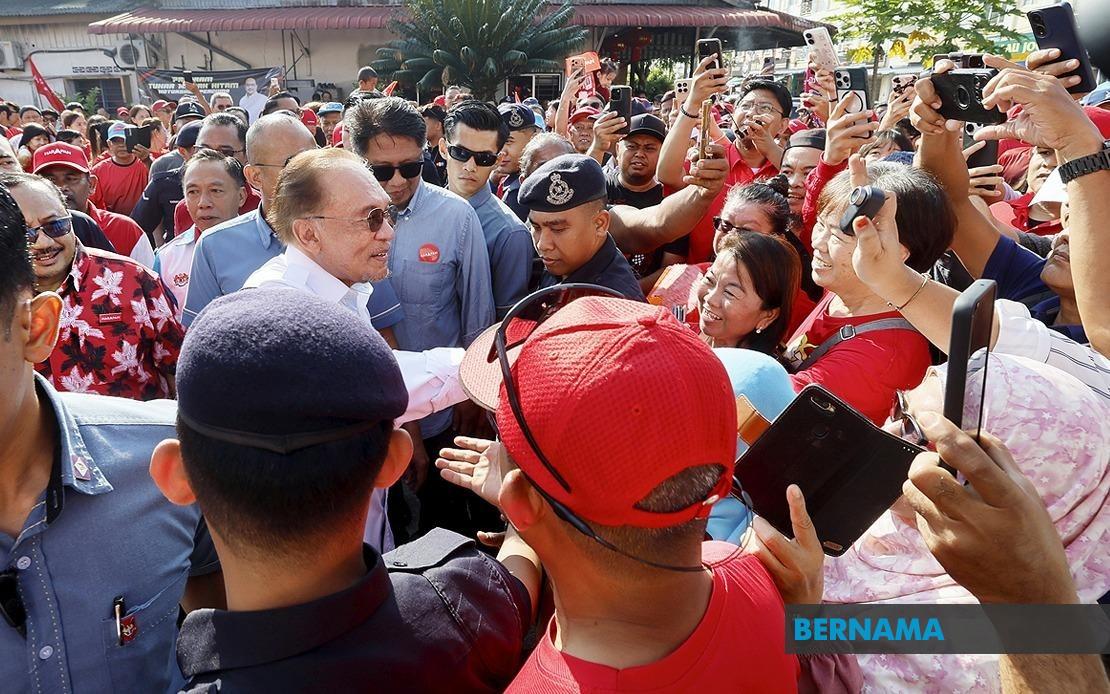
Prime Minister Datuk Seri Anwar Ibrahim has moved to counter perceptions of political bias in federal funding and development, declaring that his government distributes resources and implements projects equitably across all Malaysian states irrespective of their political complexion. Speaking at a campaign event in Batu Pahat during the Johor state election cycle, Anwar emphasised that his administration's record demonstrates a commitment to serving all communities and addressing welfare concerns without discrimination based on party allegiance.
The assertion comes amid an ongoing political landscape in Malaysia where opposition-ruled states have historically raised concerns about resource allocation and federal support. By highlighting specific development initiatives spanning multiple states with different political administrations, Anwar appeared to directly address questions about whether the federal government might privilege states governed by his Pakatan Harapan coalition. The timing of his remarks, made during campaigning for the 16th Johor state election, suggests an awareness of voter concerns about governance and fairness across the federation.
Anwar pointed to concrete examples to substantiate his claims, particularly referencing the Johor-Singapore Special Economic Zone (JS-SEZ) as a flagship project demonstrating federal commitment to development in Johor. This economic corridor represents a significant bilateral initiative aimed at enhancing regional competitiveness and creating economic opportunities along the southern coast. Beyond this, the Prime Minister highlighted substantial federal allocations for flood mitigation infrastructure in Segamat and Muar, two areas that have experienced severe flooding in recent years and where residents have demanded improved water management systems.
The selection of these projects reveals a strategic approach to governance messaging. Flood management is a visceral issue for Johor residents who have endured devastating inundation events, making visible investment in mitigation work both practically important and politically salient. By anchoring his defence with infrastructure that directly impacts daily life and safety, Anwar attempted to shift the conversation from abstract questions about political fairness to tangible government action that benefits citizens regardless of electoral outcomes.
Beyond Johor, Anwar referenced development initiatives in Kelantan and Kedah, both states where political opposition parties hold significant power or have held recent governing authority. This geographic breadth in his examples served to underscore his claim that federal resource allocation transcends partisan boundaries. The inclusion of these states, which are not governed by Pakatan Harapan, functioned as evidence that his administration does not restrict developmental support to coalition-controlled territories.
The framing of the government's development approach also emphasised the distinction between sustained policy implementation and transactional electoral promises. Anwar criticised the practise of making development pledges exclusively during election campaigns, implying that his government operates differently by maintaining consistent investment and project execution across the political cycle. This rhetorical positioning attempts to elevate his administration above what he characterised as opportunistic campaign-season gesturing, asserting instead a principled commitment to development that precedes and outlasts electoral contests.
Pakatan Harapan's communications apparatus supported this message through the presence of Communications Minister Datuk Fahmi Fadzil at the Senggarang event, where coalition candidates for three state constituencies were unveiled. The coordination of messaging across party leadership and campaign activities suggests this fairness narrative represents a deliberate strategic communication effort rather than ad-hoc comments. For a coalition that regained federal power in 2022 after a period in opposition, reestablishing credibility around equitable governance carries particular weight.
For Malaysian voters, particularly those in contested states, the question of whether federal administrations treat states fairly regardless of political control remains consequential. States governed by opposition parties have occasionally reported difficulties securing federal funding or experiencing delays in project approvals, though these allegations are contested. Anwar's proactive address of this concern signals recognition that public confidence in institutional fairness is essential to democratic legitimacy and that perceptions of partisan governance can undermine support for federal initiatives even when material conditions improve.
The broader implications of this messaging extend beyond immediate electoral considerations in Johor. As Malaysia navigates a period of coalition politics where several states maintain different governing parties from the federal administration, establishing norms of equitable resource distribution becomes increasingly important for institutional stability. A federal government perceived as punishing or neglecting opposition-ruled states risks creating cycles of mistrust and potentially motivating voters in those territories to resist federal authority.
Anwar's emphasis on development across multiple states also reflects practical economic logic. Large-scale infrastructure projects like the JS-SEZ require cooperation and coordination across state boundaries, making partisan discrimination counterproductive even from a narrow self-interested perspective. Federal flood management programmes similarly demand cross-state cooperation and shared resource allocation, particularly in river basins that span multiple constituencies and states with different political alignments.
The campaign event in Senggarang served as a platform for these governance claims while simultaneously advancing Pakatan Harapan's electoral interests in Johor, creating a dual-purpose occasion. Candidates contesting the Senggarang, Semerah, and Penggaram seats were presented alongside this messaging about federal fairness, attempting to link local electoral choices to the broader narrative of responsible, non-partisan governance that the Prime Minister was articulating.
Moving forward, the credibility of Anwar's assertions about impartial state treatment will likely depend on continued visible investment in opposition-governed territories and transparent mechanisms for federal funding allocation that can be independently verified by civil society observers. In an era of intense political polarisation and declining institutional trust across Southeast Asia, Malaysian governments at all levels face heightened scrutiny regarding procedural fairness and equitable resource distribution, making such declarations both necessary and subject to rigorous public assessment.

