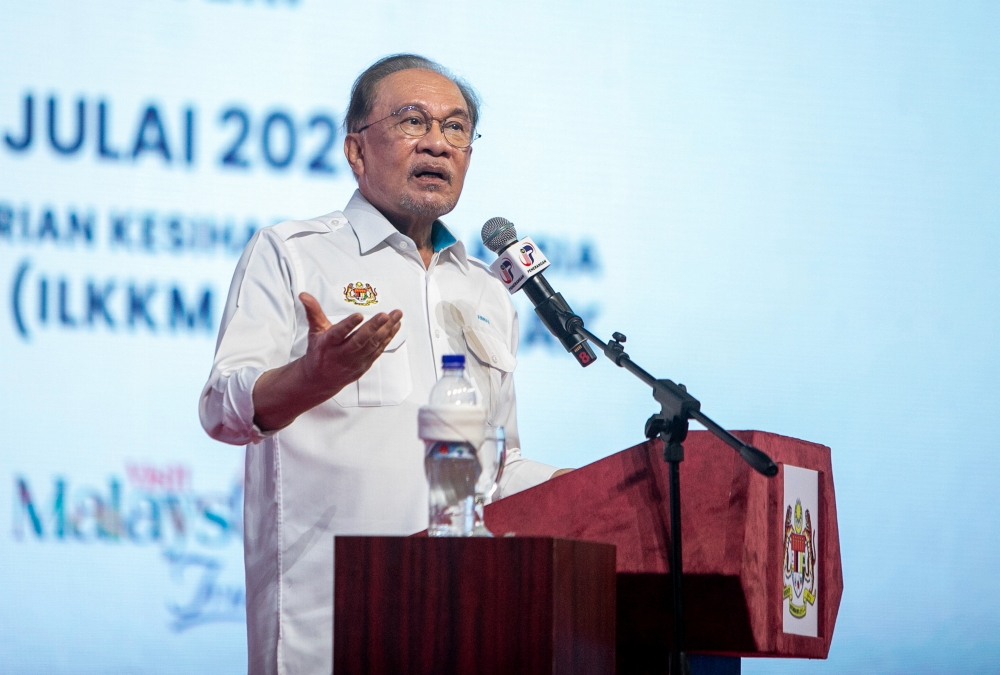
Prime Minister Datuk Seri Anwar Ibrahim has mounted a vigorous defence of the government's approach to fuel pricing, framing the decision to maintain subsidies as a pragmatic balancing act between immediate household relief and long-term fiscal stability. Speaking in Kajang, Anwar articulated a central tension that has bedevilled Malaysian policymakers for decades: how to shield consumers from volatile global energy markets without allowing state finances to spiral into unsustainability.
The Premier's remarks come as Malaysia navigates a complex economic landscape where energy costs reverberate through every sector, from transportation to manufacturing to agriculture. Unlike some neighbouring economies that have pursued more aggressive subsidy reductions or targeted support mechanisms, Malaysia's government has opted to maintain broader fuel price controls. This choice reflects both political considerations and genuine concerns about the purchasing power of lower-income households who spend a disproportionate share of their earnings on fuel and transport.
Anwar's central argument addresses a question that often remains implicit in policy debates: who ultimately bears the cost of subsidies? By framing the issue this way, the Prime Minister pushes back against arguments that subsidy maintenance represents simple fiscal irresponsibility. Rather, he suggests that abrupt removal would transfer immediate hardship to citizens while creating longer-term complications through inflation cascades and reduced economic productivity. The positioning implicitly acknowledges that the real choice is not between spending money and not spending money, but between different temporal distributions of costs and different groups bearing those costs.
The government's cautionary stance on debt accumulation reflects Malaysia's particular vulnerability to external shocks. Unlike some larger economies with more diversified revenue streams and deeper capital markets, Malaysia remains sensitive to fluctuations in crude oil prices, palm oil exports, and foreign investor sentiment. Taking on substantially more debt to fund fuel subsidies could compromise the country's fiscal space for other critical investments in education, healthcare, and infrastructure modernisation. This constraint means policy choices carry magnified consequences.
The fuel subsidy debate also intersects with regional economic dynamics. Thailand, Indonesia, and Vietnam have each pursued different strategies regarding energy pricing, creating natural experiments in policy outcomes. Malaysia's government has observed these approaches and their consequences, informing the decision to chart a middle course rather than embrace the full liberalisation some economists advocate or the unconstrained subsidisation that some populist movements demand.
From a structural perspective, Anwar's intervention suggests growing internal government debate about fiscal priorities. The tension between maintaining social protection through subsidies and preserving fiscal headroom for strategic investments reflects competing legitimate concerns within any administration. By publicly addressing the question of sustainability, the Prime Minister signals that the government takes seriously the risk of debt accumulation while defending the current framework as workable.
The Malaysia-specific context matters considerably here. The country emerged from the pandemic with elevated debt levels relative to pre-COVID baselines. International investors closely monitor Malaysia's fiscal indicators, including debt-to-GDP ratios and government spending trajectories. Maintaining investor confidence while protecting household living standards requires sophisticated calibration. This reality constrains how far any government can push either in the direction of austerity or expansionary spending without triggering market reactions that could ultimately harm the same households it seeks to protect.
Anwar's framing also addresses a political economy question that affects governance throughout Southeast Asia: how long current policy paths remain defensible as circumstances evolve. Global energy transitions, potential changes in oil markets, demographic shifts, and long-term fiscal sustainability all create pressure points that will eventually force Malaysia to revisit these questions. By establishing the intellectual framework now—that subsidies exist within broader sustainability constraints rather than as unlimited entitlements—the government may be laying groundwork for future adjustments that avoid the shock-and-outrage pattern of sudden policy reversals.
The renewable energy transition adds another dimension to this debate. Malaysia has set ambitious targets for solar and other renewable capacity, investments that require sustained fiscal commitment. If fuel subsidies consume increasing budget allocations, they necessarily crowd out spending on energy infrastructure that could reduce long-term fuel import dependence and vulnerability. This trade-off between present consumption support and future energy security represents a genuine policy dilemma without easy solutions.
For ordinary Malaysians, the implications are concrete: petrol pump prices reflect government calculation about which costs to absorb. For policymakers across the region watching Malaysia's approach, the question centres on whether this equilibrium proves durable or whether circumstances will eventually force the reckoning that Anwar's warnings implicitly acknowledge may arrive eventually. The government's current stance essentially bets that gradual economic growth will ease these pressures before they become acute, while maintaining present support for those most vulnerable to energy price volatility.
Looking forward, Malaysia's fuel policy will likely remain a lightning rod for domestic political debate and subject to ongoing recalibration. Anwar's defence establishes parameters for that conversation: subsidies are not free, their costs are real, and sustainability concerns are legitimate even if the current framework is defensible. This sets a different tone from either blanket subsidy advocacy or dismissal, suggesting a government wrestling seriously with genuine trade-offs rather than avoiding difficult questions.

