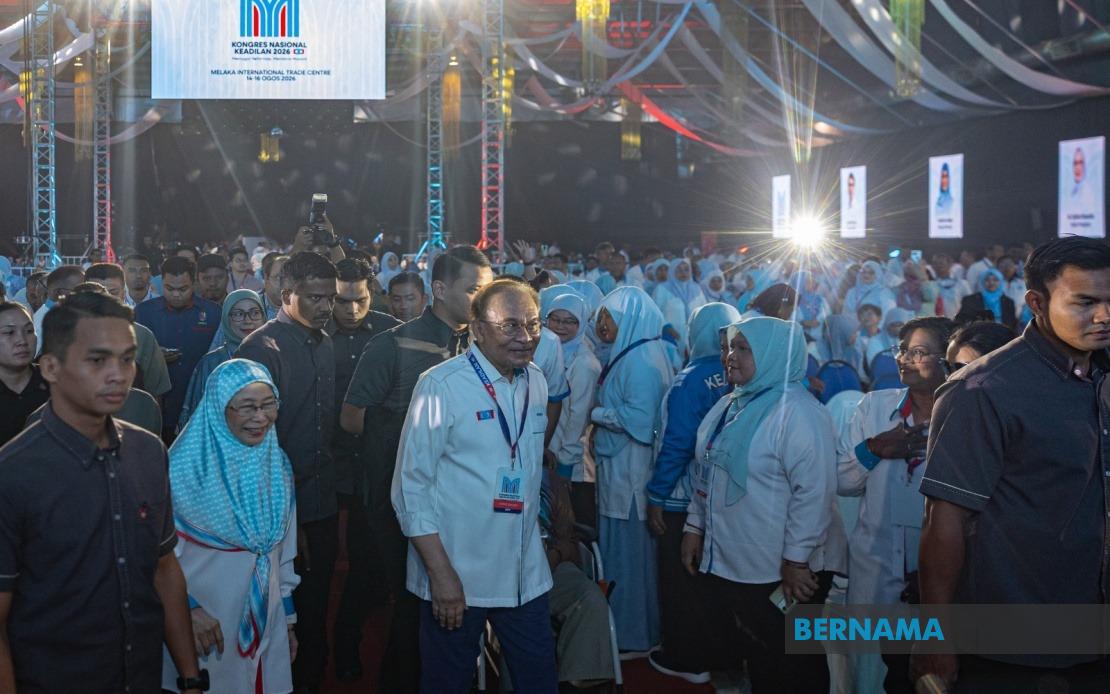
Prime Minister Datuk Seri Anwar Ibrahim has made an unequivocal statement prioritising political continuity, declaring that the Unity Government will persist in its partnership with UMNO-Barisan Nasional at the Federal level in pursuit of sustained economic development and stability. Speaking at the PKR National Congress 2026 in Melaka on August 16, Anwar sought to quell uncertainty surrounding the coalition's future by anchoring his position firmly in pragmatism rather than ideology or factional considerations.
The timing of Anwar's remarks carries particular significance. Recent developments had prompted speculation within political circles about potential fractures in the Unity Government arrangement that has underpinned Malaysia's governance structure since 2022. By publicly recommitting to the UMNO-BN partnership, Anwar has signalled that despite any internal tensions or disagreements that may have surfaced, the coalition framework remains the foundation upon which his administration intends to operate.
In his capacity as both Prime Minister and Parti Keadilan Rakyat president, Anwar articulated a vision of governance divorced from ego-driven calculations. He explicitly cautioned against allowing personal ambitions, institutional rivalry, or emotional reactions to dictate political direction, emphasising instead that decisions affecting the nation's trajectory must be rooted in tangible benefits for ordinary Malaysians. This framing represents a deliberate repositioning of the debate away from questions of political mechanics and towards outcomes-based governance.
The emphasis on stability carries particular resonance for Malaysia's business community and international investors, who have consistently cited political predictability as essential for economic confidence. The region has witnessed considerable volatility in coalition politics across Southeast Asia in recent years, with governments rising and falling based on shifting allegiances. Anwar's public commitment to continuity therefore serves to reassure both domestic and foreign stakeholders that the regulatory environment and policy trajectory will remain consistent, at least in the medium term.
Anwar's rhetorical framing around prosperity through economic growth suggests a deliberate prioritisation of delivery over procedural concerns. The Unity Government has pursued various infrastructure projects, business-friendly policies, and investment initiatives since its formation. By tethering the UMNO-BN partnership to economic performance, Anwar has effectively created a metric by which the arrangement's viability can be measured. Should economic growth falter significantly, this positioning could become problematic; conversely, sustained growth would vindicate the coalition's continuation.
The statement also reflects internal dynamics within PKR, where some elements may harbour reservations about alignment with UMNO, traditionally viewed as the institutional opponent during decades of Pakatan Harapan opposition. By making an explicit pronouncement at his party's national congress, Anwar has attempted to establish party-wide consensus around the coalition strategy, limiting room for dissenting voices to gain organisational traction. This represents a significant consolidation of leadership authority within PKR.
For UMNO-BN, the remarks offer reassurance at a moment when the coalition has navigated considerable internal restructuring and electoral challenges. The public reaffirmation of Federal-level partnership provides cover for UMNO's continued association with PKR and other Unity Government components, countering narrative that might suggest the traditional power broker was being marginalised. The statement thus serves bilateral interests in maintaining the arrangement's legitimacy across both blocs.
The broader Southeast Asian context renders Malaysia's coalition stability noteworthy. Thailand has experienced multiple constitutional disruptions, Myanmar remains under military rule, and several other regional democracies have faced frequent government transitions. Malaysia's ability to maintain a working multi-party government, despite ideological differences, offers a contrasting model of institutional durability. Anwar's commitment to continuity contributes to reinforcing this comparative advantage.
Looking forward, the sustainability of this arrangement will likely depend on several factors: the trajectory of economic growth, whether UMNO and PKR can manage competition at state level without destabilising Federal arrangements, and whether either coalition member faces internal schisms that render partnership untenable. Anwar's framing around national interest rather than narrow partisan advantage provides some rhetorical insulation against these pressures, but such declarations are only as durable as the material conditions that support them.
The Prime Minister's remarks also implicitly acknowledge that political cooperation requires deliberate affirmation in Malaysia's multiparty environment. Unlike single-party dominant systems where continuity is assumed, coalition governments must periodically reassert their commitment to partnership. Anwar's statement at the PKR congress functions as such a reaffirmation, signalling both to party members and the broader political establishment that pragmatism will govern rather than adversarialism.

