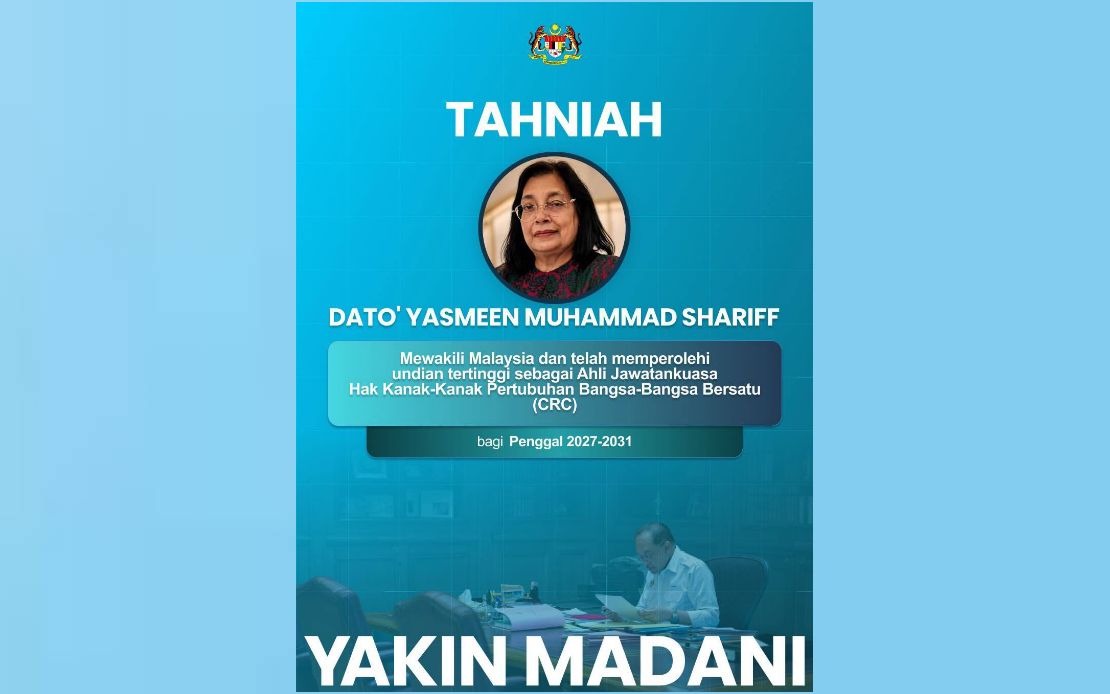
Prime Minister Datuk Seri Anwar Ibrahim has publicly commended Datuk Yasmeen Muhamad Shariff for securing a seat on the United Nations Committee on the Rights of the Child, with her selection covering the 2027-2031 term. The announcement, made through a Facebook post on June 25, positioned the election as a significant diplomatic victory for Malaysia at the global level. Anwar framed the accomplishment as evidence of the international community's trust in Malaysia's dedication to advancing child welfare policies and human rights advocacy across borders.
Yasmeen achieved her election during the 21st Meeting of States Parties to the Convention on the Rights of the Child, held at UN headquarters in New York on Tuesday. She garnered 136 votes from the 189 States Parties present and casting ballots, demonstrating substantial international backing. The Ministry of Women, Family and Community Development announced the result, emphasizing the significance of the outcome for Malaysia's international standing. This electoral success underscores the reputation Malaysia has built in child protection advocacy, a sector increasingly vital to global development and humanitarian agendas.
What makes Yasmeen's election particularly noteworthy is that this represents her second stint on the influential committee. She previously served as a member during the 2013-2017 term, which speaks to her recognized expertise and the respect she commands among UN member states. The fact that she was reelected after a decade away suggests that her previous contributions were substantive enough to warrant another mandate. Her reselection also indicates consistency in Malaysia's approach to child rights issues, with the country maintaining continuity through experienced personnel rather than rotating to new representatives.
Serving on the UN Committee on the Rights of the Child places significant responsibility on individual members, who operate independently as expert contributors rather than as official government delegates. This distinction is important for Southeast Asian observers to understand, as it means Yasmeen will bring her personal professional judgment and expertise to committee deliberations while maintaining formal independence from Malaysia's government. Her decisions and recommendations will be grounded in her technical knowledge rather than direct political instruction, though her selection reflects Malaysia's institutional commitment to the committee's mandate.
The committee itself functions as a monitoring body responsible for reviewing how countries implement the Convention on the Rights of the Child, a foundational international human rights treaty that Malaysia has ratified. The committee examines government compliance reports, issues recommendations for improvement, and addresses complaints from individuals or organizations regarding child rights violations. Membership on this committee places Yasmeen in a position to influence global standards for child protection while potentially shaping how Malaysia itself approaches its obligations under the convention.
Anwar's public congratulations carried broader significance beyond merely acknowledging an individual achievement. By highlighting the election through an official statement, he emphasized child rights as a national priority and signalled Malaysia's continued engagement with international human rights mechanisms. In the Malaysian political context, where government officials have occasionally faced criticism over human rights concerns, this public celebration of a child rights appointment serves as symbolic reinforcement of the administration's commitment to these values. The congratulations extended to the entire Ministry of Women, Family and Community Development, strengthening institutional accountability for child welfare outcomes.
For Malaysia's regional standing, Yasmeen's election contributes to the country's diplomatic influence in Asia and globally. Southeast Asian nations, while increasingly prosperous, remain under international scrutiny regarding labor practices, migrant worker treatment, and child protection standards. Malaysia's presence on UN oversight committees helps counter perceptions of regional backwardness on human rights and positions the country as a constructive participant in the international rules-based order. This matters particularly as geopolitical competition intensifies, with soft power investments through respected committee memberships serving as valuable diplomatic assets.
The Ministry of Women, Family and Community Development, which oversees child welfare and family policy in Malaysia, will benefit from having an insider on this influential global committee. Yasmeen can bring back insights into international best practices and emerging standards for child protection, potentially informing Malaysia's domestic policy evolution. This bidirectional flow of information strengthens institutional capacity within the ministry and ensures that Malaysian approaches remain aligned with contemporary global understanding of child rights and welfare.
Yasmeen's election also reflects Malaysia's continued participation in multilateral institutions despite occasional tensions between the government and international human rights organizations. Malaysia has faced criticism from groups including Amnesty International and Human Rights Watch regarding freedom of expression, religious minorities, and detention practices. Maintaining respected voices on UN committees demonstrates that despite these tensions, Malaysia retains credibility and engagement capacity within the international system. It suggests that Malaysian expertise on specific issues—in this case child protection—is sufficiently valued to transcend broader geopolitical disagreements.
The five-year term beginning in 2027 positions Yasmeen to influence an increasingly important agenda. Children's rights discussions are evolving to encompass digital safety, climate change impacts on youth, mental health in educational settings, and economic exploitation in global supply chains. These emerging areas will likely feature prominently in the committee's work during Yasmeen's tenure. Her Malaysian perspective will contribute to discussions that shape how wealthy and developing nations approach these contemporary challenges affecting children worldwide.
For Malaysian civil society organizations focused on child welfare, Yasmeen's appointment offers potential leverage in advocating for stronger domestic protections. Child rights advocates can reference Malaysia's UN committee membership when lobbying for policy improvements, framing such efforts as consistent with international commitments. This creates additional accountability mechanisms beyond government directives, though actual impact will depend on how effectively domestic stakeholders mobilize this international mandate to advance local reforms.
Looking forward, Anwar's emphasis on the achievement serving as a catalyst for further Malaysian accomplishments suggests the administration views committee memberships as stepping stones toward broader influence within the UN system. Malaysia could pursue additional expert positions on specialized committees covering areas from environmental protection to technological regulation. Success in one committee can enhance credibility for candidacies in others, potentially expanding Malaysia's institutional influence across multiple domains of global governance.
The election ultimately represents a validation of Malaysia's institutional capacity and diplomatic relationships. In a region where several nations lack significant UN committee representation, Yasmeen's continued presence underscores Malaysia's comparative advantages in international engagement. Whether this translates into substantive improvements in how child rights are protected globally and domestically will depend on the effectiveness of her contributions throughout the 2027-2031 term.

