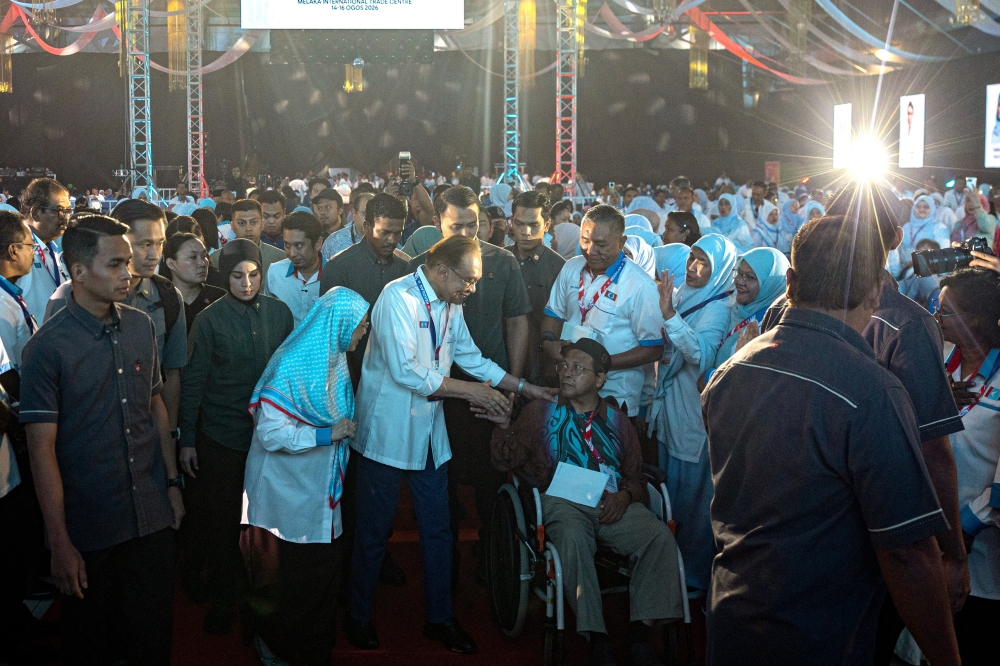
Prime Minister Datuk Seri Anwar Ibrahim delivered a pointed message to PKR party delegates in Melaka on Friday, emphasising that any strategic decisions concerning Umno must be anchored in the material interests of ordinary Malaysians rather than historical grievances or emotional responses. Speaking at a party gathering, Anwar underscored the need for deliberation grounded in pragmatism, a statement that carries significant implications for the stability of Malaysia's ruling coalition at a time when political tensions remain palpable across multiple fronts.
The message reflects an increasingly mature stance within PKR's leadership hierarchy, one that recognises the complexities of governing a multi-ethnic democracy where coalition partners often harbour deep-seated resentments. By explicitly cautioning against decision-making driven by anger, Anwar appears to be tempering expectations among his party's more vocal sections, many of whom have maintained visceral opposition to Umno stemming from decades of political rivalry. This disciplined rhetoric suggests a calculation that short-term political satisfaction must yield to longer-term governance stability and economic performance.
Anwar's intervention arrives at a critical juncture for Malaysia's political architecture. The Pakatan Harapan coalition that currently anchors the federal government depends on maintaining viable working relationships across ideological divides. Umno, despite its formal exclusion from the federal coalition since 2020, continues to wield substantial parliamentary influence and controls multiple state governments. Any coalition reconfiguration or sustained deterioration in informal coordination between federal and state-level power brokers could destabilise both economic policy implementation and legislative agenda-setting.
The Prime Minister's framing reveals sophisticated coalition management. Rather than dismissing Umno as an irredeemable political opponent, Anwar has instead positioned PKR as the adult in the room—willing to engage Umno when circumstances warrant, but only on terms dictated by rational assessment of public benefit. This rhetorical move serves multiple audiences simultaneously: it reassures investors and international observers concerned about political instability, signals to PKR's base that party interests remain secondary to national welfare, and leaves diplomatic channels open for future negotiations with Umno without appearing to capitulate to the opposition.
Historically, Malaysian coalition politics has frequently been derailed by personal animosity and revenge cycles. The Umno-PAS alliance that governed for six decades until 2018 eventually fractured partly over personality clashes and resource distribution disputes. Similarly, the early PKR-DAP alliance operated amid mutual suspicion despite shared anti-Umno sentiment. Anwar's emphasis on objective criteria for coalition decisions—specifically public welfare—attempts to break this destructive pattern by establishing a principle-based framework that transcends personality and grievance.
For ordinary Malaysians, Anwar's message carries tangible relevance. Coalition instability typically translates into legislative gridlock, policy reversals, and reduced investor confidence, all of which constrain economic growth and job creation. A government capable of sustained partnerships based on mutual interest rather than temporary truces tends to execute longer-term development plans more effectively. Whether Anwar can maintain this discipline across his own coalition partners—particularly DAP, which has shown stronger resistance to Umno engagement—remains an open question.
The timing of Anwar's remarks also deserves scrutiny. Recent months have witnessed incremental thawing of Umno-PKR relations, with informal cooperation on parliamentary business becoming more routine. Some analysts interpret this as preliminary groundwork for potential formal realignment ahead of the next general election, scheduled for 2028. By publicly establishing welfare-based criteria now, Anwar may be pre-positioning himself to negotiate deeper ties with Umno later without triggering accusations of opportunism or betrayal within PKR's ranks.
Yet Anwar faces genuine internal constraints. PKR's base includes activists and younger cadres for whom opposition to Umno carries moral weight beyond mere partisan rivalry. The party's formation in the 1990s occurred partly in resistance to Umno's perceived abuses of power. Asking party members to subordinate these concerns to abstract calculations about public welfare requires careful narrative management and continued delivery of tangible results that validate pragmatic coalition-building.
The broader Southeast Asian context adds another dimension. Regional investors increasingly favour political stability and predictable policy frameworks. Malaysia's inability to maintain coherent long-term planning—partly due to coalition fragility—has been identified as a competitive disadvantage relative to Vietnam and Thailand in attracting certain manufacturing investments. A government capable of maintaining pragmatic working relationships across factional lines sends positive signals to capital markets.
Anwar's statement ultimately represents an attempt to normalise Malaysian coalition politics by removing emotion from strategic calculation. Whether this succeeds depends partly on circumstances beyond his control—if economic performance falters or key policies fail, pressure will mount for more confrontational stances toward political opponents. Nevertheless, by establishing public welfare as the metric for coalition decisions, Anwar has created an intellectual framework that could reshape how Malaysian political actors justify and explain their behaviour to ordinary citizens concerned above all with jobs, prices, and stability.

