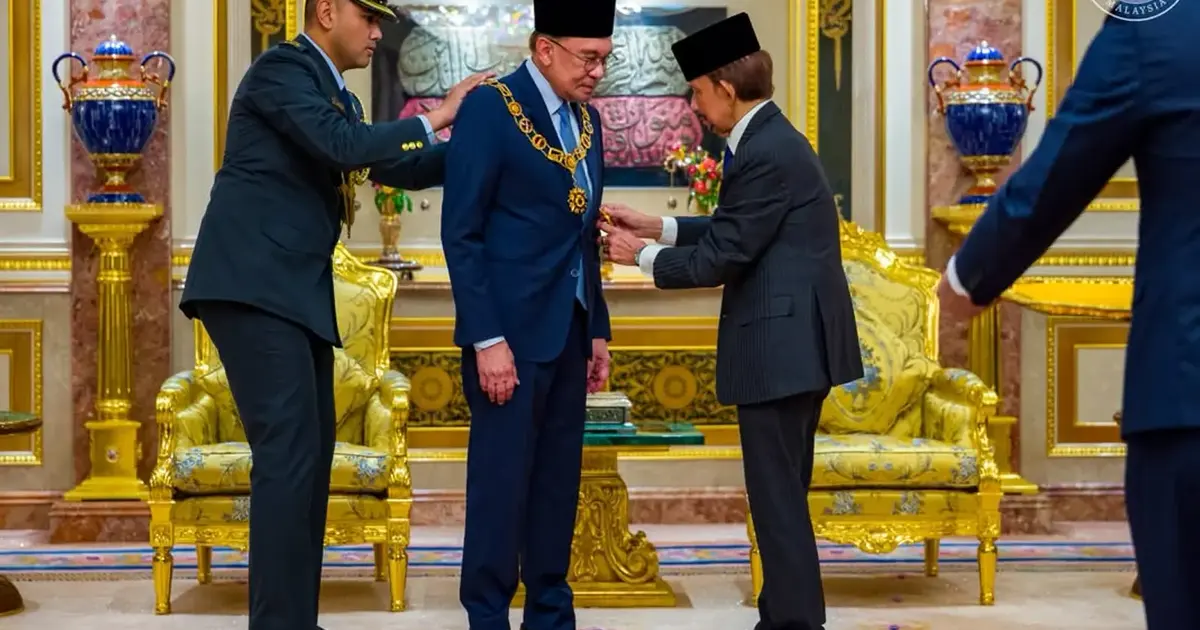
Prime Minister Anwar Ibrahim has received one of Brunei's most esteemed honours, the Darjah Kerabat Laila Utama Yang Amat Dihormati (D.K.), presented by Sultan Hassanal Bolkiah. The conferment represents a significant diplomatic gesture from the Sultanate toward Malaysia's top political leader, underscoring the continued importance both nations place on their relationship.
The D.K. honour belongs to Brunei's formal honours system and carries considerable prestige within the realm. Such decorations are typically reserved for distinguished figures who have contributed meaningfully to state interests or maintained exemplary conduct in their respective spheres of influence. The award reflects Sultan Hassanal Bolkiah's acknowledgement of Anwar's role in steering Malaysia's leadership and his engagement with regional affairs.
The recognition arrives amid the broader context of Malaysia-Brunei relations, which have long been characterised by proximity, cultural affinity, and shared interests in maritime security and regional stability. Both nations are members of the Association of Southeast Asian Nations and participate jointly in various multilateral forums addressing economic cooperation, border management, and security challenges across the region. The honour signals continued confidence in Anwar's administration from Brunei's perspective.
Anwar Ibrahim has been Malaysia's Prime Minister since November 2022, following a complex political transition that saw the formation of a coalition government. His tenure has involved navigating significant domestic policy initiatives, managing economic pressures, and maintaining Malaysia's diplomatic standing in an increasingly complex geopolitical landscape. International recognition of his leadership, such as this Brunei honour, bolsters his credibility on the regional stage.
The sultanate, under Sultan Hassanal Bolkiah's rule since 1967, maintains a carefully calibrated approach to its international relationships, particularly with neighbouring Malaysia. Brunei, despite its smaller size and population, commands considerable influence through its substantial petroleum wealth and strategic location along key maritime routes. The country's rulers have historically used honours and diplomatic protocols as instruments to deepen state relationships and signal political alignment.
This award also reflects the broader pattern of diplomatic exchange between Southeast Asian monarchies and senior political figures. Such honours systems serve multiple functions within the region: they formalise recognition of diplomatic achievements, strengthen personal ties between leaders, and communicate messages about the health and trajectory of bilateral relations to domestic and international audiences. In the context of Malaysia-Brunei ties, the gesture suggests both nations view their partnership as robust and forward-looking.
The timing of such honours can carry subtle political significance within regional dynamics. By conferring this recognition on Anwar, Sultan Hassanal Bolkiah publicly demonstrates Brunei's confidence in Malaysia's current leadership direction. This is particularly relevant given Malaysia's complex domestic political environment, where coalition governments require careful management and consistent regional validation can reinforce a leader's domestic position.
For Malaysia, receiving such honours from neighbouring monarchies provides diplomatic capital and reinforces the nation's standing within ASEAN's network of relationships. Southeast Asia's diplomatic culture places considerable emphasis on respect, protocol, and the symbolic dimensions of state-to-state interaction. An honour from Brunei's sultan carries weight not only in bilateral relations but also in the broader regional perception of Malaysia's leadership stability and international regard.
Sultan Hassanal Bolkiah has been consistent in using the honours system to maintain relationships across Southeast Asia. His approach reflects a traditional understanding of statecraft wherein personal recognition of foreign leaders strengthens state bonds. For Anwar, receiving such honours during his premiership contributes to what might be termed diplomatic legitimacy, demonstrating that he commands respect from significant regional counterparts.
The conferment also takes place within Malaysia's broader foreign policy framework under Anwar's administration. His government has prioritised strengthening bilateral relationships with neighbouring states, diversifying Malaysia's international partnerships, and positioning the country as a constructive participant in regional affairs. Recognition from Brunei's ruler aligns with these strategic objectives.
Beyond the symbolic dimensions, such honours represent historical documentation of diplomatic relations. They become part of the formal record of state interaction and can carry weight in how relationships are understood by subsequent administrations and international observers. The D.K. honour thus represents a permanent recognition of Anwar's tenure and Malaysia's relationship with Brunei during this period.
Moving forward, this recognition may serve as a foundation for deeper cooperation on specific bilateral issues. Border management, maritime security, and economic collaboration are areas where Malaysia and Brunei have longstanding interests. Strengthened personal rapport between leaders, formalised through such honours, can facilitate more productive engagement on these practical matters.
The award underscores a reality often overlooked in discussions of Southeast Asian geopolitics: despite the region's diversity and sometimes divergent interests, there exists a strong diplomatic culture and commitment to maintaining stable, mutually respectful state relationships. Sultan Hassanal Bolkiah's recognition of Anwar Ibrahim exemplifies this commitment and suggests that bilateral ties between Malaysia and Brunei will remain a cornerstone of regional stability.

