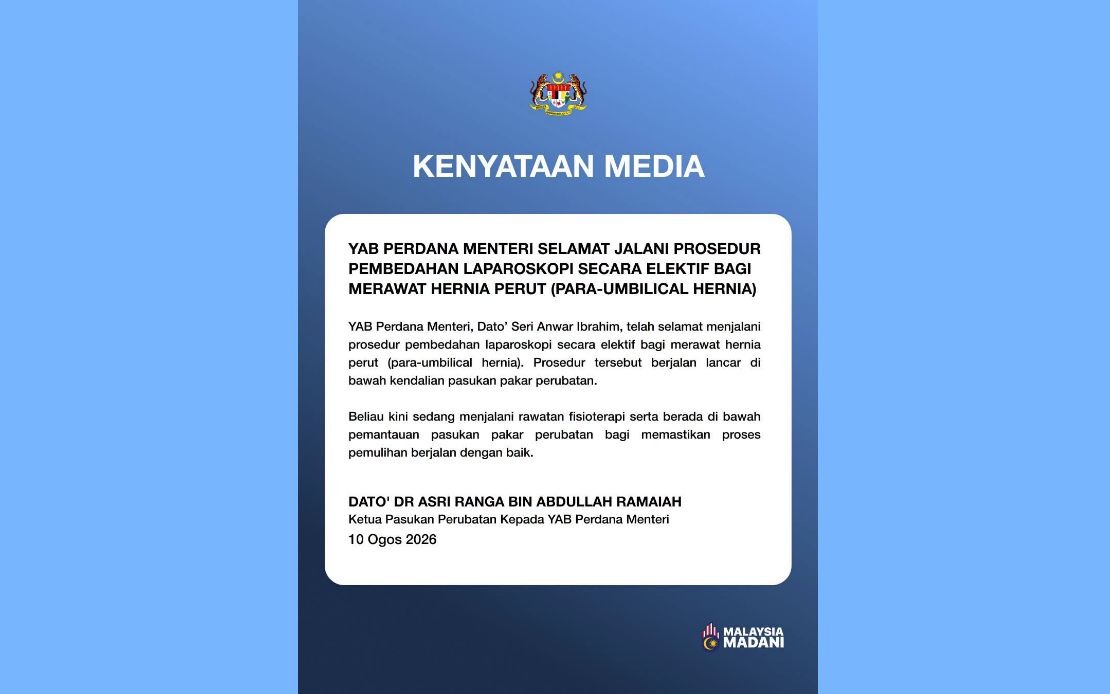
Prime Minister Datuk Seri Anwar Ibrahim has successfully undergone an elective laparoscopic surgical procedure to treat an abdominal hernia, specifically a para-umbilical hernia, marking a routine medical intervention for the nation's chief executive. The operation, conducted on August 10, proceeded smoothly under the management of a dedicated team of medical specialists, according to an official statement released through government channels.
The head of the Prime Minister's Medical Team, Datuk Dr Asri Ranga Abdullah Ramaiah, confirmed that the minimally invasive procedure achieved its intended outcomes without incident. Laparoscopic surgery, which employs small incisions and a camera to guide the operation, represents the contemporary standard for treating hernias as it typically results in faster recovery periods and reduced postoperative discomfort compared to conventional open surgery methods.
Following the successful completion of the surgical intervention, Anwar has commenced a structured physiotherapy regimen designed to facilitate tissue healing and restore full functional capacity. The specialist medical team maintains continuous monitoring protocols to track the Prime Minister's recuperation trajectory, with particular attention devoted to ensuring that the recovery proceeds according to medical expectations and without complications.
According to Tunku Nashrul Abaidah, the Prime Minister's senior press secretary, the initial postoperative phase encompasses a two-day observation period during which Anwar remains under hospital care while undergoing prescribed examinations and monitoring procedures. This observation window allows medical professionals to assess the immediate postoperative recovery and intervene promptly should any unforeseen issues emerge during this critical early phase.
The elective nature of this surgical procedure indicates that the hernia condition, while requiring medical attention, was not an acute emergency but rather a planned intervention scheduled at a time deemed appropriate by the medical team. Para-umbilical hernias, which develop near the navel region, can progressively enlarge over time and may cause discomfort or complications if left untreated, making surgical repair a prudent preventive measure.
The disclosure of the Prime Minister's medical procedure reflects the Malaysian government's commitment to transparency regarding matters of national importance, particularly those affecting the health and continuity of the country's highest office. By promptly releasing accurate medical information, the government addresses public concern while mitigating speculation and rumour that could arise from an absence of reliable information.
The timing and disclosure of such medical interventions carry implications for governmental operations and public confidence. Ensuring that the Prime Minister receives appropriate medical care while maintaining operational continuity demonstrates institutional robustness and the depth of Malaysia's administrative structures, which can sustain governance during periods when the chief executive requires medical attention.
Public expressions of support through prayer and well-wishes, as called for by the Prime Minister's office, reflect cultural values prevalent throughout Malaysia and Southeast Asia, where community solidarity during health challenges remains an important social convention. Such collective expressions serve to reinforce public connection with national leadership during vulnerable moments.
The Prime Minister's anticipated return to full duties in the near term underscores medical confidence in the recovery prognosis and suggests that the surgical intervention, while necessary, carries favourable long-term outcomes. The specialist team's optimistic assessment regarding recovery trajectory provides reassurance that governance and policy implementation will continue without significant disruption.
Abdominal hernias, which occur when tissue protrudes through weakened areas in the abdominal wall, represent conditions that affect populations across demographic categories and income levels. The deployment of contemporary laparoscopic techniques in treating the Prime Minister's condition reflects Malaysia's access to advanced surgical technology and skilled medical professionals capable of delivering high-quality healthcare services.
The recovery from laparoscopic hernia repair generally progresses more rapidly than from traditional open surgery, with many patients resuming normal activities within weeks rather than months. This expedited recovery profile, combined with reduced postoperative pain and shorter hospital stays, has made minimally invasive approaches increasingly standard in modern surgical practice throughout the region.
The medical intervention and its successful completion reaffirm the importance of addressing health concerns proactively rather than allowing conditions to deteriorate. The Prime Minister's example of undergoing necessary elective surgery contributes, albeit indirectly, to a culture where preventive and timely medical intervention receives normalisation and acceptance within society.

