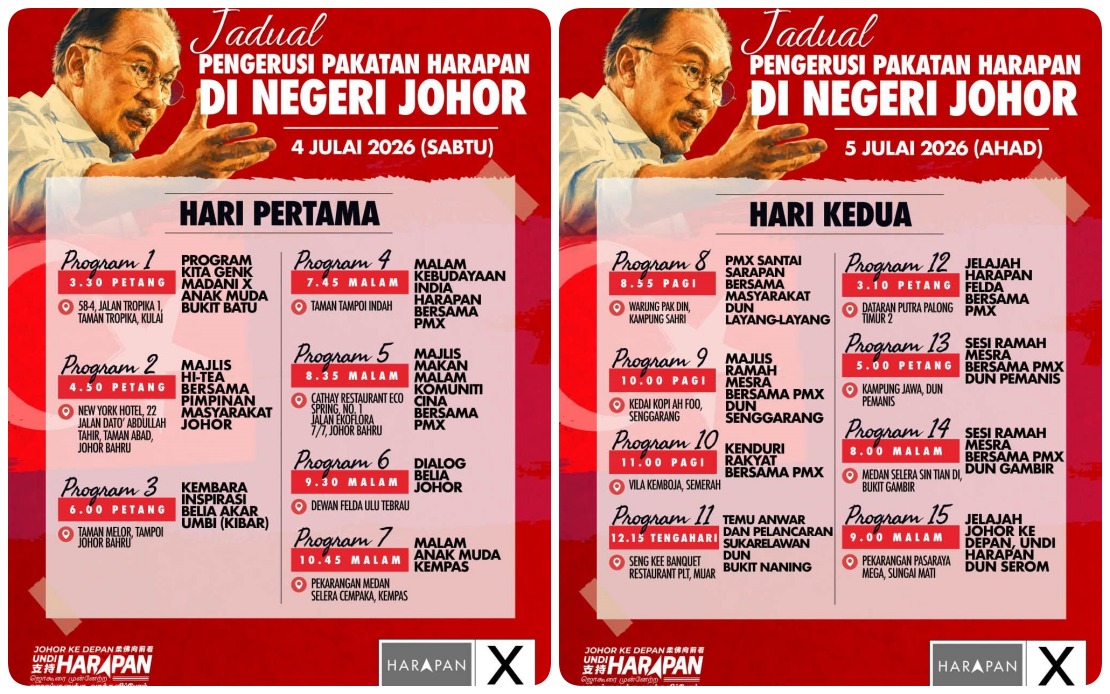
Prime Minister Datuk Seri Anwar Ibrahim is mounting an aggressive campaign blitz across Johor state as Pakatan Harapan seeks to consolidate support ahead of the 16th state election on July 11. The coalition chairman has scheduled seven separate campaign events on July 4 alone, with plans to conduct eight additional programmes the following day, demonstrating the strategic importance PH places on retaining its position in Malaysia's southern powerhouse.
Anwar's itinerary reflects a carefully calibrated approach to campaign messaging. His schedule spans diverse voter segments, beginning with direct engagement at grassroots level before transitioning to a high tea reception with community leaders at a Johor Bahru hotel at 4.50 pm. This tiered approach allows the Prime Minister to connect with voters from varied socioeconomic backgrounds while simultaneously courting influential figures whose endorsement carries weight within their respective communities.
The campaign strategy demonstrates particular attention to mobilising younger voters, a demographic crucial for maintaining electoral momentum in a state where generational shifts have reshaped political alignments in recent years. The Johor Youth Dialogue scheduled for 9.30 pm at Felda Ulu Tebrau Hall signals PH's recognition that capturing youth enthusiasm remains essential for sustaining the coalition's electoral viability beyond the immediate contest.
Pakatan Harapan is contesting all 56 state assembly seats in this election, fielding a diverse slate of candidates that reflects the coalition's internal composition. The 20 representatives from PKR form the largest PH contingent, while Amanah contributes 19 candidates and the Democratic Action Party supplies 17 hopefuls. This distribution underscores the careful power-sharing negotiations that preceded candidate selection, with each component party securing positions commensurate with its bargaining strength within the coalition structure.
The broader electoral battlefield features 172 candidates competing across the 56 seats, creating a highly fragmented contest where every vote potentially carries outsized significance. The presence of multiple contenders in most constituencies means that PH cannot afford complacency, as vote-splitting could allow opposition candidates to slip through with relatively modest vote shares. This dynamic explains the intensity of Anwar's personal campaign engagement, as the coalition's top leadership must demonstrate visible commitment to energising party machinery and motivating supporters to turn out on polling day.
Johor's political significance extends beyond its own state assembly. As the nation's third-largest state by population and a traditional barometer of national political sentiment, electoral outcomes here often carry implications for federal politics. The state has historically alternated between different political configurations, and recent years have witnessed considerable fluidity in voter preferences. A strong PH performance would strengthen the coalition's claims to legitimacy ahead of potential federal elections, while any setback would provide ammunition to opposition parties questioning the government's electoral appeal.
The campaign calendar compresses all major political activity into a narrow window, with early voting scheduled for July 7 and the main poll three days later on July 11. This compressed timeframe intensifies pressure on political parties to maximise their media presence and on-ground activities. Anwar's decision to conduct seven events in a single day reflects both the urgency imposed by this schedule and the resources the coalition can mobilise through its coalition partners' organisational networks across Johor.
Previous Johor elections have demonstrated the state's capacity to deliver surprising results that defy conventional expectations. Local issues often override national narratives, and candidate quality at the state assembly level exerts considerable influence on voter choice. PH's candidate selection process must therefore have balanced factional interests within the coalition against the imperative of fielding competitive candidates in each constituency. The intensity of Anwar's personal campaigning suggests the coalition leadership views this election as sufficiently competitive to warrant top-level attention.
For Malaysian observers and the broader regional audience, this election offers important signals about the trajectory of PH's reform agenda and the coalition's ability to sustain electoral appeal beyond the novelty of its 2018 breakthrough. The campaign's emphasis on youth engagement and community dialogue reflects lessons learned from previous contests, where grassroots mobilisation proved decisive. Success in Johor would provide PH with momentum heading into future electoral cycles, while defeat in significant constituencies would invite internal coalition recriminations and potentially destabilise the fragile power-sharing arrangements currently underpinning federal governance.
The seven-and-eight event marathon also serves another function beyond direct voter contact. Intensive campaign schedules generate media coverage, social media content, and party worker enthusiasm that amplifies reach far beyond those attending specific venues. In an era of digital political engagement, physical campaign events function partly as content generation exercises, with speeches, handshakes, and crowd scenes repurposed across multiple communication channels to sustain campaign momentum throughout the critical final week before polling day.

