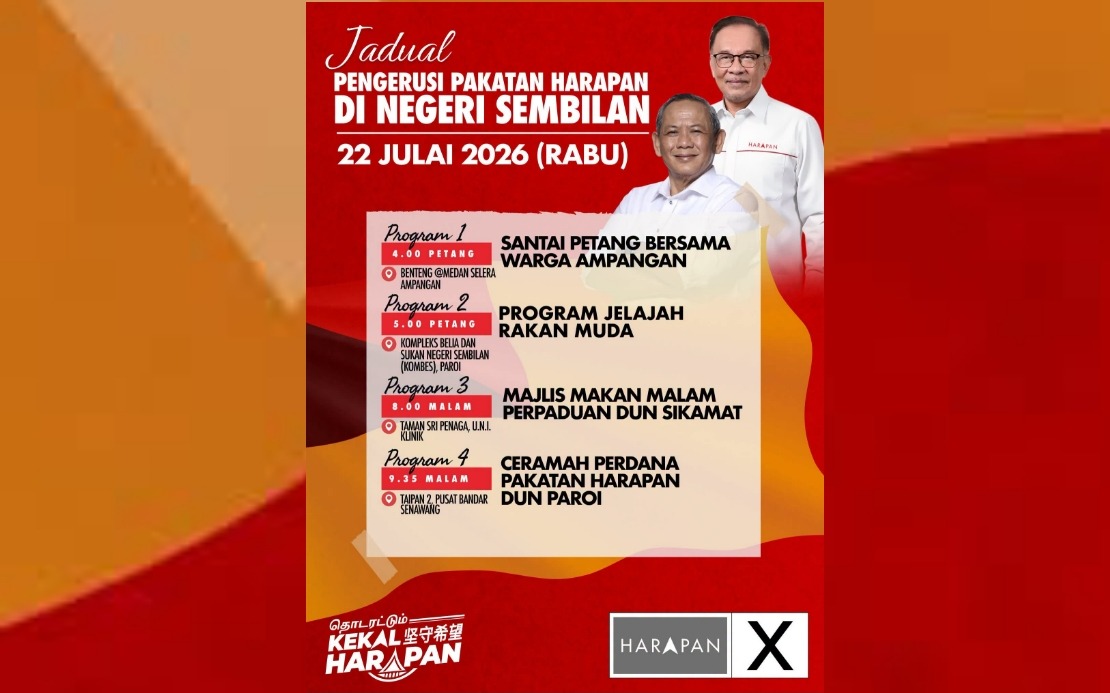
Prime Minister Datuk Seri Anwar Ibrahim is set to undertake an extensive campaign swing through Negeri Sembilan tomorrow, hitting four separate venues in Seremban and Paroi as the federal government intensifies its ground presence ahead of the state polls. The multi-location itinerary marks Anwar's inaugural foray into the state since the campaign period commenced, signalling the strategic importance Pakatan Harapan accords to retaining control of the peninsular state.
Anwar, who doubles as chairman of the Pakatan Harapan coalition and president of Parti Keadilan Rakyat, will commence his engagements at 4 pm, with further activities scheduled throughout the evening. The schedule reflects a calculated approach to maximising voter contact during peak engagement hours, targeting both afternoon and evening constituencies who may have differing availability windows.
The evening agenda includes a networking dinner at the Sikamat State Legislative Assembly precinct, to be held at Taman Sri Penaga beginning at 8 pm. This community-focused event aims to forge direct connections with local leaders and engaged residents, allowing the Prime Minister to communicate key messaging to influential grassroots figures who shape neighbourhood sentiment and voter mobilisation efforts.
Following the dinner engagement, Anwar will transition to a larger public gathering, appearing at the Paroi DUN Pakatan Harapan Grand Rally staged at Taipan 2 within Senawang Town Centre. This format represents a shift toward mass mobilisation tactics, enabling the coalition to energise its base supporters and generate media momentum during the critical final campaign phase.
The timing of Anwar's visit reflects growing recognition within Pakatan Harapan that direct ministerial engagement proves crucial when navigating competitive electoral contests. By deploying the sitting Prime Minister rather than delegating to state-level figures, the coalition demonstrates that it treats Negeri Sembilan as a territory meriting senior attention—a symbolic gesture that often translates into heightened grassroots enthusiasm and local media coverage that extends beyond typical political reporting.
Negeri Sembilan represents a significant battleground within Malaysia's current political landscape. Held by Pakatan Harapan since 2018, the state carries consequences that ripple across both federal stability and coalition cohesion. A weakened performance—or worse, a loss of control—could embolden rival factions within the broader opposition and complicate Anwar's navigation of federal parliamentary mathematics, where his government relies upon carefully maintained coalition arithmetic.
The Election Commission has organised the electoral timeline to compress the campaign period, with early voting designated for July 28 and general polling scheduled for August 1. This compressed schedule intensifies pressure upon parties to maximise impact during available windows, explaining why senior figures like Anwar undertake multiple-venue days rather than spreading activities across several weeks as in previous cycles.
For Pakatan Harapan, momentum proves particularly vital given that internal coalition tensions occasionally surface publicly. A successful showing in Negeri Sembilan would provide Anwar with tangible evidence that the coalition remains viable and capable of winning electoral mandates, thereby strengthening his hand when negotiating with component parties over resource allocation and policy direction. Conversely, a disappointing result might embolden dissenters within the broader coalition architecture.
The Negeri Sembilan contest also reflects broader trends within Malaysian politics where religious sentiment, economic grievance, and local service delivery increasingly determine outcomes rather than traditional party loyalty. By personally engaging with multiple community types—from business-oriented dinner attendees to mass rally participants—Anwar attempts to demonstrate that Pakatan Harapan understands the state's diverse concerns and possesses the capacity to address them through both local state government action and federal resource allocation.
From a Southeast Asian perspective, Malaysia's internal political health matters considerably. Stable, predictable governance attracts investment and allows the nation to engage strategically with regional initiatives. Conversely, political turbulence can distract from economic priorities and complicate ASEAN coordination. The Negeri Sembilan election therefore carries significance extending beyond state boundaries, touching upon Malaysia's broader trajectory during a period when regional competition for influence intensifies.
Anwar's personal visibility in Negeri Sembilan also counters any narrative suggesting he has become primarily focused upon federal-level concerns at the expense of state-level politics. By treating the state election as sufficiently important to warrant prime ministerial participation, he signals to voters that Pakatan Harapan remains a party of government capable of bridging local and federal interests into coherent governing platforms.
The campaign architecture evident in tomorrow's schedule—combining intimate community dinners with mass rallies—reflects modern political strategy that recognises different voter segments require different engagement modalities. Dinner attendees typically include business figures, civil society leaders, and wealthy professionals who respond to substantive policy discussion and relationship-building. Conversely, rally attendees often seek emotional connection, grand vision articulation, and visible confirmation that their preferred leaders remain energised and committed to fighting for their interests.

