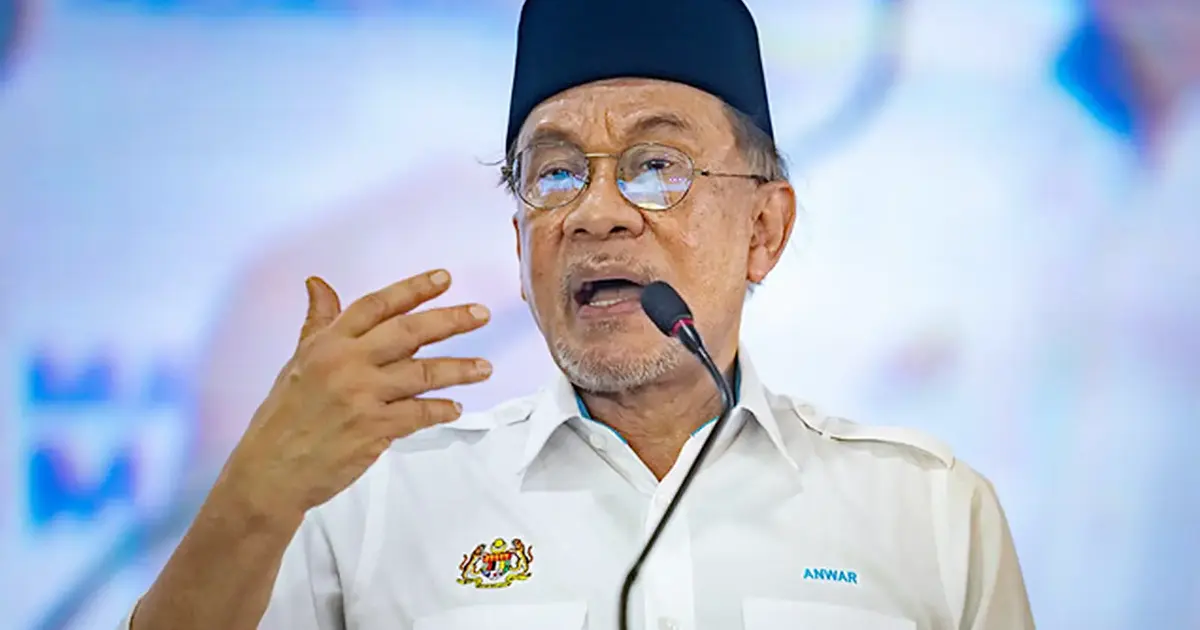
Prime Minister Anwar Ibrahim has issued a direct admonition to members of his cabinet, cautioning them against weaponising their ministerial positions to campaign against allied political parties during forthcoming state election contests. The warning represents an effort to maintain cohesion within Malaysia's fragile unity government coalition, which depends on cooperation between multiple political factions to function effectively.
Anwar made clear that government officials who exploit their official positions or resources while campaigning in state elections face serious consequences, specifically noting that resignations could be demanded from those who cross the line. This threshold-setting reflects heightened tensions within the coalition as electoral activity intensifies, with various component parties preparing for contests that could reshape regional political landscapes. The distinction Anwar drew between legitimate political advocacy and improper use of government machinery suggests growing concern about boundary violations.
The unity government, which came into being following the 2022 general election, comprises several coalition partners whose interests do not always align perfectly. During state-level contests, these partners often compete directly, creating inherent friction as they pursue their respective political fortunes. Anwar's intervention acknowledges this structural tension while attempting to establish clear rules that would preserve the broader coalition's viability despite lower-level electoral competition.
For Malaysian observers, this cautionary statement carries particular significance given the country's recent political history of fractious coalition management and defections. The unity government itself was formed as an attempt to stabilise the political system after years of parliamentary volatility, institutional challenges, and governance instability. A breakdown in discipline during state elections could potentially cascade into broader coalition instability, threatening the government's parliamentary majority and policy agenda.
The warning also reflects international norms around the use of state apparatus during electoral periods. Commonwealth democracies typically establish conventions preventing ministers from leveraging their official positions for partisan advantage. By explicitly articulating this principle, Anwar is positioning the government as conscious of proper democratic conduct, particularly relevant as Malaysia works to rebuild institutional credibility following preceding political turbulence.
Ministerial involvement in campaign activities presents inherent conflicts of interest, as those holding government posts simultaneously maintain party affiliations and electoral interests. The resources at their disposal—official vehicles, communication channels, government events, administrative machinery—can easily blur into campaign infrastructure. Anwar's directive attempts to enforce separation between these domains, distinguishing between ministers' personal political activity and their official governmental functions.
The implications for Southeast Asia are worth noting, as Malaysia's coalition governance model faces observation from neighbouring countries navigating their own multi-party systems. How effectively Anwar manages internal coalition dynamics during electoral periods will likely influence perceptions of coalition governments' viability in the region. Successful maintenance of coalition discipline despite electoral competition could strengthen arguments for broader political cooperation models in Southeast Asian democracies.
State elections in Malaysia carry particular importance for coalition calculations, as regional outcomes often provide early indicators of shifting political sentiment before federal contests. Coalition partners naturally want to maximise their own electoral performance, but at risk of inadvertently triggering broader fragmentation. The fact that Anwar felt compelled to issue this warning suggests previous incidents of ministers overstepping proper boundaries, necessitating clarification of expectations.
From a governance perspective, this statement underscores persistent challenges in managing systems where multiple political parties share executive responsibility. Unlike single-party governments with unified command structures, coalition cabinets require ongoing negotiation about acceptable behaviour and resource allocation. Ministerial appointments themselves become sensitive in coalition contexts, as each party seeks portfolio positions providing influence and visibility for their members.
The threatened consequence—demanding resignations—carries weight precisely because ministerial positions represent significant political prize. For members ambitious within their parties, loss of a government position could damage career prospects and party influence. This leveraging of the resignation threat as disciplinary mechanism demonstrates Anwar's willingness to use structural incentives to enforce coalition cohesion, suggesting previous warnings may have gone unheeded.
Longer term, Anwar's approach highlights the tension between maintaining coalition stability and allowing democratic competition. State elections serve legitimate democratic functions, permitting voters to make regional choices and political parties to test messaging and mobilise supporters. Excessive restrictions on ministerial participation could suppress healthy democratic participation, yet unrestrained competitive behaviour could destabilise the national government.
The Prime Minister's statement also carries implications for how Malaysia's unity government navigates its own political future. If coalition partners remain disciplined during state contests despite competition, it suggests the broader partnership retains sufficient institutional stability to survive lower-level electoral rivalry. Conversely, if ministers repeatedly ignore warnings about campaign misconduct, it signals deeper coalition fragility requiring more fundamental restructuring.
Moving forward, the practical enforcement of Anwar's directive will prove telling. Whether ministers actually moderate their campaign activities in response to this warning, and whether the Prime Minister follows through on resignation threats if violations occur, will determine whether this represents genuine boundary-setting or merely rhetorical positioning. The answer will shape coalition stability throughout the remainder of this parliamentary term and inform calculations about Malaysia's political future.

