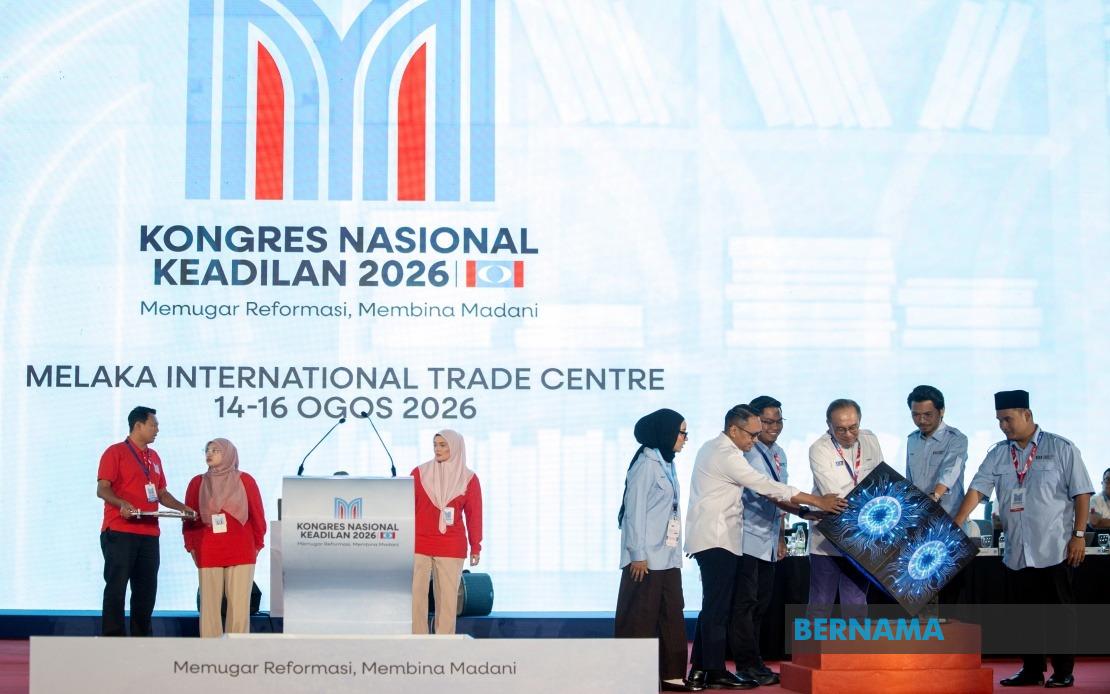
Prime Minister Datuk Seri Anwar Ibrahim unveiled a comprehensive 113-page strategic publication in Melaka on August 16, marking a significant moment for Parti Keadilan Rakyat's youth and activist movement, Amanah Muda Keadilan (AMK). The document, authored by AMK chief Muhammad Kamil Ahmad Munim and executive committee member Ashraf Ahmad Hadi, represents the movement's evolving framework for addressing Malaysia's contemporary political and social challenges through a lens that combines ideological commitment with practical governance.
Anwar characterised the publication as arriving at a critical juncture, coinciding with what he described as the adoption of fresh national priorities. His framing positioned the work not as mere administrative guidance or seasonal political messaging, but rather as a deliberate exercise in what he termed "civilisational renewal"—a concept that recentres Malaysia's development trajectory around humanising principles rather than narrow technocratic efficiency. This distinction matters significantly in the Malaysian political context, where competing visions of development have long pitted instrumental, business-focused approaches against those emphasising social welfare and ethical governance.
The Prime Minister's foreword carries particular weight given PKR's positioning as the leading coalition partner in the current government. By endorsing this publication through such prominent framing, Anwar signalled that questions of moral integrity and spiritual resilience are not marginal to governance but central to how his administration views state-building and institutional renewal. His language suggests discomfort with depoliticised, technocratic models of reform that have dominated Malaysian policy discourse for decades, instead advocating for an approach that explicitly integrates values and principled conduct into development frameworks.
Crucially, Anwar directed pointed remarks toward the young generation, particularly AMK members, reminding them that their access to power and influence represents not privilege or opportunity for self-advancement, but rather an obligation grounded in moral responsibility and spiritual accountability. This messaging reflects ongoing tension within PKR between different generational cohorts and competing interpretations of what the party's "Reformasi" movement should ultimately achieve. By emphasising that youth leadership entails testing one's piety and integrity, Anwar repositioned the conversation away from purely structural or institutional reforms toward questions of character and ethical foundation.
The Prime Minister acknowledged the scale of reconstruction required across Malaysian institutions and society, framing the task as one demanding "extraordinary creativity, intellectual courage and spiritual resilience." This formulation is revealing, particularly his inclusion of "spiritual resilience" alongside more conventional markers of institutional capacity. It suggests a diagnosis of Malaysia's governance challenges that goes beyond technical deficiency or resource constraints to encompass what might be termed a crisis of institutional morality and social purpose—problems that require more than procedural fixes or technological solutions.
Anwar's reference to a nation "scarred by past injustices and leakages" carries implicit reference to corruption, misgovernance, and the legacies of the previous administration's tenure, though without explicit accusation. This framing allows him to position the young generation not as mere administrators managing existing systems, but as potential agents of fundamental renewal and rectification. The inclusion of both "injustices" and "leakages" alongside each other blurs distinctions between political wrongdoing and administrative corruption, presenting them as aspects of a broader institutional failure.
The publication itself functions on multiple levels within PKR's organisational ecosystem. Formally, it serves as a cadre-building resource, designed to transmit institutional knowledge and party ideology to successive cohorts of activists and potential leaders. This function addresses a recurring challenge within reform-oriented movements globally: how to maintain ideological coherence and strategic purpose across generational turnover without either calcifying into dogmatism or fragmenting into purely opportunistic factionalism. The document's emphasis on historical appreciation and understanding party foundations speaks directly to this challenge.
Beyond cadre training, however, the publication appears designed to accomplish something more ambitious: internalising the meaning of "Reformasi" itself for a generation that may not have directly experienced PKR's foundational struggles. This matters because Reformasi, in Malaysian political vocabulary, carries contested meanings—for some it denotes anti-corruption activism, for others systemic constitutional reform, and for still others moral and social awakening. By creating a structured resource that encourages members to "internalise" this meaning, PKR attempts to guide interpretation and prevent dilution or distortion as the movement engages new adherents.
The emphasis on cultivating "knowledgeable and principled members" who remain "steadfast in upholding the mandate" suggests concern about drift and compromise within party structures. In Malaysian politics, where coalition governments frequently require accommodation and pragmatic compromise, there is perpetual tension between maintaining ideological purity and achieving governmental effectiveness. AMK's cadre-building initiative implicitly positions principled adherence to stated party values as essential to long-term institutional legitimacy, rather than viewing such adherence as potentially constraining.
For Malaysian political analysts, this publication signals several broader developments. First, it indicates PKR's continued investment in institutionalising its movement identity even while serving in government—a strategy aimed at preventing the party from becoming absorbed into state structures or losing its distinctive identity. Second, it demonstrates explicit concern among PKR leadership about ideological coherence and values transmission, particularly toward younger members who may prioritise pragmatic advantage over movement principle. Third, Anwar's prominent championing of the work elevates questions of moral and spiritual renewal into high-level political discourse, suggesting these themes will feature prominently in PKR's positioning heading toward future electoral contests.
The geographical choice of Melaka for this launch carries symbolic significance within Malaysian political geography, given the state's historical importance to multiple communities and its contemporary status as a strategically competitive political terrain. Launching the document there underscores AMK's aspiration to operate as a nationwide movement rather than merely a peninsular urban phenomenon, positioning itself as capable of engaging diverse constituencies around shared principles rather than narrow identity appeals.
For observers across Southeast Asia, this initiative illuminates broader patterns within reform-oriented movements navigating the transition from oppositional activism to governmental responsibility. How effectively can such movements maintain their distinctive ideological identity and moral mission while participating in the pragmatic compromises that governance demands? The AMK publication and Anwar's accompanying remarks suggest PKR leadership views this question as urgent and consequential, not merely abstract.

