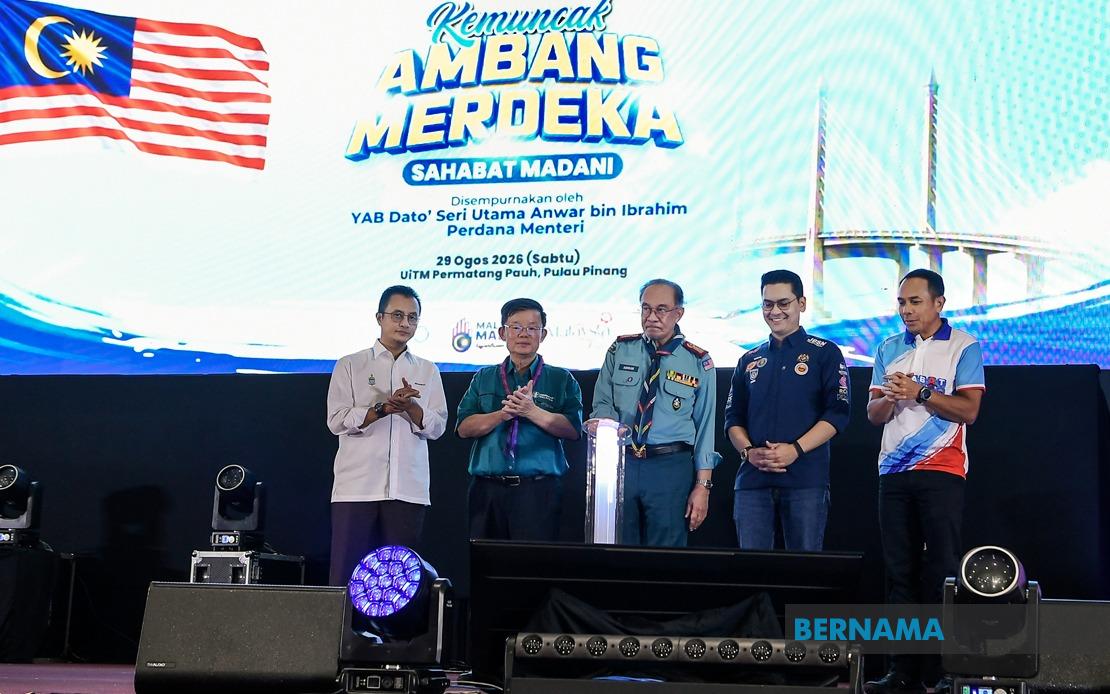
Prime Minister Datuk Seri Anwar Ibrahim has formally unveiled Sahabat MADANI, an ambitious nationwide volunteer initiative that has already mobilised more than 11,000 registered participants across Malaysia. The launch occurred during the Ambang Merdeka Sahabat MADANI 2026 programme held at Universiti Teknologi MARA (UiTM) Permatang Pauh in Bukit Mertajam, marking a significant step in the government's efforts to embed community engagement into Malaysia's national fabric.
The volunteer network represents a deliberate attempt to harness grassroots participation for social development. According to the Implementation Coordination Unit of the Prime Minister's Department (ICU JPM), Sahabat MADANI operates on principles of mutual respect and inclusivity, explicitly designed to unite individuals from diverse ethnic, religious and socioeconomic backgrounds around shared service objectives. This structure addresses a persistent challenge in Malaysia's multicultural context: channelling national unity rhetoric into tangible collaborative action at the community level.
The scope of Sahabat MADANI's work extends across several interconnected areas that align with government priorities on poverty reduction and social mobility. Volunteers engage in direct support for vulnerable populations, interventions targeting out-of-school children, skills development and entrepreneurship pathways for youth, and rapid-response assistance during emergencies or natural disasters. This multi-pronged approach reflects recognition that effective social progress requires simultaneous action across education, economic opportunity and safety networks.
Underpinning the initiative is the Malaysia MADANI framework, which emphasises "Kesejahteraan Dinikmati" or shared wellbeing as a national aspiration. The ICU JPM framed Sahabat MADANI as the practical manifestation of this philosophy, translating policy statements into volunteer-driven service delivery. By positioning volunteers as active participants rather than passive beneficiaries, the programme attempts to create ownership of development outcomes at the community level—a marked departure from top-down service provision models.
For Malaysia's broader governance challenges, Sahabat MADANI carries particular significance. The emphasis on transparency and accountability within the volunteer network directly addresses public concerns about corruption and government effectiveness. By creating visible, decentralised service delivery mechanisms, the initiative offers opportunities for community scrutiny and direct feedback that traditional bureaucratic channels may not facilitate as readily. This structural openness could serve as both a practical service mechanism and a confidence-building exercise in public institutions.
The movement also reflects deliberate strategic thinking about youth engagement and national cohesion. Rather than allowing divisive narratives to take root among younger generations, the programme channels youthful energy and idealism toward constructive national projects. By providing pathways for young Malaysians to deploy their skills in service to community development, Sahabat MADANI addresses recruitment and retention challenges that plague many volunteer organisations while simultaneously building social capital across generational lines.
The inclusion of young people carries particular weight within Malaysia's political and social context. Youth disaffection with traditional institutions and susceptibility to polarising messaging represent ongoing concerns for policymakers. Sahabat MADANI attempts to counter these trends by demonstrating that young Malaysians can contribute meaningfully to national progress through non-partisan community service. This positioning sidesteps ideological contestation by anchoring participation in shared welfare objectives rather than electoral competition.
From an operational standpoint, the coordination framework merging government agencies, volunteer networks and local communities represents a governance innovation worth monitoring. Successful implementation requires sustained funding, training infrastructure, and mechanisms to prevent the initiative from becoming merely bureaucratic theatre. The 11,060 initial registrations suggest genuine interest, but the real test lies in maintaining momentum and translating registrations into sustained, impactful volunteer engagement over successive years.
Regionally, Sahabat MADANI offers a model of institutionalised volunteerism that other Southeast Asian nations facing similar development and cohesion challenges might study. Malaysia's experience navigating ethnic and religious diversity while pursuing rapid development has generated institutional knowledge that could inform similar programmes in neighbouring countries. The emphasis on community-driven solutions to poverty and social fragmentation reflects broader regional recognition that state capacity alone cannot address development objectives of this magnitude.
The timing of Sahabat MADANI's launch during National Day celebrations carries symbolic weight, linking volunteer service to independence and nationhood itself. This framing suggests the government views community engagement not as an ancillary social programme but as foundational to Malaysia's continued national project. The message conveyed is that contemporary nationhood requires active participation from citizens in strengthening community bonds and ensuring inclusive development.
Looking forward, the initiative's success will depend on translating enthusiasm into sustained impact. Early recruitment numbers are encouraging, but volunteer retention, volunteer training quality, and measurable outcomes in target communities will determine whether Sahabat MADANI becomes an enduring national institution or a well-intentioned but ultimately ephemeral programme. The establishment of clear performance metrics and regular public reporting on community benefits could strengthen both accountability and citizen confidence in the initiative.
The launch of Sahabat MADANI ultimately reflects an understanding that Malaysia's development aspirations and social cohesion goals require mobilisation of resources beyond government budgets and bureaucratic capacity. By formalising pathways for volunteers to contribute to defined national priorities while explicitly embracing Malaysia's diversity, the programme positions citizen engagement as central to Malaysia's future trajectory. Whether this vision can translate into sustained, transformative community impact remains to be seen, but the scale of initial recruitment suggests genuine appetite among Malaysians to participate in collective nation-building efforts.

