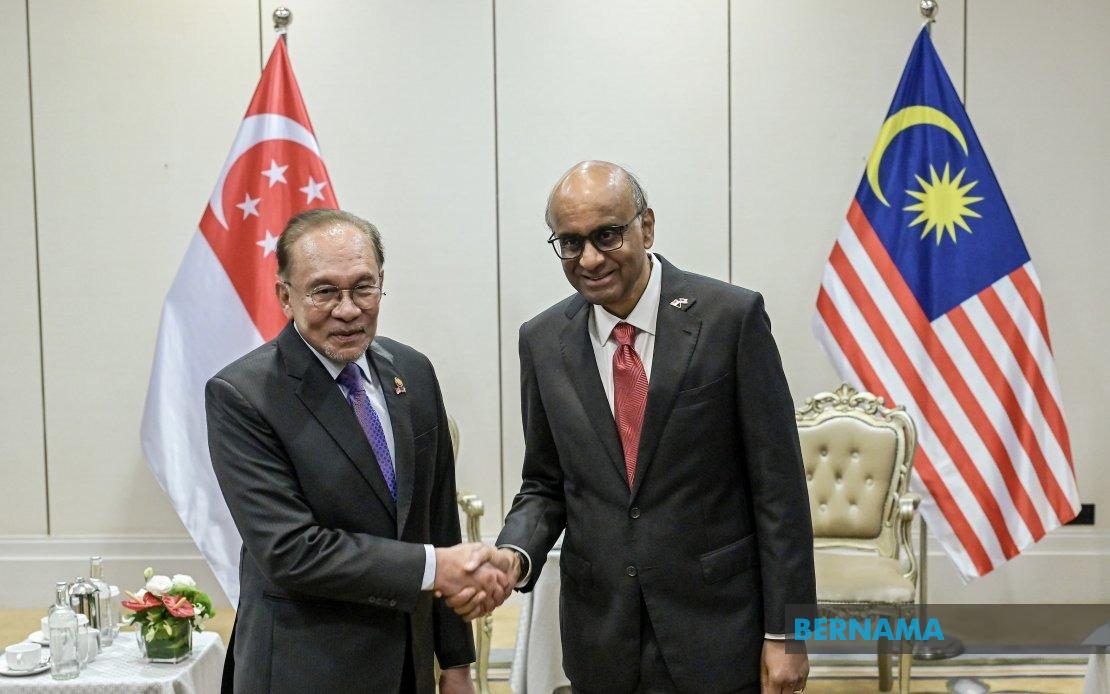
Prime Minister Datuk Seri Anwar Ibrahim received Singapore President Tharman Shanmugaratnam on Monday as part of the latter's three-day official visit to Malaysia, underscoring the continued importance of diplomatic engagement between the two neighbouring countries. The meeting, which lasted 40 minutes, took place at a senior level and involved key Malaysian government figures tasked with overseeing economic and trade portfolios.
Tharman's delegation included representatives responsible for Malaysia's foreign affairs, investment promotion, and business development. The Malaysian side was represented by Foreign Minister Datuk Seri Mohamad Hasan, Investment, Trade and Industry Minister Datuk Seri Johari Abdul Ghani, and Entrepreneur and Cooperatives Development Minister Steven Sim Chee Keong. The presence of these ministers signals that economic and commercial matters were central to the discussions, reflecting the countries' deep integration across multiple sectors.
The formal welcome for the Singapore President occurred earlier at Istala Negara, where Yang di-Pertuan Agong Sultan Ibrahim extended a state welcoming ceremony. This ceremonial aspect demonstrates the protocol and respect accorded to bilateral relations at the highest levels of both nations' governments. The visit itself was conducted at the specific invitation of the Malaysian King, highlighting the traditional diplomatic channels through which such engagements are coordinated.
This visit reciprocates the Malaysian head of state's official journey to Singapore in May 2024, maintaining the balanced exchange of high-level visits that characterises the relationship between these two ASEAN neighbours. The regularity and formality of such reciprocal visits reflect the strategic importance both countries place on their bilateral relationship and their commitment to sustained political and economic dialogue.
Economically, Singapore occupies a crucial position in Malaysia's trade architecture. The island republic ranks as Malaysia's second-largest trading partner globally, a position that underscores the significance of their commercial relationship despite Singapore's much smaller geographic footprint. Within Southeast Asia itself, Singapore holds even greater importance—it is Malaysia's largest trading partner among all ten ASEAN member states, demonstrating the depth of integration between the two economies.
Bilateral trade between Malaysia and Singapore reached RM402.35 billion (US$93.97 billion) in 2025, reflecting a modest year-on-year growth of 1.5 per cent compared to the previous year. While this growth rate may appear modest, it demonstrates the resilience of trade ties in an uncertain global economic environment. The absolute value of the trade relationship is substantial, indicating that even incremental percentage increases represent significant monetary flows between the two nations.
More encouraging trends emerge when examining more recent monthly data. From January through May 2025, bilateral trade expanded at a considerably faster pace, growing 14.5 per cent compared to the same period in 2024. During these five months, total trade reached RM189.90 billion (US$47.87 billion), compared to RM165.93 billion (US$37.65 billion) in the corresponding months of 2024. This acceleration suggests strengthening momentum in bilateral commerce, potentially reflecting recovery in regional demand or expansion in particular sectors.
The acceleration in trade growth during the early months of 2025 warrants closer examination by Malaysian policymakers and analysts. Several factors could explain this upswing, including increased activity in key sectors such as semiconductors, petroleum products, and manufactured goods that typically dominate Malaysia-Singapore trade flows. The stronger performance in the first half of the year may indicate that economic conditions are improving for both nations, or that specific trade agreements or investment flows are generating increased commercial activity.
For Malaysia, this relationship carries implications beyond mere trade statistics. Singapore's position as a financial and investment hub means that flows between the two countries often involve high-value services, capital investment, and technology transfer alongside physical goods trade. Malaysian businesses frequently use Singapore as a gateway to regional and global markets, while Singaporean companies depend on Malaysian natural resources and manufacturing capabilities. This complementary relationship has evolved over decades and remains one of the most important bilateral relationships in Southeast Asia.
The visit also carries symbolic weight amid the broader regional context. Malaysia and Singapore navigate occasionally complex historical issues, making continuous high-level engagement important for maintaining stability and addressing potential friction points. Regular diplomatic visits and ministerial meetings provide forums for discussing not only trade but also water agreements, border matters, transportation links, and security cooperation. The presence of multiple ministers at Monday's meeting suggests that the agenda extended beyond ceremonial pleasantries to substantive policy discussions.
For Malaysian readers and policymakers, the strengthening trade momentum reflected in early 2025 figures offers cautious optimism about economic prospects. Singapore remains a bellwether for regional economic health, and strong bilateral trade growth suggests resilience in key sectors. The visit also reinforces Malaysia's position as a serious economic partner within ASEAN and demonstrates the commitment of both governments to maintaining one of the region's most important bilateral relationships. Moving forward, sustaining this growth will require continued focus on trade facilitation, infrastructure improvements, and deepening economic integration across sectors.

