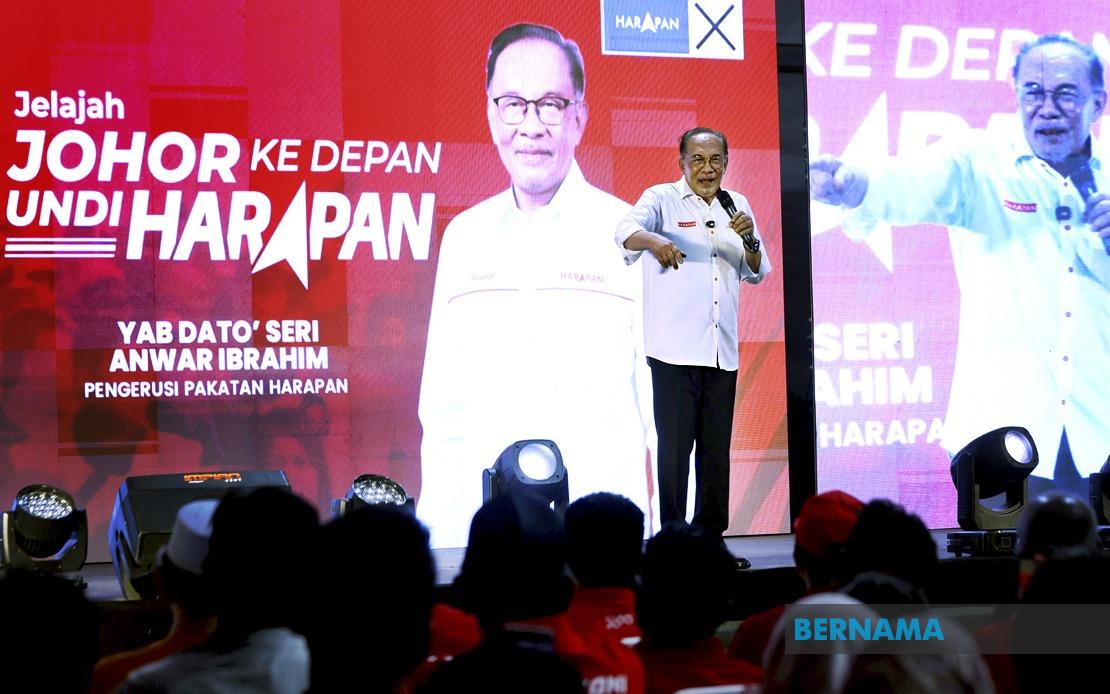
Prime Minister Datuk Seri Anwar Ibrahim has drawn a sharp line against what he characterises as Malaysia's entrenched culture of abuse, declaring that the era of using state power to enrich political insiders and their families is finished. Speaking at a campaign event in Sungai Mati, Muar, on behalf of the MADANI Government, Anwar positioned clean governance as central to his administration's legitimacy and Malaysia's future credibility on the global stage.
The Prime Minister's language reflected a rhetorical shift in how the Pakatan Harapan coalition is framing its political case to voters. Rather than focusing narrowly on competing policy platforms, Anwar explicitly rejected the transactional model of governance in which state contracts flow to favoured business associates and family members of politicians. He characterised this system as antithetical to national progress, suggesting that Malaysia's standing internationally depends on demonstrating institutional integrity rather than merely managing economic output.
Anwar's framing carries particular weight in the context of Malaysian politics because it directly addresses long-standing public anxiety about the concentration of wealth and opportunity among political elites. The notion that government office serves as a vehicle for private enrichment has persisted across multiple administrations and remains a touchstone of public cynicism. By positioning his government as fundamentally opposed to this paradigm, Anwar appears to be anchoring his political brand to a commitment that transcends party affiliation or sectarian interest.
Critically, Anwar's remarks on leadership selection deserve attention. He stated his preference for Malay leaders who are honest and uncorrupted, alongside Chinese leaders meeting the same standard, rather than endorsing candidates primarily on ethnic or communal grounds. This formulation attempts to reorient Malaysian political discourse away from identity-based mobilisation and toward meritocratic and ethical criteria. The statement implicitly critiques opposition politicians who, in his assessment, exploit narrow racial sentiments to obscure their own records of governance or financial impropriety.
The assurance that no official will receive preferential treatment if implicated in corruption marks an important articulation of institutional principle. In Malaysian practice, corruption cases have occasionally been perceived as selective or influenced by political calculations, particularly when they involve figures from rival parties or those who have fallen out of favour within their own coalitions. Anwar's explicit declaration that immunity from prosecution will not be extended on political grounds signals an attempt to restore public confidence in the impartiality of enforcement mechanisms.
The timing and location of these remarks warrant consideration alongside the broader political calendar. The Johor State Election, scheduled for July 11, represents a significant test for Pakatan Harapan in a state where the coalition faces considerable competition. By positioning the election as a choice between leaders committed to institutional integrity and those lacking such commitment, Anwar frames the ballot as a referendum on governance philosophy rather than merely a contest for seats and state revenue. This rhetorical strategy seeks to elevate the contest above transactional politics and appeals to voters concerned about long-term institutional health.
Anwar's characterisation of opposition activity as driven by desire to regain federal power rather than genuine policy disagreement further sharpens his argument. He suggests that opposition pressure on his government stems from tactical calculation rather than principled objection, thereby delegitimising their critiques as self-serving. This rhetorical move attempts to insulate the government from accountability by reframing criticism as motivated by factional interest rather than legitimate democratic disagreement.
The presence of Penang Chief Minister Chow Kon Yeow at the event reinforces the message of united commitment across state and federal levels within the Pakatan Harapan coalition. Chow's appearance signals that multiple layers of government are aligned on the anti-corruption platform, potentially enhancing its credibility among voters who have witnessed fragmented or contradictory messaging from the coalition in previous election cycles. The inclusion of Ledang MP Syed Ibrahim Syed Noh similarly demonstrates cross-district party unity.
For Malaysian voters and observers across Southeast Asia, Anwar's declarations raise important questions about institutional mechanisms for enforcement. Anti-corruption rhetoric remains a common feature of Malaysian politics; what distinguishes implementation is the willingness of governments to investigate and prosecute figures within their own political base. Historical precedent suggests that such even-handed enforcement has been inconsistent. The robustness of Malaysia's anti-corruption commission, the Malaysian Anti-Corruption Commission (MACC), and its independence from political interference will ultimately determine whether these promises translate into sustained institutional change.
The scope of Anwar's anti-corruption agenda extends beyond individual prosecutions to systemic reform. He identified the administrative architecture itself as requiring cleanup—a recognition that corruption often flourishes through entrenched bureaucratic practices rather than isolated acts by rogue officials. This suggests a more comprehensive reform agenda targeting procurement processes, regulatory capture, and the revolving door between government and private sector interest that has historically enabled improper enrichment.
The campaign's intensity—Anwar had completed eight engagements by the time of the Sungai Mati event and would conduct 15 total over two days in Johor—underscores the strategic importance Pakatan Harapan assigns to the state. With 172 candidates contesting 56 state seats in the July 11 election, the coalition's performance in Johor will send signals about its ability to consolidate support ahead of what may ultimately be a federal election. Johor's historical significance as a stronghold of the Barisan Nasional coalition adds to the symbolic weight of any gains the current government might achieve.
For regional observers, Anwar's emphasis on merit-based leadership and institutional integrity reflects broader governance challenges across Southeast Asia. Many nations in the region struggle with public perception that political office represents primarily a vehicle for personal wealth accumulation. Malaysia's experience with high-profile corruption cases, prosecutions of former prime ministers, and public demands for accountability positions it within a regional conversation about state legitimacy and institutional renewal. How effectively the current government translates rhetorical commitment into sustained institutional practice will carry implications not only for Malaysian politics but for wider regional discourse on governance standards.

