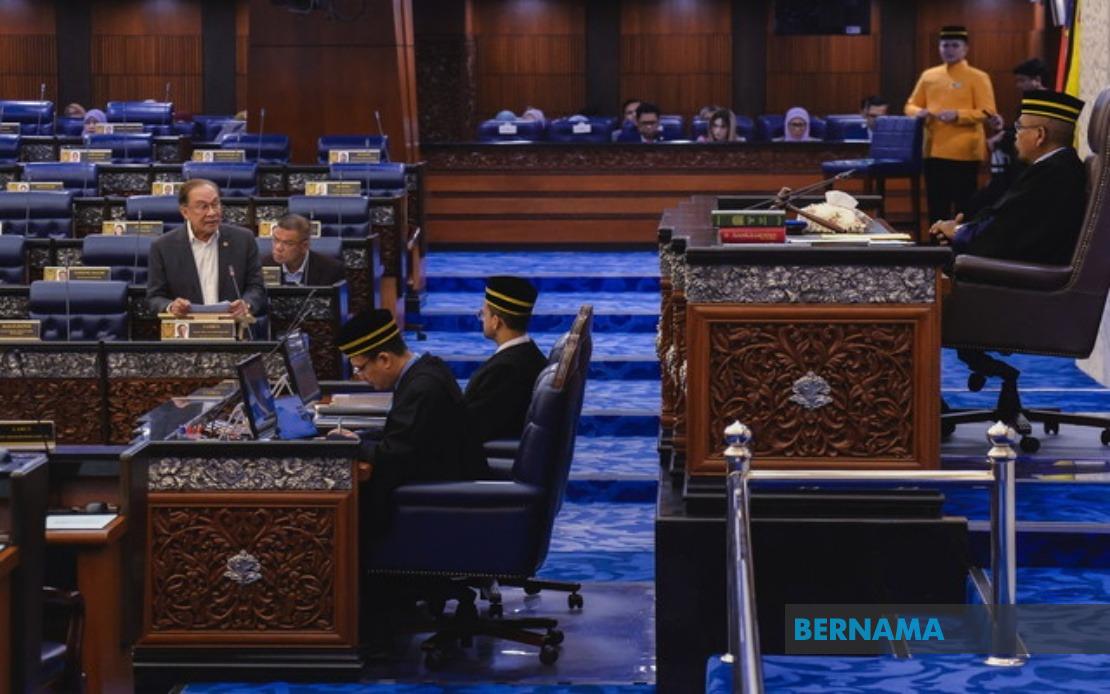
Prime Minister Datuk Seri Anwar Ibrahim has reaffirmed the strict prohibition against announcing new projects or introducing fresh policies during the heat of election campaigns, emphasizing that this rule remains a cornerstone of Malaysia's electoral framework and will be consistently enforced ahead of upcoming state polls.
Speaking during Minister's Question Time in the Dewan Rakyat, Anwar clarified that the restriction derives its legal authority from Section 24B of the Election Offences Act 1954, a provision designed to ensure fair competition and prevent the ruling administration from gaining undue electoral advantage through the strategic timing of government announcements. The Prime Minister underscored that his administration's position on this matter has not wavered and will continue to be upheld regardless of electoral pressures or political circumstances.
Anwar's response came after Datuk Seri Dr Shahidan Kassim from Perikatan Nasional raised questions about whether the prohibition on government allocations and project announcements following nomination day would remain in effect for the Johor, Melaka and Negeri Sembilan state elections, and what mechanisms would be deployed to monitor and ensure compliance across different levels of government.
The Prime Minister laid out the operational framework with precision, stating that once nomination day has been officially declared, campaigning activities may commence in full force, but strict boundaries must be maintained regarding government pronouncements. Specifically, no fresh commitments to execute new projects or introduce novel policies targeting the affected states can be made during the election period, regardless of which tier of government initiates the announcement.
Critically, Anwar emphasized that the restriction extends across the entire governmental apparatus, including municipal and city councils, state government bodies, and federal government agencies. This comprehensive approach prevents any branch of the administration from circumventing the electoral rules by delegating project announcements to ostensibly independent entities or lower-level authorities. The blanket restriction reflects Malaysia's legislative intent to maintain the integrity of democratic contests by preventing incumbents from weaponizing public resources and announcements for electoral gain.
However, the Prime Minister drew an important distinction that carries practical implications for governance continuity. Projects that have already received formal approval and budgetary allocation in previous federal budgets do not fall under the election campaign prohibition, even if their official unveiling or commencement occurs during the campaign window. This carve-out acknowledges that rigid adherence to the ban could paralyze government operations and prevent the delivery of services that citizens are entitled to receive, creating a distinction between opportunistic new announcements and the continuation of pre-existing commitments.
This clarification addresses a nuanced grey area in Malaysian election law that has occasionally generated controversy and confusion at state and local levels. Government agencies sometimes struggle to determine whether proceeding with groundbreaking ceremonies for previously-budgeted infrastructure projects constitutes a violation of the spirit of the electoral rules. Anwar's statement provides clarity that the electoral commission and government bodies should focus their scrutiny on genuinely novel undertakings rather than the ceremonial conclusion of commitments made before the campaign period commenced.
The timing of Anwar's restatement is significant given the imminent state elections in three crucial states. Johor, Melaka and Negeri Sembilan represent a diverse cross-section of Malaysian politics, with varying levels of opposition presence and competitive dynamics. By reinforcing the election law constraints now, the Prime Minister is signaling that his government intends to conduct these elections under strict adherence to democratic principles, potentially deflecting opposition accusations of using state machinery for political advantage.
The emphasis on enforcement mechanisms is particularly noteworthy. Rather than leaving compliance to voluntary adherence, the reiteration suggests that watchdog bodies and electoral authorities will actively monitor government communications and announcements throughout the campaign period. This multilayered approach involves not just the Election Commission but also internal government protocols, with ministries and agencies expected to self-regulate and pre-screen announcements for compliance.
For Malaysian voters and observers of electoral conduct, this stance reinforces the principle that elections should be determined by policy platforms, campaign rhetoric, and candidate quality rather than by governments deploying taxpayer resources as electoral ammunition. The distinction between previously-approved projects and new announcements effectively draws a temporal line that prevents the ruling coalition from leveraging budgetary surprises to swing undecided voters during the critical final weeks of campaigning.
Stakeholders in the construction, infrastructure and service sectors may experience temporary uncertainty as contractors and implementers navigate the campaign period, but Anwar's clarification that pre-approved work can proceed should provide sufficient operational flexibility. Government agencies will need to exercise prudent judgment in distinguishing between what constitutes a genuine new announcement and what represents the continuation of established plans, a determination that election observers and opposition parties will undoubtedly scrutinize intensely.
The Prime Minister's reaffirmation demonstrates a commitment to maintaining public confidence in electoral fairness, a critical factor in Malaysia's political stability. By clearly articulating the rules and indicating their enforceability, Anwar is attempting to establish a level playing field where electoral outcomes reflect genuine voter preferences rather than administrative manipulation. This approach, if executed consistently, strengthens the democratic institution and reinforces the legitimacy of electoral results in the eyes of all contending parties.

