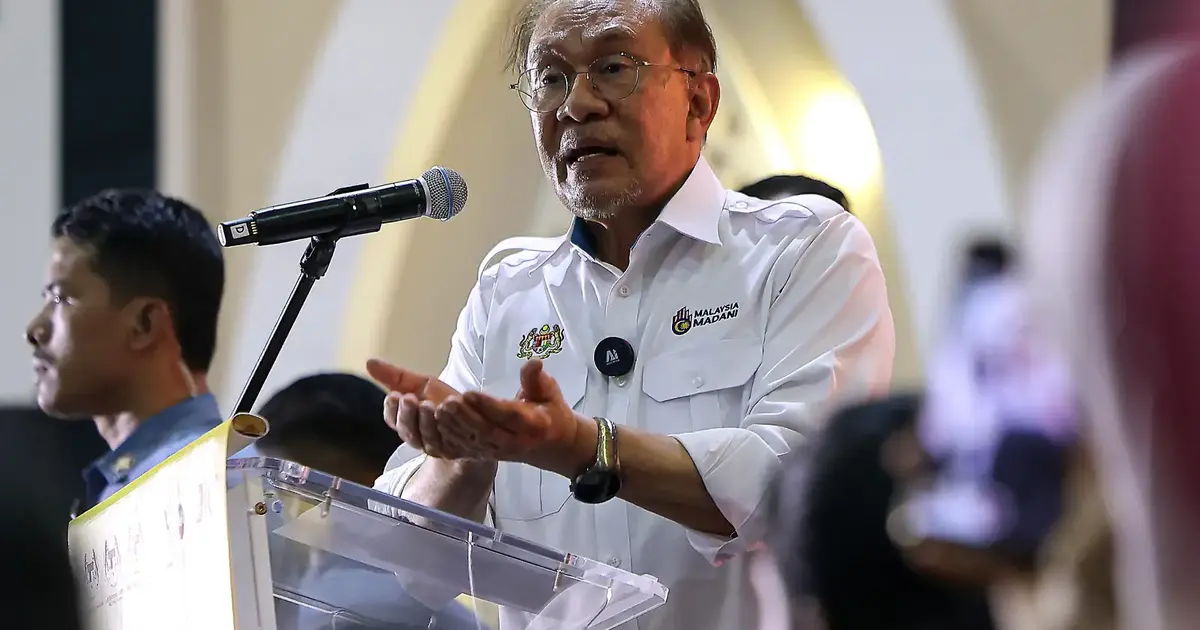
Prime Minister Anwar Ibrahim has moved to dispel concerns that his government's commitment to safeguarding the rights of Malaysia's Chinese and Indian communities represents a departure from the constitutional framework protecting Malays and Islam. The statement addresses persistent anxieties within segments of the Malay-Muslim majority about whether inclusive governance comes at the expense of Article 153 protections enshrined in the Federal Constitution.
Anwar's remarks underscore a fundamental tension in Malaysian politics: the balance between upholding constitutionally guaranteed privileges for the Bumiputera population and Islam's position as the federation religion, while simultaneously fostering social cohesion across the country's diverse ethnic and religious landscape. This tension has intensified in recent years as economic pressures, demographic changes, and shifting political coalitions have prompted more open discussions about minority grievances that were previously considered politically sensitive.
The Prime Minister's position reflects a deliberate attempt to construct a governing narrative that rejects what he characterizes as a false choice between protecting minority interests and maintaining constitutional safeguards. Rather than framing these as zero-sum propositions, Anwar suggests that genuine nation-building requires addressing the legitimate concerns of all communities while preserving the constitutional settlement that underpins Malaysia's federal system. This approach seeks to challenge the assumption, held by some, that any expansion of protections or recognition for non-Malays necessarily diminishes the status or privileges of the Malay-Muslim majority.
For Malaysian readers, the significance of this statement lies in how it attempts to reshape the terms of a deeply entrenched political debate. Since independence, Malaysian governance has rested on a foundational bargain: the Malays and indigenous groups would accept a democratic system and Chinese and Indian participation in commerce and politics, while non-Malays accepted constitutional recognition of Malay-Muslim prerogatives. Anwar's framing suggests that this bargain need not be rigid or immutable, but can evolve to accommodate greater inclusivity without dismantling its core elements.
The timing and context of these remarks matter significantly. Malaysia's political landscape has become increasingly fractured, with competing visions of national identity and governance offered by different coalition blocs. Anwar's government, anchored by the Pakatan Harapan alliance, has positioned itself as a modernizing force committed to institutional reform, fighting corruption, and addressing economic inequality—objectives that benefit citizens across ethnic lines. Yet this positioning creates political vulnerability with constituencies that view such initiatives as potentially diluting established protections or precedence.
The question of how to protect minority rights while respecting constitutional guarantees for Malays has practical implications across multiple policy domains. Education, corporate governance, civil service recruitment, and land ownership remain areas where constitutional provisions create distinct frameworks for different communities. Any government seeking to address grievances—whether improving access for minorities or enhancing transparency in bumiputera policies—must navigate these constitutional boundaries carefully. Anwar's statement essentially argues that working within these constraints while expanding opportunity and fairness does not require dismantling the underlying structure.
Regional and international observers have increasingly scrutinized Malaysia's approach to minority protections and communal harmony, particularly as other Southeast Asian nations grapple with rising majoritarian movements and religious nationalism. Anwar's articulation of an inclusive vision that preserves constitutional protections positions Malaysia as potentially offering an alternative model: one where majority-group prerogatives and minority-group protections coexist rather than compete. Whether this vision can be sustained politically and implemented effectively remains an open question.
Critics from various quarters, however, may find the position insufficient. Some in the Malay-Muslim community worry that any rhetorical or practical shift toward greater minority accommodation inevitably erodes their constitutional standing, while minority advocates contend that genuine equality requires more substantial changes to Article 153 or its implementation. Anwar's formulation attempts to occupy middle ground that satisfies neither camp completely but aims to establish a floor beneath which political competition should not descend.
The Prime Minister's assertion that defending minorities need not mean abandoning constitutional protections for Malays rests on a particular interpretation of the Constitution's language and spirit. It suggests that these guarantees were designed to ensure a minimum threshold of protection and participation, not to prevent all other communities from advancing their interests or seeking redress for discrimination. This reading potentially opens space for policy innovation—targeted social programs, civil service inclusion efforts, or business opportunities—that improves minority circumstances without technically violating constitutional provisions.
Looking forward, Anwar's position will be tested through governance choices, policy implementation, and the government's handling of politically sensitive issues. How the administration addresses specific grievances—whether concerning vernacular education, minority representation in public institutions, or religious freedom matters—will indicate whether the rhetorical commitment to inclusive governance reflects substantive policy shifts or represents primarily a reframing of existing arrangements.
The broader significance of Anwar's remarks extends beyond immediate political calculations. Malaysia's stability and prosperity depend fundamentally on inter-communal trust and the perception that all groups have stake in the system. If the government can demonstrate that protecting minorities and respecting constitutional protections for Malays are compatible objectives pursued in good faith, it may help stabilize a political arena that has grown increasingly contentious. Conversely, if communities perceive the government as favoring one set of interests over another or making promises it cannot keep, inter-communal tensions may intensify. Anwar's clarification thus serves not merely as political messaging but as a foundational statement about the government's understanding of its role as guardian of the constitutional compact that binds Malaysians together.

