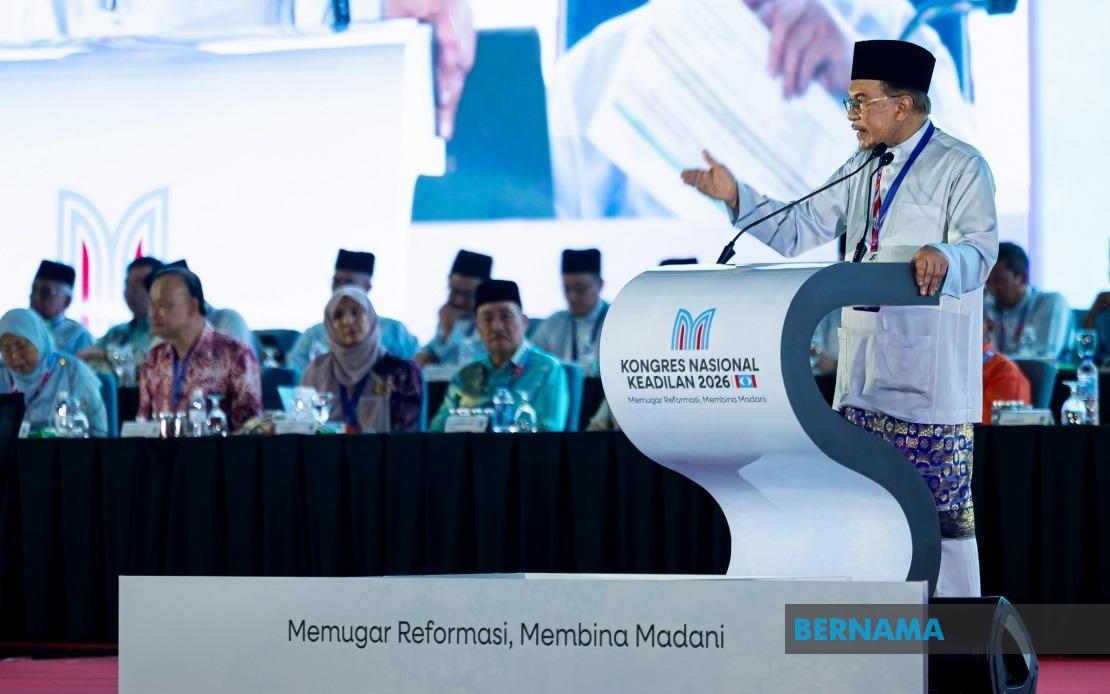
Prime Minister Datuk Seri Anwar Ibrahim moved swiftly to quell mounting speculation about strains within Malaysia's governing coalition by publicly affirming that his working relationship with Deputy Prime Minister Datuk Seri Dr Ahmad Zahid Hamidi remains intact and functional. Speaking at the 2026 PKR National Congress in Melaka on Thursday, Anwar rejected recent commentary suggesting the two leaders' partnership had soured, framing the criticism as an individual's subjective interpretation rather than an accurate reflection of their actual rapport.
The Prime Minister's comments came in direct response to former Rembau MP Khairy Jamaluddin's assertion made the previous day that trust between the two leaders had reached its lowest point since the Unity Government's establishment following the 15th General Election in 2022. Khairy attributed this alleged deterioration to mounting tensions between Barisan Nasional and Pakatan Harapan, particularly following BN's decision to align with Perikatan Nasional during the Negeri Sembilan state elections. Rather than engage substantively with these specific concerns, Anwar characterised the criticism as reflective of a broader philosophical difference in how the former UMNO Youth leader approaches political disagreements.
Anwar's rebuttal highlighted what he perceives as a fundamental contrast in political methodology between himself and Khairy. The Prime Minister suggested that while his detractor tends to view coalition politics through a lens of confrontation and conflict, he himself prioritises dialogue and consensual approaches to resolving differences. This framing allows Anwar to simultaneously acknowledge the existence of policy disagreements within the Unity Government while positioning his own leadership style as more pragmatic and stability-focused. By casting the criticism as stemming from Khairy's inherent disposition toward confrontation rather than objective reality, Anwar attempted to neutralise its impact on public perception of governmental cohesion.
Notably, Anwar used his presidential address to the PKR congress to reinforce this message of unity and cooperation with coalition partners. He explicitly thanked Ahmad Zahid and UMNO for their instrumental role in facilitating the formation of the Unity Government in the immediate aftermath of GE15. This public acknowledgment served a dual purpose: it demonstrated gratitude to a crucial coalition partner while simultaneously creating a public record of appreciation that counters any narrative of deteriorating relations. Such gestures carry symbolic weight in Malaysian politics, where public displays of inter-party harmony often function as stabilising mechanisms within fragile governing alliances.
The emphasis on peaceful resolution mechanisms reflects broader realities of Malaysia's current political configuration. The Unity Government represents an unprecedented coalition bringing together Pakatan Harapan, Barisan Nasional, and various other parliamentary support partners. This arrangement lacks the traditional ideological cohesion of previous governments and requires careful management of competing interests. Disagreements over state-level elections, resource allocation, and policy priorities inevitably arise, making the capacity to resolve such tensions through discussion rather than public confrontation essential to the coalition's survival.
Khairy's intervention introduces an additional layer of complexity. As a prominent UMNO figure despite his loss of the Youth leadership position, his claims carry credibility with observers monitoring coalition stability. His suggestion that BN and PH relations have become increasingly fraught addresses a genuine fault line within the government. The Negeri Sembilan state election represented a significant moment of divergence, with BN opting to work with PN rather than PH, signalling that state-level cooperation arrangements may not automatically align with federal-level partnership. This kind of strategic flexibility, while politically rational, can create perceptions of wavering commitment to the broader coalition project.
Yet Anwar's response suggests confidence in the fundamental durability of current arrangements. By declining to engage in detailed rebuttals of specific charges and instead emphasising his own commitment to peaceful problem-solving, the Prime Minister avoided being drawn into the minutiae of coalition grievances. This rhetorical strategy proves particularly valuable given the current political environment, where media scrutiny of coalition stability remains intense and any detailed acknowledgment of tension points could be weaponised by opposition figures seeking to accelerate governmental fragmentation.
The timing of these remarks at a PKR congress carries additional significance. Party congresses function partly as exercises in internal morale-building and partly as platforms for signalling broader political messages. By addressing coalition stability at such a forum, Anwar demonstrated responsiveness to concerns permeating not only PKR ranks but the wider political ecosystem. His willingness to publicly address and rebuff claims of internal discord suggests he views such speculation as sufficiently damaging to warrant active counter-messaging, even as he simultaneously downplayed its seriousness by attributing it to personal bias.
For Malaysian and Southeast Asian observers, these dynamics illuminate the particular challenges facing consensual political systems that lack clear single-party majorities. Indonesia and Thailand have experienced numerous coalition governments, many of which fractured due to inadequate mechanisms for managing inter-party disagreement. Malaysia's experience remains comparatively nascent, with the Unity Government having operated for less than two years at the time of these remarks. The capacity of leaders like Anwar and Zahid to sustain cooperative arrangements despite periodic strains will significantly influence both Malaysia's political trajectory and broader regional patterns of democratic governance.
Moving forward, the effectiveness of Anwar's denial strategy will likely depend on concrete evidence of continued cooperation between PKR and UMNO on substantive policy matters and parliamentary support. Public assurances of intact relationships carry limited persuasive power if not reinforced by demonstrable collaborative action. The coming months will test whether the coalition can navigate divisive issues without public recrimination, or whether the fundamental tensions Khairy alluded to eventually overcome leadership commitment to unity.

