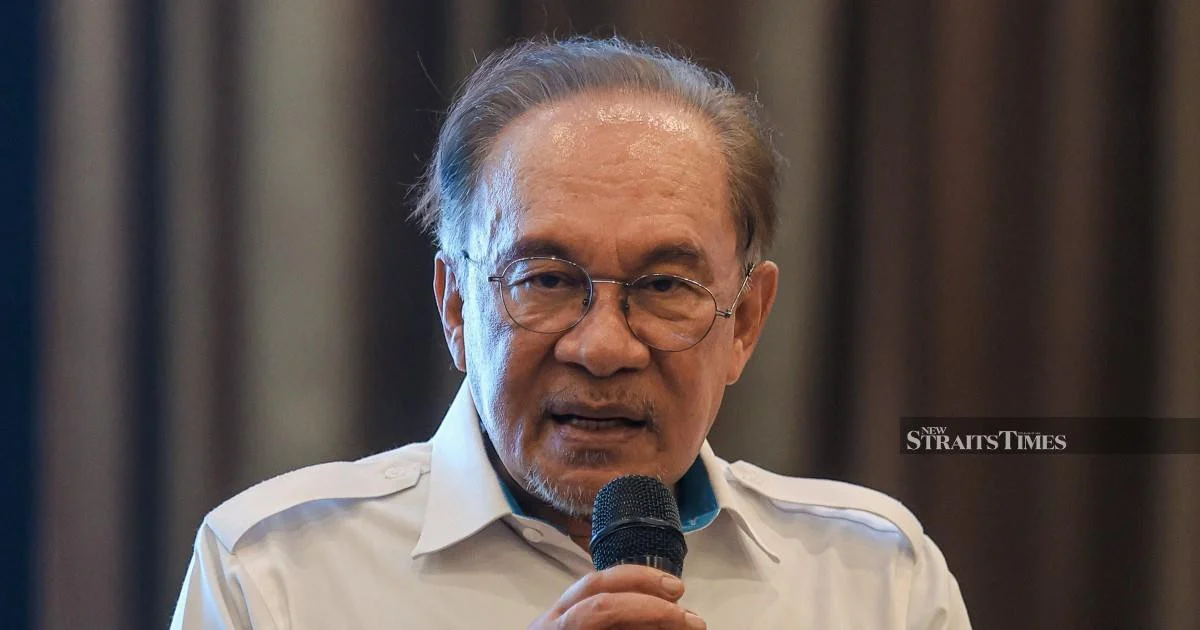
Prime Minister Datuk Seri Anwar Ibrahim delivered a sharp rebuke to fellow political leaders in Johor Baru, accusing them of deliberately weaponising racial supremacy discourse to serve narrow personal ambitions rather than the broader national interest. Speaking with evident frustration at what he characterised as cynical political manoeuvring, Anwar identified a troubling pattern whereby inflammatory racial rhetoric becomes a vehicle for accumulating power, expanding personal wealth and cultivating networks of political dependents.
The prime minister's comments strike at what he perceives as a corrosive tendency within Malaysia's political landscape, where appeals to ethnic identity have historically generated significant electoral traction. By framing racial sentiment explicitly as a tool for self-enrichment rather than as a genuine expression of community concerns, Anwar appears determined to reshift the conversation toward what he views as more authentic governance priorities. His willingness to address the issue directly reflects growing domestic pressure on his administration to demonstrate that inclusive governance can deliver tangible benefits to all Malaysians, regardless of ethnic background.
The substance of Anwar's criticism gains particular resonance given Malaysia's complex racial and religious dynamics. Since independence, political actors across the spectrum have occasionally channelled communal anxieties into electoral strategies, a phenomenon that transcends simple left-right divisions. The prime minister's intervention suggests his government recognises that unchecked appeals to ethnic supremacy can polarise society, undermine institutional stability and distract from substantive policy challenges including economic stagnation, inflation and sectoral competitiveness. By publicly naming this problem, Anwar positions himself as attempting to elevate Malaysian political discourse beyond what he views as divisive identity politics.
Cronyism and family enrichment within political ecosystems represent companion concerns that Anwar bundled with his criticism. Malaysia has witnessed recurring scandals involving ruling party figures and their associates securing lucrative government contracts, licensing arrangements and business opportunities through proximity to power. When political leaders justify these arrangements through appeals to ethnic solidarity or religious duty, they compound the delegitimacy of both their governance and their stated ideological commitments. Anwar's framing suggests he intends to separate legitimate community representation from illegitimate personal gain masked by communal rhetoric.
The political calculus underlying Anwar's remarks reflects internal tensions within his coalition government. The Pakatan Harapan administration, despite occasional cooperation with United Malays National Organisation (UMNO) members through various mechanisms, faces continuing challenges in consolidating voter confidence. Opposition forces, particularly certain UMNO factions and the Malaysia United Indigenous Party (Bersatu), have actively mobilised racial and religious sentiment in their messaging. By explicitly calling out this strategy, Anwar attempts to claim higher moral and political ground while simultaneously pressuring coalition partners to moderate their own communal appeals.
The prime minister's intervention also carries implications for Malaysia's standing within Southeast Asia and globally. Regional observers have noted increased polarisation across several democracies in the area, with identity-based politics intersecting with institutional stress. Malaysia's ability to maintain itself as a relatively stable democracy while managing ethnic and religious plurality depends partly on political leaders avoiding zero-sum framings of communal identity. Anwar's defence of inclusive governance, even if imperfectly executed, signals commitment to that model and potentially influences how international observers assess Malaysia's democratic health.
For Malaysian businesses and investors, the critique holds indirect but significant weight. Political instability stemming from unresolved communal tensions dampens foreign direct investment, complicates regulatory certainty and elevates transaction costs across sectors. When business opportunities become distributed primarily through patronage networks activated by racial appeals, merit-based competition suffers and allocative efficiency declines. Anwar's push against this syndrome, regardless of how effectively executed, acknowledges that inclusive institutions ultimately serve economic interests better than faction-driven arrangements.
The audience for Anwar's criticism extends beyond immediate political rivals to encompass civil society actors, media practitioners and informed citizens observing whether their leaders genuinely prioritise governance over identity mobilisation. Educational institutions, business forums and faith communities face increasing pressure to adopt positions on charged communal questions. When political leaders demonstrate that racial supremacy rhetoric functions primarily as a wealth-capture mechanism rather than a principled community stance, they undermine the moral credibility of such appeals and create space for alternative political conversations.
Anwar's remarks in Johor Baru represent one element within a broader struggle over Malaysia's political and institutional future. The challenge remains whether Malaysia's major political forces can constructively compete while respecting constitutional protections for multiple communities and their legitimate interests. His public denunciation of racial supremacy exploitation appears designed to establish clear boundaries around acceptable political discourse while simultaneously creating accountability for political leaders who cross those boundaries. Whether this rhetorical stance translates into substantive policy changes, institutional reforms and measurable shifts in how patronage networks operate will determine its actual political significance beyond the immediate statement.

