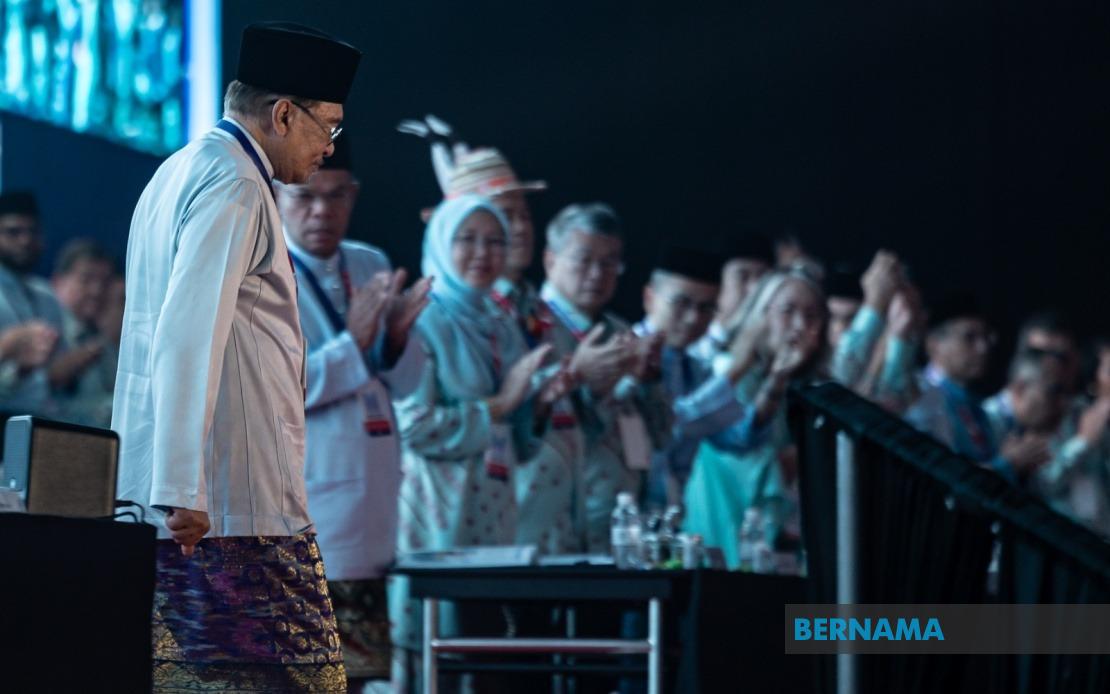
Prime Minister Datuk Seri Anwar Ibrahim firmly rebutted suggestions that the MADANI Government has been sidelining particular states, instead framing variations in federal spending as deliberate policy choices reflecting each region's distinct developmental needs. Speaking at the 2026 PKR National Congress at the Melaka International Trade Centre in Ayer Keroh on August 15, Anwar underscored that allocations have grown consistently across the country during his tenure, contradicting what he characterised as unfounded complaints from certain quarters.
The Prime Minister presented a detailed breakdown of budget increases to support his assertion, beginning with Sabah's trajectory under his administration. Federal expenditure for the East Malaysian state has surged by 35 per cent since the MADANI Government took office, climbing from RM13 billion in 2022 to RM17.6 billion in 2026. Anwar's implicit challenge to his critics was pointed: if previous administrations had neglected Sabah, why had state leaders not raised these concerns before? This rhetorical framing positioned the current government as having reversed historical underinvestment rather than perpetuating it.
Sarawak, Malaysia's largest state by area and home to significant natural resources and a substantial population, has received even more pronounced budgetary improvements. Its federal allocation expanded from RM10.2 billion in 2022 to RM15.1 billion in 2026, representing a 48 per cent increase. This trajectory suggests a deliberate effort to channel resources toward major regional economies where development demands are substantial and geopolitical considerations merit attention. The emphasis on Sarawak's growing budget signals recognition of the state's economic importance and the need to maintain federal-state relations in a region where political sentiments remain strategically consequential.
Anwar extended his justification beyond East Malaysia to Peninsular states, citing diverse examples to demonstrate broad-based investment. Terengganu's allocation has grown from RM6 billion in 2022 to RM8.1 billion in the current fiscal year, representing a 35 per cent rise that brings the northern state into alignment with regional development priorities. Similarly, Johor's budget has expanded substantially from RM10.2 billion in 2022 to RM14.6 billion in 2026, a 43 per cent increase reflecting the southern state's status as a critical economic hub adjacent to Singapore and a major contributor to the national economy.
The Prime Minister also addressed Kedah and Kelantan, two states with differing political complexions and development profiles, indicating that allocations to both have risen overall. This inclusive framing, mentioning both opposition-governed and coalition-ruled states, was designed to preempt accusations of partisan distribution. Perlis rounded out the list of mentioned recipients, with its allocation similarly noted as having increased. By cataloguing gains across diverse regions—from the wealthy southern corridor to the agricultural northern states—Anwar attempted to establish that federal spending increases have been neither concentrated nor selective based on political affiliation.
The policy speech delivered at PKR's national congress served as a platform to defend the government's fiscal stewardship against mounting criticism regarding resource distribution. Opposition voices and certain state governments have increasingly questioned whether federal allocations adequately reflect regional needs or demonstrate equitable treatment. By presenting concrete numbers spanning multiple states across different regions and political configurations, Anwar sought to neutralise such criticism with empirical evidence. The emphasis on percentage increases rather than absolute figures proved strategically important, as it highlighted the trajectory of change under his administration regardless of baseline differences.
Understanding the context of Malaysian federalism enriches interpretation of these figures. States depend heavily on federal transfers for essential services including education, health, and infrastructure development. While states generate their own revenue through land taxes and business licenses, the bulk of public investment funding flows from central government allocations. Accusations that particular states are being sidelined carry significant political weight because they imply deprivation in critical service delivery. Anwar's detailed rebuttal thus addresses not merely budget arithmetic but fundamental questions about equitable governance and federal-state partnership during a period when regional disparities remain a sensitive national issue.
The timing of these remarks at a PKR gathering adds a layer of party-political context. As the ruling coalition's dominant partner, PKR carries responsibility for government performance and faces internal pressures to demonstrate that its leadership delivers benefits across diverse constituencies. By showcasing rising allocations to states under various political control, Anwar signalled to party members that the MADANI Government operates according to developmental priorities rather than partisan calculus. This messaging aims to strengthen party morale and provide ammunition for grassroots defenders who encounter accusations of bias or neglect during campaigning or community engagement.
The specific choice of examples carries strategic weight. Highlighting Sarawak's 48 per cent increase is particularly significant given that state's history of occasionally contentious federal-state relations and its status as home to politically important indigenous communities. Emphasising Johor's growth acknowledges the southern state's economic clout and the political necessity of maintaining investor confidence in Malaysia's most developed corridor. Terengganu and Kelantan, despite their relatively smaller absolute allocations, represent acknowledgment of the northern region's development aspirations and the political dividend of being seen to invest in traditional Malay-Muslim heartland constituencies.
Critics may contend that percentage increases require contextualisation against inflation, population growth, and comparative baseline figures. A 35 per cent increase from a lower base might deliver fewer real resources per capita than a smaller percentage increase from a larger starting point. Moreover, questions remain about whether allocations translate into effective service delivery or whether bureaucratic implementation challenges result in underutilisation of budgeted funds. These technical critiques, however, extend beyond the scope of Anwar's remarks, which targeted the fundamental assertion that states are being sidelined by establishing that nominal allocations have risen consistently.
Looking forward, these allocations figures will likely feature prominently in government communications and parliamentary defence of fiscal policy. As Malaysia approaches a more competitive electoral environment and as regional governments—regardless of political colour—seek greater resources for development, questions about fair distribution will persist. The MADANI Government's strategy appears to combine tangible budgetary increases with rhetorical emphasis on developmental criteria rather than political considerations. Whether this approach successfully resolves allegations of bias or adequately addresses regional development disparities will depend on implementation outcomes and the political environment's evolution.

